
VMS: Exceptional Lithium, Strontium & Magnesium Test Recoveries
Original announcement by asx on
- Company
- Venari Minerals NL
- Ticker
- VMS
- Exchange
- ASX
- Region
- Nevada, USA
- Primary commodity
- Lithium
- Secondary commodities
- Strontium, Magnesium
- Document categories
- Metallurgy, Resource update
- Extracted
- 2026-10-28 23:07:04 UTC
Analysis by Minestarters Atlas
Atlas analysis published:
Minestarters Atlas analysis
Summary
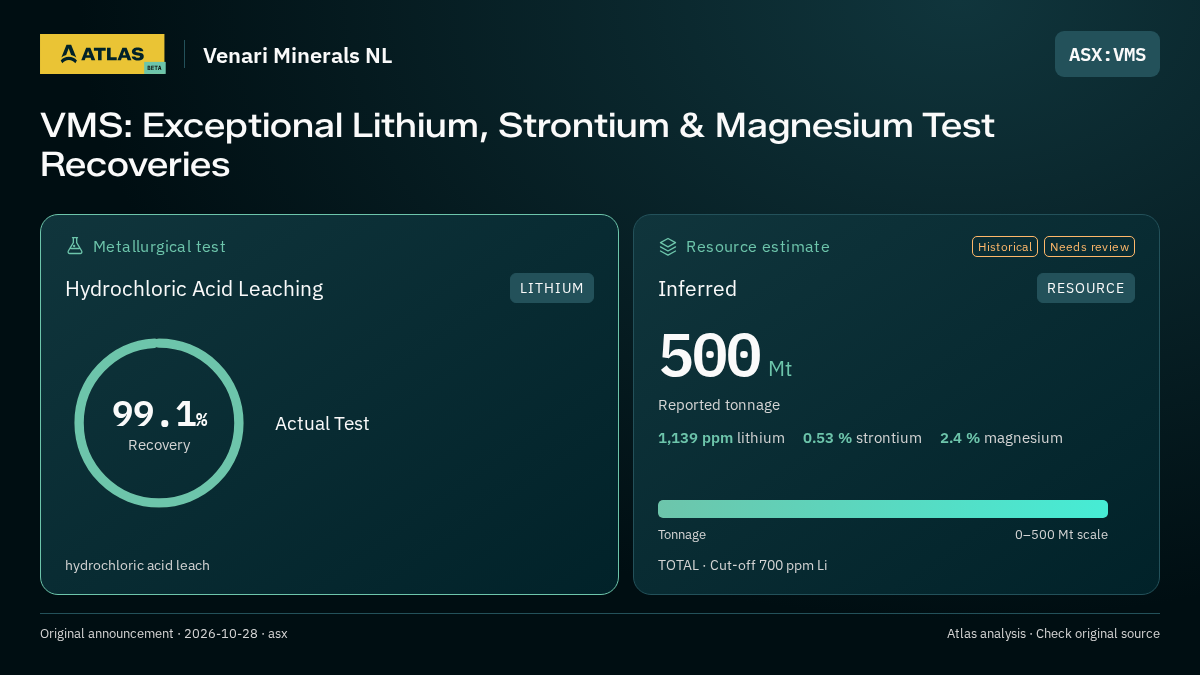
Venari Minerals has announced exceptional metallurgical test results from its Red Mountain Lithium and Strategic Metals Project in Nevada, USA, demonstrating high extraction rates for lithium (up to 99.1%), strontium (up to 98.7%), and magnesium (up to 97.7%) using hydrochloric acid leaching. These results show superior lithium extraction and lower acid consumption compared to previous sulfuric acid tests, and unlock significant by-product potential for strontium and magnesium. The company plans further test-work to produce marketable products and integrate these findings into a Scoping Study targeted for Q1 2027.
Reasoning: The metallurgical test-work demonstrates exceptional extraction rates for lithium, strontium, and magnesium using hydrochloric acid, with significantly lower acid consumption compared to previous sulfuric acid tests, substantially enhancing the project's economic potential and supporting a multi-product flowsheet.
Positive factors
- Exceptional lithium extraction rates up to 99.1% achieved with hydrochloric acid leaching.
- Significantly lower acid consumption (297-393 kg/t) compared to previous sulfuric acid tests (387-500 kg/t).
- High strontium extraction (93.2-98.7%) and magnesium extraction (94.3-97.7%) support a multi-product flowsheet.
- Strontium extraction is a major improvement over negligible recovery in sulfuric acid tests.
- The results enhance the project's economic potential and strategic profile by enabling recovery of high-value by-products.
Negative factors
- The test-work is still at the bench scale, requiring further steps to generate products and evaluate other methods.
- The economic implications are based on potential and expected outcomes, not yet fully confirmed by a Scoping Study.
Facts used in scoring: 8
Classification and evidence
High Recoverypositive
Recovery at or above the exceptional band for the commodity and processing route.
Why it applies: Lithium recovery of 99.1% is above the exceptional band for lithium (95%).
Evidence · text
“Lithium: 94.8 – 99.1% extraction”
High Recoverypositive
Recovery at or above the exceptional band for the commodity and processing route.
Why it applies: Strontium recovery of 98.7% is above the exceptional band for silver (90%), which is used as a proxy for strontium.
Evidence · text
“Strontium: 93.2 – 98.7% extraction”
High Recoverypositive
Recovery at or above the exceptional band for the commodity and processing route.
Why it applies: Magnesium recovery of 97.7% is above the exceptional band for nickel (90%), which is used as a proxy for magnesium.
Evidence · text
“Magnesium: 94.3 – 97.7% extraction”
Recovery Improvingpositive
Recovery improved versus a like-for-like prior test program on the same domain and route.
Why it applies: Lithium extraction improved from 82-97% (sulfuric acid) to 94.8-99.1% (hydrochloric acid) at the same temperature.
Evidence · text
“Higher lithium extraction 94.8-99.1% (hydrochloric) vs 82-97% (sulfuric acid)”
Recovery Improvingpositive
Recovery improved versus a like-for-like prior test program on the same domain and route.
Why it applies: Strontium recovery improved from negligible (sulfuric acid) to 93.2-98.7% (hydrochloric acid).
Evidence · text
“Strontium readily dissolved 93.2% - 98.7% vs negligible in sulfuric acid”
Multi-Domain Testedpositive
Variability across ore domains (oxide, transition, fresh) has been addressed.
Why it applies: Samples for metallurgical test-work were taken from four drill holes spread across the Red Mountain project, indicating variability testing.
Evidence · text
“Samples used in this test-work (Figure 2, Table 1) were taken from four drill holes (Table 2, Figure 2) spread across the Red Mountain project.”
Bench Scale Onlynegative
Only preliminary bench tests completed — no locked-cycle or pilot work.
Why it applies: The test-work involved 'pulverized sample' and 'leachability tests' at 21°C and 60°C, indicating bench-scale testing.
Evidence · text
“Leachability by temperature tests were conducted using pulverized sample at a target pulp density of 10% solids by weight. Two tests were conducted, at 21°C and 60°C temperatures”
QP/CP Signedpositive
Qualified Person (QP) or Competent Person (CP) named and signed off — a member of a recognized professional association (e.g., AusIMM, SME, AIG, P.Geo) with relevant experience.
Why it applies: The report includes sign-off by Competent Persons Mr. Matthew Healy (AusIMM) and Mr. Richard Newport (AIG) for different sections.
Evidence · text
“The information in this report that relates to Sampling Techniques and Data (Section 1) is based on information compiled by Mr. Matthew Healy, a Competent Person who is a Member of The Australasian Institute of Mining and Metallurgy (AusIMM Member number 303597).”
JORC Compliantpositive
Resource estimate prepared in compliance with JORC Code (Australia) — high reporting standard.
Why it applies: The report explicitly states compliance with the 'JORC Code, 2012 Edition'.
Evidence · text
“JORC Code, 2012 Edition – Table 1”
All Inferrednegative
100% of resource is Inferred category — very early stage, no engineering confidence.
Why it applies: The Red Mountain Mineral Resource Estimate is entirely in the Inferred category.
Evidence · text
“TOTAL Inferred 500 0.61% 0.53% 2.40% 3.03 2,670 12,000”
Mill Routeneutral
Processing via mill or concentrator (CIL, CIP, tank leach, flotation).
Why it applies: the document describes a flotation route ("concentrate")
POX/BIOX Routeneutral
Pressure or bio-oxidation for refractory ore — high CAPEX and OPEX.
Why it applies: the document describes a pox_biox route ("roasting")
Single Domain Onlynegative
Testing limited to one composite or domain — representativeness not established.
Why it applies: only one composite was tested
Extracted facts
Stored fact records: 8. Some facts used in scoring do not have a stored record.
Resource Estimates (3)
inferredRed Mountain Lithium and Strategic Metals Project · lithiumTonnes: 500000000Grade: 1139Grade Unit: ppmContained Metal: 3.03Contained Unit: mt lceHistorical resultNeeds review: historical_restatementView all detailsHide details
Identity
- Project
- Red Mountain Lithium and Strategic Metals Project
- Commodity
- lithium
- Region
- usa_nv
- Reported Region
- Nevada, USA
- Ticker
- VMS
Resource scope
- Estimate type
- resource
- Effective date
- 2026-10-06T00:00:00.000Z
- Reporting standards
- jorc
- QP Signed
- Yes
- Qualified person names
- Matthew Healy, Richard Newport
- Resource group id
- resource:d2b34ac0274f8a034b2e
- Deposit or zone
- TOTAL
Resource Data
- Category
- inferred
- Tonnes
- 500000000
- Grade
- 1139
- Grade Unit
- ppm
- Contained Metal
- 3.03
- Contained Unit
- mt lce
- Cutoff Grade
- 700
- Cutoff Unit
- ppm Li
Prior Estimate
- Resource Date
- 2026-10-06
Review
- Needs Review
- Yes
- Review Reason
- historical_restatement
- Historical
- Yes
- Historical Source Date
- 2026-10-06T00:00:00.000Z
Dates
- Event date
- 2026-10-28T00:00:00.000Z
Reasoning: This historical inferred resource estimate for lithium at Red Mountain, updated on October 6, 2026, provides a substantial baseline for the project but is still at an early stage of confidence.
Positive factors
- Large inferred resource of 3.03 Mt LCE, indicating significant project scale.
Negative factors
- The resource is entirely in the inferred category, indicating early stage and lower confidence.
Evidence · text
“The Red Mountain Mineral Resource Estimate of 500Mt @ 1,139ppm Li, 0.53% strontium carbonate equivalent (SCE)13 and 2.4% magnesium, contains 3.03Mt LCE, 2.67Mt SCE and 12Mt magnesium (at a 700ppm Li cut-off).”
Tags used in scoring
Inferred Resourcenegative
Speculative category — limited drilling, geological continuity assumed but not confirmed. Cannot support economic studies alone.
Why it applies: category is "inferred"
Cut-off Disclosedpositive
Cut-off grade used for resource reporting is clearly stated, enabling like-for-like comparison.
Why it applies: cutoff_grade is stated
QP/CP Signedpositive
Qualified Person (QP) or Competent Person (CP) named and signed off — a member of a recognized professional association (e.g., AusIMM, SME, AIG, P.Geo) with relevant experience.
Why it applies: qp_signed is true
JORC Compliantpositive
Resource estimate prepared in compliance with JORC Code (Australia) — high reporting standard.
Why it applies: reporting_standards includes jorc
PEA-Supportingneutral
Resource estimate prepared to support a Preliminary Economic Assessment — early-stage study.
Why it applies: the release names the study this estimate supports
DFS-Supportingneutral
Resource estimate prepared to support a Definitive Feasibility Study — requires high M&I confidence.
Why it applies: the release names the study this estimate supports
inferredRed Mountain Lithium and Strategic Metals Project · strontiumTonnes: 500000000Grade: 0.53Grade Unit: %Contained Metal: 2.67Contained Unit: mt sceHistorical resultNeeds review: historical_restatementView all detailsHide details
Identity
- Project
- Red Mountain Lithium and Strategic Metals Project
- Commodity
- strontium
- Region
- usa_nv
- Reported Region
- Nevada, USA
- Ticker
- VMS
Resource scope
- Estimate type
- resource
- Effective date
- 2026-10-06T00:00:00.000Z
- Reporting standards
- jorc
- QP Signed
- Yes
- Qualified person names
- Matthew Healy, Richard Newport
- Resource group id
- resource:d2b34ac0274f8a034b2e
- Deposit or zone
- TOTAL
Resource Data
- Category
- inferred
- Tonnes
- 500000000
- Grade
- 0.53
- Grade Unit
- %
- Contained Metal
- 2.67
- Contained Unit
- mt sce
- Cutoff Grade
- 700
- Cutoff Unit
- ppm Li
Prior Estimate
- Resource Date
- 2026-10-06
Review
- Needs Review
- Yes
- Review Reason
- historical_restatement
- Historical
- Yes
- Historical Source Date
- 2026-10-06T00:00:00.000Z
Dates
- Event date
- 2026-10-28T00:00:00.000Z
Reasoning: This historical inferred resource estimate for strontium at Red Mountain, updated on October 6, 2026, establishes a substantial by-product opportunity for the project.
Positive factors
- Significant inferred resource of 2.67 Mt SCE, highlighting by-product potential.
Negative factors
- The resource is entirely in the inferred category, indicating early stage and lower confidence.
Evidence · text
“The Red Mountain Mineral Resource Estimate to include 2.67Mt of contained strontium carbonate equivalent”
Tags used in scoring
Inferred Resourcenegative
Speculative category — limited drilling, geological continuity assumed but not confirmed. Cannot support economic studies alone.
Why it applies: category is "inferred"
Cut-off Disclosedpositive
Cut-off grade used for resource reporting is clearly stated, enabling like-for-like comparison.
Why it applies: cutoff_grade is stated
QP/CP Signedpositive
Qualified Person (QP) or Competent Person (CP) named and signed off — a member of a recognized professional association (e.g., AusIMM, SME, AIG, P.Geo) with relevant experience.
Why it applies: qp_signed is true
JORC Compliantpositive
Resource estimate prepared in compliance with JORC Code (Australia) — high reporting standard.
Why it applies: reporting_standards includes jorc
PEA-Supportingneutral
Resource estimate prepared to support a Preliminary Economic Assessment — early-stage study.
Why it applies: the release names the study this estimate supports
DFS-Supportingneutral
Resource estimate prepared to support a Definitive Feasibility Study — requires high M&I confidence.
Why it applies: the release names the study this estimate supports
inferredRed Mountain Lithium and Strategic Metals Project · magnesiumTonnes: 500000000Grade: 2.4Grade Unit: %Contained Metal: 12Contained Unit: mtHistorical resultNeeds review: historical_restatementView all detailsHide details
Identity
- Project
- Red Mountain Lithium and Strategic Metals Project
- Commodity
- magnesium
- Region
- usa_nv
- Reported Region
- Nevada, USA
- Ticker
- VMS
Resource scope
- Estimate type
- resource
- Effective date
- 2026-10-06T00:00:00.000Z
- Reporting standards
- jorc
- QP Signed
- Yes
- Qualified person names
- Matthew Healy, Richard Newport
- Resource group id
- resource:d2b34ac0274f8a034b2e
- Deposit or zone
- TOTAL
Resource Data
- Category
- inferred
- Tonnes
- 500000000
- Grade
- 2.4
- Grade Unit
- %
- Contained Metal
- 12
- Contained Unit
- mt
- Cutoff Grade
- 700
- Cutoff Unit
- ppm Li
Prior Estimate
- Resource Date
- 2026-10-06
Review
- Needs Review
- Yes
- Review Reason
- historical_restatement
- Historical
- Yes
- Historical Source Date
- 2026-10-06T00:00:00.000Z
Dates
- Event date
- 2026-10-28T00:00:00.000Z
Reasoning: This historical inferred resource estimate for magnesium at Red Mountain, updated on October 6, 2026, establishes a substantial by-product opportunity for the project.
Positive factors
- Significant inferred resource of 12.0 Mt magnesium, highlighting by-product potential.
Negative factors
- The resource is entirely in the inferred category, indicating early stage and lower confidence.
Evidence · text
“The Red Mountain Mineral Resource Estimate to include ... and 12.0Mt of contained magnesium”
Tags used in scoring
Inferred Resourcenegative
Speculative category — limited drilling, geological continuity assumed but not confirmed. Cannot support economic studies alone.
Why it applies: category is "inferred"
Cut-off Disclosedpositive
Cut-off grade used for resource reporting is clearly stated, enabling like-for-like comparison.
Why it applies: cutoff_grade is stated
QP/CP Signedpositive
Qualified Person (QP) or Competent Person (CP) named and signed off — a member of a recognized professional association (e.g., AusIMM, SME, AIG, P.Geo) with relevant experience.
Why it applies: qp_signed is true
JORC Compliantpositive
Resource estimate prepared in compliance with JORC Code (Australia) — high reporting standard.
Why it applies: reporting_standards includes jorc
PEA-Supportingneutral
Resource estimate prepared to support a Preliminary Economic Assessment — early-stage study.
Why it applies: the release names the study this estimate supports
DFS-Supportingneutral
Resource estimate prepared to support a Definitive Feasibility Study — requires high M&I confidence.
Why it applies: the release names the study this estimate supports
Metallurgical Results (5)
hydrochloric acid leachingRed Mountain Lithium and Strategic Metals Project · lithiumRecovery: 99.1 %View all detailsHide details
Identity
- Project
- Red Mountain Lithium and Strategic Metals Project
- Commodity
- lithium
- Region
- usa_nv
- Reported Region
- Nevada, USA
- Ticker
- VMS
Test Work
- Program Status
- optimization
- Test Type
- hydrochloric acid leaching
- Processing Route
- hydrochloric acid leach
- Sample
- composite from four drill holes
Recovery
- Recovery
- 99.1 %
- Recovery Basis
- actual_test
Reagents
- Acid
- 297 kg/t
Lab
- Laboratory
- Kappes, Cassidy and Associates (KCA)
Review
- Needs Review
- No
- Historical
- No
Dates
- Event date
- 2026-10-28T00:00:00.000Z
Reasoning: The hydrochloric acid leaching achieved an exceptional lithium extraction rate of 99.1% at 60°C, which is a significant improvement over previous sulfuric acid tests and is accompanied by lower acid consumption, positively impacting project economics.
Positive factors
- Exceptional lithium recovery (99.1%) achieved, significantly improving project economics.
- Lower acid consumption (297 kg/t) compared to previous sulfuric acid tests, reducing operating costs.
- Recovery is above the exceptional band for lithium (95%).
Evidence · text
“Lithium: 94.8 – 99.1% extraction”
Tags used in scoring
High Recoverypositive
Recovery at or above the exceptional band for the commodity and processing route.
Why it applies: 99.1% is at or above the exceptional band (80%)
Byproduct Commodityneutral
The tested commodity is a byproduct rather than the primary economic driver.
Why it applies: the release describes a byproduct credit
hydrochloric acid leachingRed Mountain Lithium and Strategic Metals Project · strontiumRecovery: 98.7 %View all detailsHide details
Identity
- Project
- Red Mountain Lithium and Strategic Metals Project
- Commodity
- strontium
- Region
- usa_nv
- Reported Region
- Nevada, USA
- Ticker
- VMS
Test Work
- Program Status
- optimization
- Test Type
- hydrochloric acid leaching
- Processing Route
- hydrochloric acid leach
- Sample
- composite from four drill holes
Recovery
- Recovery
- 98.7 %
- Recovery Basis
- actual_test
Lab
- Laboratory
- Kappes, Cassidy and Associates (KCA)
Review
- Needs Review
- No
- Historical
- No
Dates
- Event date
- 2026-10-28T00:00:00.000Z
Reasoning: The hydrochloric acid leaching achieved an exceptional strontium extraction rate of 98.7% at 60°C, representing a major improvement over previous sulfuric acid tests and supporting a multi-product flowsheet.
Positive factors
- Exceptional strontium recovery (98.7%) achieved, enabling potential by-product revenue.
- Significant improvement over negligible recovery in previous sulfuric acid tests.
- Recovery is above the exceptional band for silver (90%), which is a proxy for strontium.
Evidence · text
“Strontium: 93.2 – 98.7% extraction”
Tags used in scoring
Byproduct Commodityneutral
The tested commodity is a byproduct rather than the primary economic driver.
Why it applies: the release describes a byproduct credit
hydrochloric acid leachingRed Mountain Lithium and Strategic Metals Project · magnesiumRecovery: 97.7 %View all detailsHide details
Identity
- Project
- Red Mountain Lithium and Strategic Metals Project
- Commodity
- magnesium
- Region
- usa_nv
- Reported Region
- Nevada, USA
- Ticker
- VMS
Test Work
- Program Status
- optimization
- Test Type
- hydrochloric acid leaching
- Processing Route
- hydrochloric acid leach
- Sample
- composite from four drill holes
Recovery
- Recovery
- 97.7 %
- Recovery Basis
- actual_test
Lab
- Laboratory
- Kappes, Cassidy and Associates (KCA)
Review
- Needs Review
- No
- Historical
- No
Dates
- Event date
- 2026-10-28T00:00:00.000Z
Reasoning: The hydrochloric acid leaching achieved a high magnesium extraction rate of 97.7% at 60°C, supporting a multi-product flowsheet and adding economic optionality.
Positive factors
- High magnesium recovery (97.7%) achieved, enabling potential by-product revenue.
- Recovery is above the exceptional band for nickel (90%), which is a proxy for magnesium.
Evidence · text
“Magnesium: 94.3 – 97.7% extraction”
Tags used in scoring
Byproduct Commodityneutral
The tested commodity is a byproduct rather than the primary economic driver.
Why it applies: the release describes a byproduct credit
sulfuric acid leachingRed Mountain Lithium and Strategic Metals Project · lithiumRecovery: 97 %Historical resultNeeds review: historical_restatementView all detailsHide details
Identity
- Project
- Red Mountain Lithium and Strategic Metals Project
- Commodity
- lithium
- Region
- usa_nv
- Reported Region
- Nevada, USA
- Ticker
- VMS
Test Work
- Program Status
- preliminary
- Test Type
- sulfuric acid leaching
- Processing Route
- sulfuric acid leach
- Sample
- composite from four drill holes
Recovery
- Recovery
- 97 %
- Recovery Basis
- actual_test
Reagents
- Acid
- 500 kg/t
Lab
- Laboratory
- Kappes, Cassidy and Associates (KCA)
Review
- Needs Review
- Yes
- Review Reason
- historical_restatement
- Historical
- Yes
- Historical Source Date
- 2024-12-09T00:00:00.000Z
Dates
- Event date
- 2026-10-28T00:00:00.000Z
Reasoning: This historical sulfuric acid test achieved a good lithium recovery of 97% but is superseded by the more efficient hydrochloric acid leaching results, which offer higher recovery and lower acid consumption.
Negative factors
- Lower lithium recovery compared to the new hydrochloric acid tests.
- Higher acid consumption compared to the new hydrochloric acid tests.
Evidence · text
“Higher lithium extraction 94.8-99.1% (hydrochloric) vs 82-97% (sulfuric acid)5 Lower reagent consumption 297-393kg/t vs 387-500kg/t5”
Tags used in scoring
High Recoverypositive
Recovery at or above the exceptional band for the commodity and processing route.
Why it applies: 97% is at or above the exceptional band (80%)
Byproduct Commodityneutral
The tested commodity is a byproduct rather than the primary economic driver.
Why it applies: the release describes a byproduct credit
sulfuric acid leachingRed Mountain Lithium and Strategic Metals Project · strontiumRecovery: 8 %Historical resultNeeds review: historical_restatementView all detailsHide details
Identity
- Project
- Red Mountain Lithium and Strategic Metals Project
- Commodity
- strontium
- Region
- usa_nv
- Reported Region
- Nevada, USA
- Ticker
- VMS
Test Work
- Program Status
- preliminary
- Test Type
- sulfuric acid leaching
- Processing Route
- sulfuric acid leach
- Sample
- composite from four drill holes
Recovery
- Recovery
- 8 %
- Recovery Basis
- actual_test
Lab
- Laboratory
- Kappes, Cassidy and Associates (KCA)
Review
- Needs Review
- Yes
- Review Reason
- historical_restatement
- Historical
- Yes
- Historical Source Date
- 2024-12-09T00:00:00.000Z
Dates
- Event date
- 2026-10-28T00:00:00.000Z
Reasoning: This historical sulfuric acid test showed negligible strontium recovery, highlighting a major limitation of that processing route for strontium extraction, which has now been overcome by hydrochloric acid leaching.
Negative factors
- Negligible strontium recovery (8%) in historical sulfuric acid tests, indicating a significant processing challenge for this by-product.
Evidence · text
“Strontium readily dissolved 93.2% - 98.7% vs negligible in sulfuric acid11”
Tags used in scoring
Byproduct Commodityneutral
The tested commodity is a byproduct rather than the primary economic driver.
Why it applies: the release describes a byproduct credit
How Atlas produces this analysis
Minestarters Atlas uses automated extraction to summarize mining announcements, identify reported measurements, and classify supporting evidence. Sentiment reflects the extracted narrative and classification rules; it is an interpretation, not a reported measurement. Evidence quotes and context are provided where available. Missing data, low-confidence results, and review flags indicate limitations. Check the original publisher announcement before relying on an interpretation.