
Viscount Identifies Three Near-Surface Gold-Copper Porphyry Targets at Passiflora Above 843.9-Metre Mineralized Intercept; Rosor High-Resolution Drone Survey Confirms District-Scale System
Original announcement by orestocks on
- Company
- Viscount Mining Corp.
- Ticker
- VML.V
- Exchange
- Unavailable
- Region
- Colorado
- Primary commodity
- Unavailable
- Secondary commodities
- None reported
- Document categories
- Other, Drill results
- Extracted
- 2026-11-18 12:31:00 UTC
Analysis by Minestarters Atlas
Atlas analysis published:
Minestarters Atlas analysis
Summary
Viscount Mining has completed a high-resolution Rosor SAEM drone survey that independently confirms the large gold-copper porphyry system at the Passiflora target. The survey resolved three distinct conductive zones within the upper 500 metres, providing high-priority targets for an upcoming Phase Two diamond drilling campaign.
Reasoning: The announcement provides significant geophysical de-risking and target refinement for the Passiflora porphyry system, though it does not report new assay results.
Positive factors
- Independent geophysical confirmation of existing target
- Resolution of three distinct conductive zones
- Spatial consistency with high-grade drill intercept
- Large system remains open at depth
Negative factors
- Geophysical anomalies are not direct proof of mineralization
Facts used in scoring: 1
Classification and evidence
Nearology Playneutral
Value premise rests on proximity to a known deposit rather than own results.
Why it applies: The survey results are used to refine targets within the broader, previously identified Quantec MT-defined system.
Evidence · text
“confirms the broader conductive system previously identified by Quantec Geoscience's magnetotelluric ("MT") survey”
QA/QC Disclosedpositive
Release includes QA/QC disclosure — certified lab, QP sign-off, or stated methods (blanks, standards, duplicates).
Why it applies: The release names a Qualified Person (Harald Hoegberg, C.P.G.) who reviewed and approved the technical information.
Evidence · text
“reviewed and approved by Harald Hoegberg, C.P.G., an independent consulting geologist who is a "Qualified Person"”
Extracted facts
Stored fact records: 1. Some facts used in scoring do not have a stored record.
Drill Results (1)
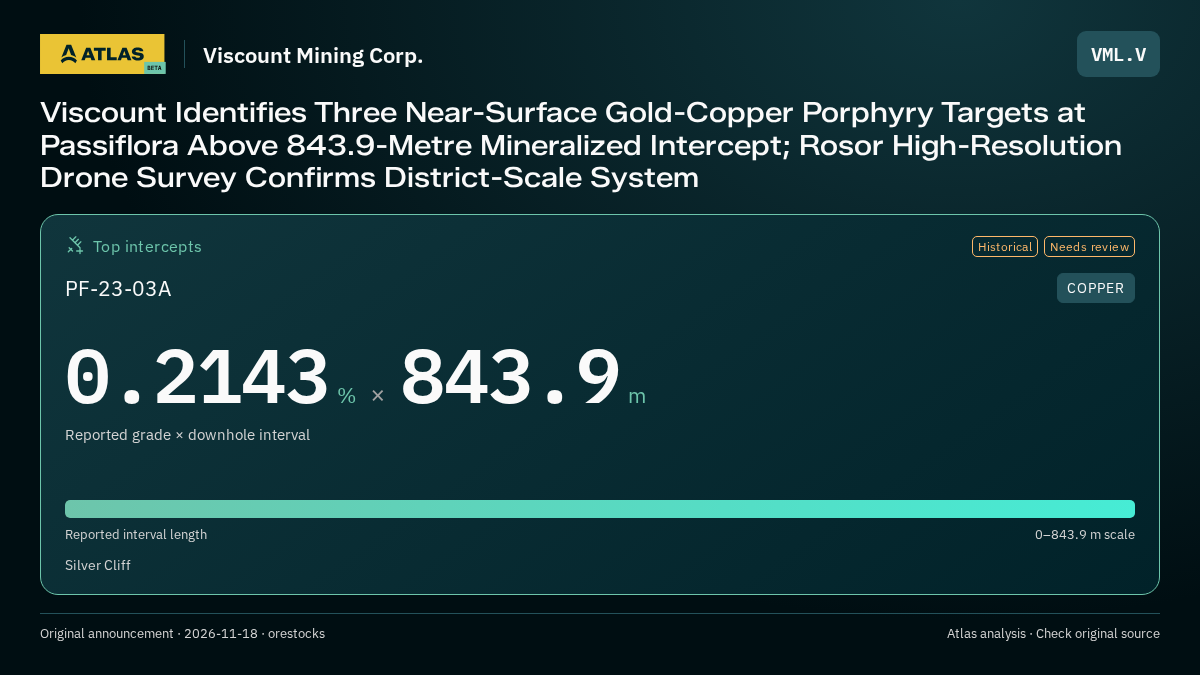
PF-23-03ASilver Cliff · copperGrade: 0.2143Grade Unit: %Intercept: 843.9 mHistorical resultNeeds review: historical_restatementView all detailsHide details
Identity
- Hole ID
- PF-23-03A
- Project
- Silver Cliff
- Commodity
- copper
- Region
- usa_co
- Reported Region
- usa_co
- Ticker
- VML.V
Geometry
- Grade
- 0.2143
- Grade Unit
- %
- Intercept
- 843.9 m
Classification
- Sample Type
- drill
QA/QC
- QP Signed
- Yes
- QA/QC Methods
- standards
Review
- Needs Review
- Yes
- Review Reason
- historical_restatement
- Interp. Status
- scored
- Historical
- Yes
- Historical Source Date
- 2024-08-14T00:00:00.000Z
Dates
- Event date
- 2026-11-18T00:00:00.000Z
Reasoning: This is a restatement of a previously reported intercept from August 2024.
Positive factors
- Significant continuous mineralized interval
Evidence · text
“843.9 metres of continuous gold-copper mineralization grading 0.2143% copper-equivalent*”
Tags used in scoring
No QA/QC Disclosurenegative
Release does not disclose QA/QC — lab certification, CP/QP sign-off and assay protocols cannot be checked from this document.
Why it applies: qaqc_disclosed is not true
Cut-off Undisclosednegative
High-grade interval reported without stating the cut-off grade used for compositing.
Why it applies: no cutoff_grade was stated
Stale Data Re-releasenegative
Historical results re-announced with no new assays or reinterpretation — low genuine novelty.
Why it applies: the fact restates a prior release
How Atlas produces this analysis
Minestarters Atlas uses automated extraction to summarize mining announcements, identify reported measurements, and classify supporting evidence. Sentiment reflects the extracted narrative and classification rules; it is an interpretation, not a reported measurement. Evidence quotes and context are provided where available. Missing data, low-confidence results, and review flags indicate limitations. Check the original publisher announcement before relying on an interpretation.