
Snowline expands gold system at Duke
Original announcement by miningjournal on
- Company
- Snowline Gold
- Ticker
- Unavailable
- Exchange
- Unavailable
- Region
- Yukon, Canada
- Primary commodity
- Gold
- Secondary commodities
- None reported
- Document categories
- Drill results
- Extracted
- 2026-11-18 18:16:44 UTC
Analysis by Minestarters Atlas
Atlas analysis published:
Minestarters Atlas analysis
Summary
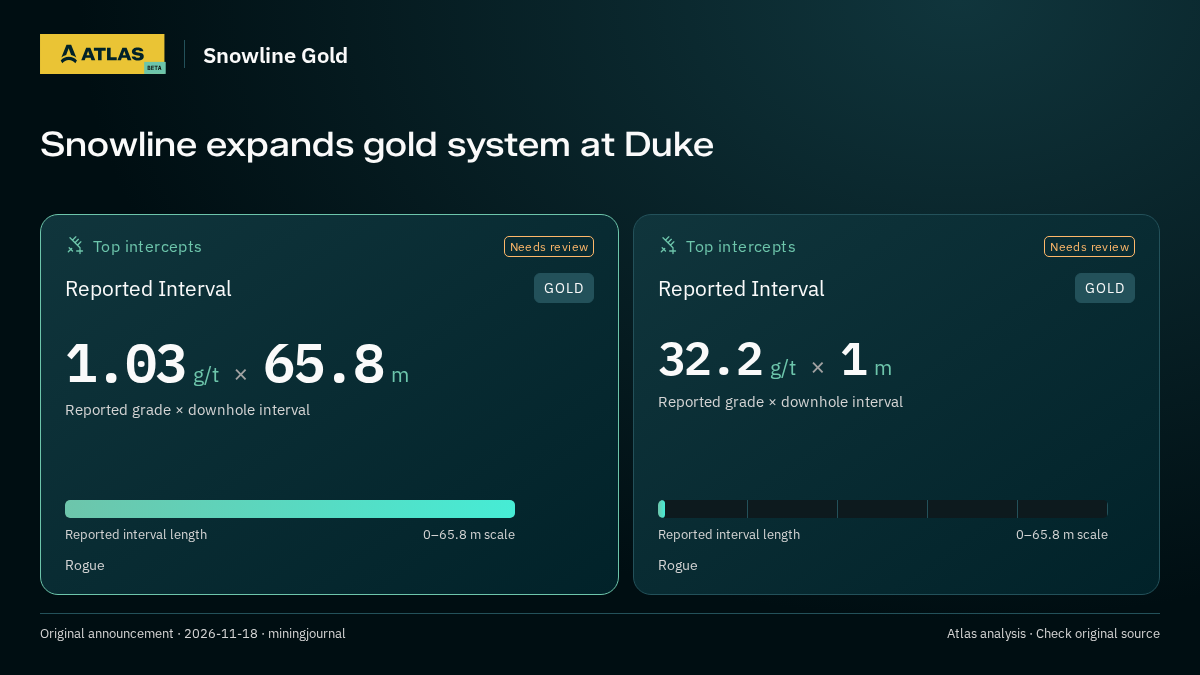
Snowline Gold has announced new drill results from its 2026 exploration program at the Duke target within the Rogue project in Yukon, Canada. The results include a significant intercept of 1.03 g/t gold over 65.8 metres, featuring a high-grade 32.2 g/t gold interval.
Reasoning: The announcement reports new drill results demonstrating widespread gold mineralisation and a high-grade bonanza-style intercept at the Duke target.
Positive factors
- discovery of widespread gold mineralisation
- high-grade intercept (32.2 g/t Au)
Facts used in scoring: 2
Classification and evidence
Bonanza Interceptpositive
Exceptionally high-grade zone, well above the deposit-type norm.
Why it applies: The intercept of 32.2 g/t Au is exceptionally high grade.
Evidence · text
“32.2 g/t Au over 1m”
Step-Out Extensionpositive
Mineralization extended beyond the previously known limit.
Why it applies: The release describes the discovery of widespread mineralisation at the Duke target as part of an exploration program.
Evidence · text
“discovery of widespread gold mineralisation at its Duke target”
Extracted facts
Stored fact records: 2. Some facts used in scoring do not have a stored record.
Drill Results (2)
Fact 1Rogue · goldGrade: 1.03Grade Unit: g/tIntercept: 65.8 mNeeds review: drill_no_hole_idView all detailsHide details
Identity
- Project
- Rogue
- Commodity
- gold
- Region
- canada_yt
- Reported Region
- canada_yt
Geometry
- Grade
- 1.03
- Grade Unit
- g/t
- Intercept
- 65.8 m
Classification
- Sample Type
- drill
- Mining Method
- unknown
Location
- Location
- Duke
- Loc. Source
- document
QA/QC
- QA/QC Methods
- standards
Review
- Needs Review
- Yes
- Review Reason
- drill_no_hole_id
- Interp. Status
- scored
- Historical
- No
Dates
- Event date
- 2026-11-18T00:00:00.000Z
Reasoning: A wide intercept of 65.8m at 1.03 g/t gold demonstrates significant mineralised width.
Positive factors
- significant width
Evidence · text
“Intersects 1.03 g/t over 65.8 m”
Tags used in scoring
No QA/QC Disclosurenegative
Release does not disclose QA/QC — lab certification, CP/QP sign-off and assay protocols cannot be checked from this document.
Why it applies: qaqc_disclosed is not true
Cut-off Undisclosednegative
High-grade interval reported without stating the cut-off grade used for compositing.
Why it applies: no cutoff_grade was stated
Fact 2Rogue · goldGrade: 32.2Grade Unit: g/tIntercept: 1 mNeeds review: drill_no_hole_idView all detailsHide details
Identity
- Project
- Rogue
- Commodity
- gold
- Region
- canada_yt
- Reported Region
- canada_yt
Geometry
- Grade
- 32.2
- Grade Unit
- g/t
- Intercept
- 1 m
Classification
- Sample Type
- drill
- Mining Method
- unknown
Location
- Location
- Duke
- Loc. Source
- document
QA/QC
- QA/QC Methods
- standards
Review
- Needs Review
- Yes
- Review Reason
- drill_no_hole_id
- Interp. Status
- scored
- Historical
- No
Dates
- Event date
- 2026-11-18T00:00:00.000Z
Reasoning: The 32.2 g/t gold intercept is an exceptionally high-grade interval.
Positive factors
- bonanza grade
Evidence · text
“including 32.2 g/t Au over 1m”
Tags used in scoring
No QA/QC Disclosurenegative
Release does not disclose QA/QC — lab certification, CP/QP sign-off and assay protocols cannot be checked from this document.
Why it applies: qaqc_disclosed is not true
Cut-off Undisclosednegative
High-grade interval reported without stating the cut-off grade used for compositing.
Why it applies: no cutoff_grade was stated
How Atlas produces this analysis
Minestarters Atlas uses automated extraction to summarize mining announcements, identify reported measurements, and classify supporting evidence. Sentiment reflects the extracted narrative and classification rules; it is an interpretation, not a reported measurement. Evidence quotes and context are provided where available. Missing data, low-confidence results, and review flags indicate limitations. Check the original publisher announcement before relying on an interpretation.