
Silver Bullet Mines Corp. Begins Work on First 200 Tons of DSO for Shipment
Original announcement by orestocks on
- Company
- Silver Bullet Mines Corp.
- Ticker
- SBMI.V
- Exchange
- Unavailable
- Region
- Unavailable
- Primary commodity
- Gold
- Secondary commodities
- Silver
- Document categories
- Production, Drill results
- Extracted
- 2026-11-19 13:17:20 UTC
Analysis by Minestarters Atlas
Atlas analysis published:
Minestarters Atlas analysis
Summary
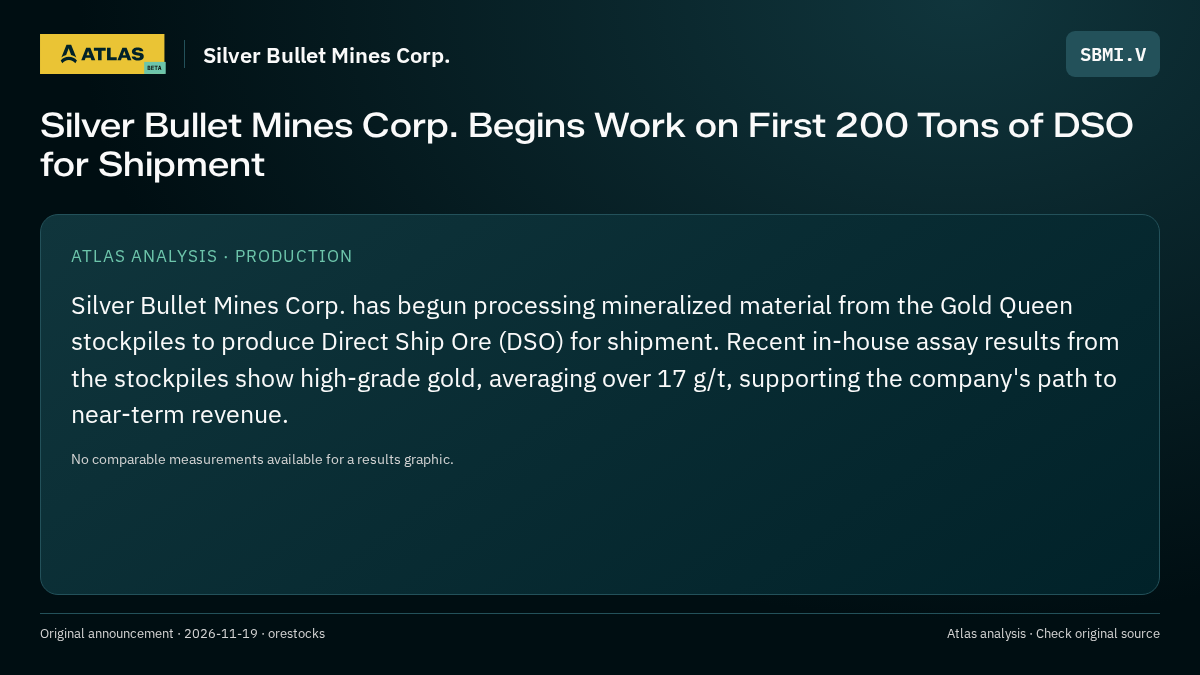
Silver Bullet Mines Corp. has begun processing mineralized material from the Gold Queen stockpiles to produce Direct Ship Ore (DSO) for shipment. Recent in-house assay results from the stockpiles show high-grade gold, averaging over 17 g/t, supporting the company's path to near-term revenue.
Reasoning: The company has transitioned from exploration to near-term production by processing stockpiles for DSO and concentrate, supported by high-grade gold assays.
Positive factors
- High-grade stockpile assays support near-term production
- Commencement of DSO processing for shipment
- QA/QC and QP sign-off provided
Negative factors
- In-house assaying used for primary results
- Concentration ratios and weekly tonnage still unknown
Facts used in scoring: 7
Classification and evidence
QA/QC Disclosedpositive
Release includes QA/QC disclosure — certified lab, QP sign-off, or stated methods (blanks, standards, duplicates).
Why it applies: Release includes detailed description of in-house assaying process and mentions a QP review.
Evidence · text
“QA/QC from SBMI Lab in Globe, Arizona”
Bonanza Interceptpositive
Exceptionally high-grade zone, well above the deposit-type norm.
Why it applies: Sample 194084 returned 65.14 g/t gold, which is exceptionally high.
Evidence · table
“65.14”
Context: 194084
Extracted facts
Stored fact records: 0. Some facts used in scoring do not have a stored record.
No stored fact records are available for this extraction.
How Atlas produces this analysis
Minestarters Atlas uses automated extraction to summarize mining announcements, identify reported measurements, and classify supporting evidence. Sentiment reflects the extracted narrative and classification rules; it is an interpretation, not a reported measurement. Evidence quotes and context are provided where available. Missing data, low-confidence results, and review flags indicate limitations. Check the original publisher announcement before relying on an interpretation.