
KNI: Phase 2 Drilling Extends Mineralisation at Silica Hill
Original announcement by asx on
- Company
- Unavailable
- Ticker
- KNI
- Exchange
- ASX
- Region
- New South Wales
- Primary commodity
- Gold
- Secondary commodities
- Silver, Zinc, Lead, Copper
- Document categories
- Drill results, Resource update
- Extracted
- 2026-11-04 22:12:57 UTC
Analysis by Minestarters Atlas
Atlas analysis published:
Minestarters Atlas analysis
Summary
Kuniko Limited announced successful Phase 2 drilling at its Silica Hill project, with all five holes intersecting gold-silver-base metal mineralisation and extending the interpreted system. The results, which include broad mineralised widths, will inform an updated Mineral Resource Estimate targeted for December 2026. While grades were generally lower than previous high-grade intercepts, the program confirmed continuity and highlighted additional exploration targets.
Reasoning: Kuniko's Phase 2 drilling at Silica Hill successfully extended known gold-silver-base metal mineralisation, providing data for an upcoming MRE update. While grades were generally lower than previous high-grade intercepts, the broad widths and confirmed continuity are positive. The detailed QA/QC and disclosed metal equivalent assumptions are good, but the lack of true width and unvalidated metal equivalent assumptions for this specific deposit introduce some caution.
Positive factors
- All five Phase 2 drill holes intersected mineralisation, extending the interpreted mineralised system at Silica Hill.
- Broad mineralised widths were encountered, demonstrating continuity of the system.
- The drilling provides additional data to support an updated Mineral Resource Estimate (MRE) targeted for December 2026.
- Detailed QA/QC procedures were disclosed, including certified labs, CRMs, blanks, and duplicates.
- The metal equivalent calculation assumptions (prices and recoveries) were clearly stated.
Negative factors
- Mineralisation grades in Phase 2 were generally lower than the high-grade intervals previously encountered in Phase 1.
- True widths have not been established for the reported intercepts, which are downhole lengths.
- Metal equivalent assumptions, while disclosed, have not been independently validated by metallurgical testwork specific to the Silica Hill mineralisation and are referenced from another deposit.
Facts used in scoring: 2
Extracted facts
Stored fact records: 2. Some facts used in scoring do not have a stored record.
Drill Results (2)
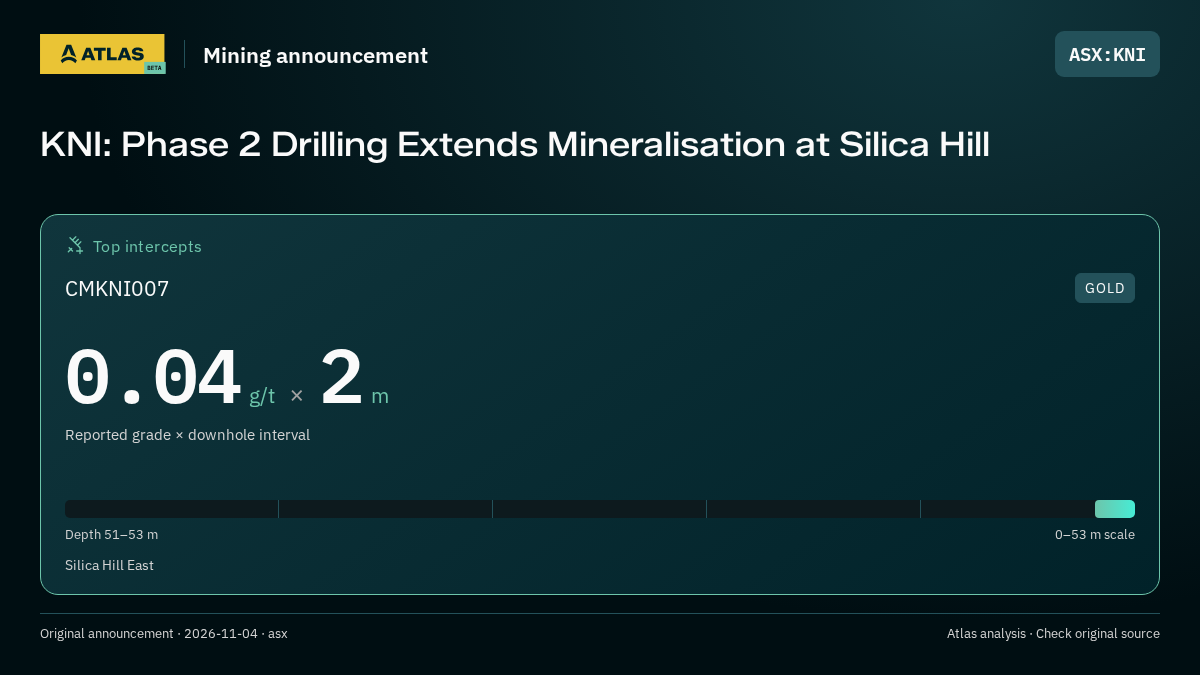
CMKNI007Silica Hill East · goldGrade: 0.04Grade Unit: g/tIntercept: 2 mView all detailsHide details
Identity
- Hole ID
- CMKNI007
- Project
- Silica Hill East
- Commodity
- gold
- Region
- australia_nsw
- Reported Region
- australia_nsw
- Ticker
- KNI
Geometry
- Grade
- 0.04
- Grade Unit
- g/t
- Intercept
- 2 m
- From
- 51 m
- To
- 53 m
- Hole Depth
- 369.9 m
- Intercept Depth
- 51 m
Classification
- Deposit Type
- epithermal
- Program
- resource
- Sample Type
- drill
- Group ID
- CMKNI007:51-53
- Mining Method
- unknown
Location
- Easting
- 692344
- Northing
- 6393011
- Elevation
- 390.48 m
- Azimuth
- 308 °
- Dip
- -60 °
- Loc. Confidence
- high
- Loc. Source
- document
QA/QC
- Laboratory
- SGS Orange and SGS Perth
- QA/QC Disclosed
- Yes
- QP Signed
- Yes
- QA/QC Methods
- standards, blanks, duplicates, check_assays
Metal Equivalent
- Metal Eq. Grade
- 0.74
- Metal Eq. Unit
- g/t AuEq
- Assumptions Disclosed
- Yes
Compositing
- Cutoff Grade
- 30
- Cutoff Unit
- g/t Ag
- Dilution Disclosed
- Yes
- Max Dilution
- 3 m
Review
- Needs Review
- No
- Interp. Status
- scored
- Historical
- No
Dates
- Event date
- 2026-11-04T00:00:00.000Z
Reasoning: A low-grade gold intercept that contributes to the overall mineralised footprint but is not individually significant. QA/QC and metal equivalent assumptions are disclosed, but true width is unknown and metal equivalent assumptions are unvalidated for the deposit.
Positive factors
- Intercepted mineralisation, contributing to the overall understanding of the system.
- Detailed QA/QC procedures were disclosed.
- Metal equivalent assumptions were stated.
Negative factors
- Low gold grade for an epithermal deposit.
- True width not established.
- Metal equivalent assumptions not validated for this specific deposit.
Evidence · table
“0.04”
Context: 2
Tags used in scoring
QA/QC Disclosedpositive
Release includes QA/QC disclosure — certified lab, QP sign-off, or stated methods (blanks, standards, duplicates).
Why it applies: qaqc_disclosed is true
Compositing Transparentpositive
Cut-off grade and internal dilution rules are clearly stated for reported intervals.
Why it applies: cutoff_grade and internal dilution are both stated
Refractory Orenegative
Ore requires oxidation/pressure treatment before recovery — a processing and recovery risk.
Why it applies: the release describes refractory metallurgy
Infill Drillingneutral
Confirmatory drilling to raise resource confidence, not new discovery.
Why it applies: drill_program_type is "resource"
Nearology Playneutral
Value premise rests on proximity to a known deposit rather than own results.
Why it applies: proximity is offered as the value premise: "Phase 2 Silica Hill drilling confirms broad mineralised extensions and links Silica Hill discovery with resource • CMKNI"
CMKNI007Silica Hill East · silverGrade: 46.5Grade Unit: g/tIntercept: 2 mView all detailsHide details
Identity
- Hole ID
- CMKNI007
- Project
- Silica Hill East
- Commodity
- silver
- Region
- australia_nsw
- Reported Region
- australia_nsw
- Ticker
- KNI
Geometry
- Grade
- 46.5
- Grade Unit
- g/t
- Intercept
- 2 m
- From
- 51 m
- To
- 53 m
- Hole Depth
- 369.9 m
- Intercept Depth
- 51 m
Classification
- Deposit Type
- epithermal
- Program
- resource
- Sample Type
- drill
- Group ID
- CMKNI007:51-53
- Mining Method
- unknown
Location
- Easting
- 692344
- Northing
- 6393011
- Elevation
- 390.48 m
- Azimuth
- 308 °
- Dip
- -60 °
- Loc. Confidence
- high
- Loc. Source
- document
QA/QC
- Laboratory
- SGS Orange and SGS Perth
- QA/QC Disclosed
- Yes
- QP Signed
- Yes
- QA/QC Methods
- standards, blanks, duplicates, check_assays
Metal Equivalent
- Metal Eq. Grade
- 0.74
- Metal Eq. Unit
- g/t AuEq
- Assumptions Disclosed
- Yes
Compositing
- Cutoff Grade
- 30
- Cutoff Unit
- g/t Ag
- Dilution Disclosed
- Yes
- Max Dilution
- 3 m
Review
- Needs Review
- No
- Interp. Status
- scored
- Historical
- No
Dates
- Event date
- 2026-11-04T00:00:00.000Z
Reasoning: A moderate-grade silver intercept that contributes to the overall mineralised footprint. QA/QC and metal equivalent assumptions are disclosed, but true width is unknown and metal equivalent assumptions are unvalidated for the deposit.
Positive factors
- Moderate silver grade for an epithermal deposit.
- Intercepted mineralisation, contributing to the overall understanding of the system.
- Detailed QA/QC procedures were disclosed.
- Metal equivalent assumptions were stated.
Negative factors
- True width not established.
- Metal equivalent assumptions not validated for this specific deposit.
Evidence · table
“46.5”
Context: 2
Tags used in scoring
QA/QC Disclosedpositive
Release includes QA/QC disclosure — certified lab, QP sign-off, or stated methods (blanks, standards, duplicates).
Why it applies: qaqc_disclosed is true
Compositing Transparentpositive
Cut-off grade and internal dilution rules are clearly stated for reported intervals.
Why it applies: cutoff_grade and internal dilution are both stated
Refractory Orenegative
Ore requires oxidation/pressure treatment before recovery — a processing and recovery risk.
Why it applies: the release describes refractory metallurgy
Infill Drillingneutral
Confirmatory drilling to raise resource confidence, not new discovery.
Why it applies: drill_program_type is "resource"
Nearology Playneutral
Value premise rests on proximity to a known deposit rather than own results.
Why it applies: proximity is offered as the value premise: "Phase 2 Silica Hill drilling confirms broad mineralised extensions and links Silica Hill discovery with resource • CMKNI"
How Atlas produces this analysis
Minestarters Atlas uses automated extraction to summarize mining announcements, identify reported measurements, and classify supporting evidence. Sentiment reflects the extracted narrative and classification rules; it is an interpretation, not a reported measurement. Evidence quotes and context are provided where available. Missing data, low-confidence results, and review flags indicate limitations. Check the original publisher announcement before relying on an interpretation.