
Ivanhoe Mines Issues 2026 Third-Quarter Financial Results, Overview of Operations and Exploration Activities
Original announcement by jmn on
- Company
- Ivanhoe Mines
- Ticker
- IVN
- Exchange
- TSX
- Region
- Democratic Republic of the Congo
- Primary commodity
- Copper
- Secondary commodities
- Zinc, Platinum, Palladium, Rhodium, Gold, Nickel
- Document categories
- Production, Resource update, Metallurgy
- Extracted
- 2026-11-04 00:19:05 UTC
Analysis by Minestarters Atlas
Atlas analysis published:
Minestarters Atlas analysis
Summary
Ivanhoe Mines reported a Q3 2026 profit of $45 million and Adjusted EBITDA of $241 million, driven by record zinc production and recovery at its Kipushi Mine and improved copper recovery at Kamoa-Kakula. The company also updated its Mineral Resource Estimate for the Western Forelands, showing a significant increase in contained copper in the Inferred category. However, 2027 copper production guidance for Kamoa-Kakula was lowered, and cash costs were increased due to operational challenges and elevated diesel prices, with plans to introduce open-pit mining to enhance flexibility.
Reasoning: Ivanhoe Mines reported strong Q3 2026 financial results, driven by record zinc production and recovery at Kipushi and improved copper recovery at Kamoa-Kakula. The company also announced a significant increase in the Western Forelands copper resource. However, 2027 copper production guidance for Kamoa-Kakula was lowered with increased cash costs due to operational challenges and higher diesel prices.
Positive factors
- Record zinc production and recovery at Kipushi, positioning it as a top-tier global producer.
- Improved copper recovery at Kamoa-Kakula, driven by Project 95 upgrades and solar power integration.
- Significant increase in contained copper in the Inferred Mineral Resource category at Western Forelands.
- Introduction of shallow, high-grade open-pit mining at Kamoa to enhance operational flexibility and reduce risk.
- Sulphuric acid by-product credits significantly offsetting smelter operating costs at Kamoa-Kakula.
Negative factors
- Lowered 2027 copper production guidance and increased cash costs for Kamoa-Kakula due to operational challenges and elevated diesel prices.
- Delay in stoping at Kakula and reduced estimated maximum mining rate impacting production ramp-up.
- Increased exploration expenditure, partly due to resettlement costs at Makoko District.
- Discrepancy in Indicated resource tonnage reported for Makoko District vs. Western Forelands, creating some ambiguity.
Low confidence — this extraction should be reviewed alongside the original source.
Facts used in scoring: 22
Classification and evidence
Tonnage Growthpositive
Significant tonnage increase (≥15%) vs prior estimate with grade maintained or improved.
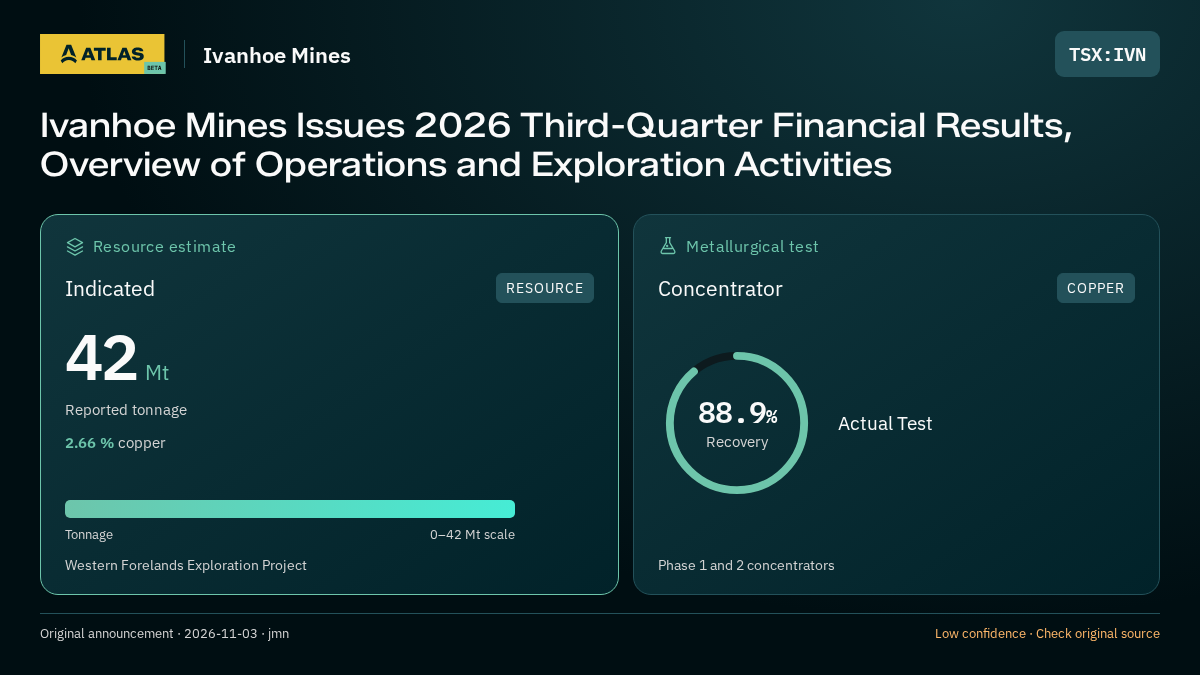
Why it applies: The Inferred Mineral Resource for Western Forelands/Makoko District increased by 31% in contained copper (2.63 Mt added to 11.0 Mt total).
Evidence · text
“A further 2.63 million tonnes of contained copper have been added to the Inferred category for an increase of 31%.”
Category Upgradepositive
Resource confidence improved — Inferred upgraded to Indicated, or Indicated to Measured. De-risking signal.
Why it applies: The Indicated Mineral Resource for Makoko District increased by 17% in contained copper, indicating improved confidence.
Evidence · text
“This drilling added approximately 0.13 million tonnes of contained copper in the Indicated Mineral Resource category for an increase of 17%.”
QP/CP Signedpositive
Qualified Person (QP) or Competent Person (CP) named and signed off — a member of a recognized professional association (e.g., AusIMM, SME, AIG, P.Geo) with relevant experience.
Why it applies: Tim Williams, Vice President, Geosciences, is named as the Qualified Person for the exploration projects.
Evidence · text
“Disclosures of a scientific or technical nature regarding the Western Forelands Exploration Project, as well as the company’s other exploration projects, in this release have been reviewed and approved by Tim Williams, who is considered, by virtue of his education, experience and professional association, a Qualified Person under the terms of NI 43-101.”
NI 43-101 Compliantpositive
Resource estimate prepared in compliance with NI 43-101 (Canada) — high reporting standard.
Why it applies: The resource estimate is stated to be compliant with NI 43-101 standards.
Evidence · text
“a Qualified Person under the terms of NI 43-101.”
Inferred Resourcenegative
Speculative category — limited drilling, geological continuity assumed but not confirmed. Cannot support economic studies alone.
Why it applies: A significant portion of the updated resource for Western Forelands is in the Inferred category (612 Mt).
Evidence · text
“Inferred Mineral Resources of 612 million tonnes at 1.80% copper”
Recovery Improvingpositive
Recovery improved versus a like-for-like prior test program on the same domain and route.
Why it applies: Copper recoveries from Phase 1 and 2 concentrators improved to 89% in Q3, up from an average of 83-85% prior to Project 95 completion.
Evidence · text
“Following the completion of Project 95 at the end of the second quarter, copper recoveries have improved, averaging 89% during Q3.”
High Recoverypositive
Recovery at or above the exceptional band for the commodity and processing route.
Why it applies: Kipushi's zinc recovery of 96.02% is exceptional for zinc flotation (above 92% exceptional threshold).
Evidence · table
“96.02%”
Context: Zinc recovery (%)
Refractory Orenegative
Ore requires oxidation/pressure treatment before recovery — a processing and recovery risk.
Why it applies: The Kamoa-Kakula smelter produces high-strength sulphuric acid, which is sold to nearby mining operations that use it to leach copper and cobalt metal from oxide ores, implying some refractory characteristics in the region's oxide ores.
Evidence · text
“Kamoa-Kakula sells sulphuric acid from the mine gate to nearby mining operations on the DRC Copperbelt that use it to leach copper and cobalt metal from oxide ores.”
Heap Leach Routeneutral
Processing via heap leach — lower CAPEX and OPEX, lower recovery expected.
Why it applies: Sulphuric acid is sold for leaching copper and cobalt from oxide ores, indicating the use of heap leach or similar acid leach processes in the region.
Evidence · text
“Kamoa-Kakula sells sulphuric acid from the mine gate to nearby mining operations on the DRC Copperbelt that use it to leach copper and cobalt metal from oxide ores.”
Mill Routeneutral
Processing via mill or concentrator (CIL, CIP, tank leach, flotation).
Why it applies: Kamoa-Kakula operates Phase 1, 2, and 3 concentrators, which are mill-based processing plants.
Evidence · text
“The Phase 1, 2 and 3 concentrators target 400,000 to 450,000 tonnes of copper production”
Gravity Routeneutral
Gravity separation forms a material part of the flowsheet.
Why it applies: the document describes a gravity route ("gravity")
Multi-Domain Testedpositive
Variability across ore domains (oxide, transition, fresh) has been addressed.
Why it applies: 2 distinct composites were tested
Extracted facts
Stored fact records: 22. Some facts used in scoring do not have a stored record.
Resource Estimates (3)
indicatedWestern Forelands Exploration Project · copperTonnes: 42000000Grade: 2.66Grade Unit: %View all detailsHide details
Identity
- Project
- Western Forelands Exploration Project
- Commodity
- copper
- Ticker
- IVN
Resource scope
- Estimate type
- resource
- Reporting standards
- ni_43_101
- QP Signed
- Yes
- Qualified person names
- Tim Williams
- Resource group id
- resource:325ef5d266205df5e523
Resource Data
- Category
- indicated
- Tonnes
- 42000000
- Grade
- 2.66
- Grade Unit
- %
Prior Estimate
- Resource Date
- 2026-09-08
Review
- Needs Review
- No
- Historical
- No
Dates
- Event date
- 2026-11-03T00:00:00.000Z
Reasoning: The updated Indicated Mineral Resource of 42 Mt at 2.66% copper for the Western Forelands Exploration Project is a strong grade and adds to the project's geological confidence, with QP sign-off.
Positive factors
- Indicated resource grade is strong (2.66% Cu vs 1% strong threshold for copper).
- Resource update adds to geological confidence and potential for future development.
- QP sign-off ensures credibility and compliance with NI 43-101.
Negative factors
- Contained metal not explicitly stated for this tonnage.
Evidence · text
“Indicated Mineral Resources of 42 million tonnes at 2.66% copper”
Tags used in scoring
Indicated Resourcepositive
Reasonable geological confidence based on adequate drilling; continuity can be assumed. Basis for Probable Reserves.
Why it applies: category is "indicated"
Cut-off Undisclosednegative
High-grade interval reported without stating the cut-off grade used for compositing.
Why it applies: no cutoff_grade was stated
QP/CP Signedpositive
Qualified Person (QP) or Competent Person (CP) named and signed off — a member of a recognized professional association (e.g., AusIMM, SME, AIG, P.Geo) with relevant experience.
Why it applies: qp_signed is true
NI 43-101 Compliantpositive
Resource estimate prepared in compliance with NI 43-101 (Canada) — high reporting standard.
Why it applies: reporting_standards includes ni_43_101
No Contained Metalnegative
Tonnage and grade reported but contained metal not calculated or disclosed — incomplete reporting.
Why it applies: contained_metal was not reported
inferredWestern Forelands Exploration Project · copperTonnes: 612000000Grade: 1.8Grade Unit: %Contained Metal: 11Contained Unit: mtView all detailsHide details
Identity
- Project
- Western Forelands Exploration Project
- Commodity
- copper
- Ticker
- IVN
Resource scope
- Estimate type
- resource
- Reporting standards
- ni_43_101
- QP Signed
- Yes
- Qualified person names
- Tim Williams
- Resource group id
- resource:d394e705b50485ad2515
Resource Data
- Category
- inferred
- Tonnes
- 612000000
- Grade
- 1.8
- Grade Unit
- %
- Contained Metal
- 11
- Contained Unit
- mt
Prior Estimate
- Resource Date
- 2026-09-08
- Prior Contained Metal
- 8397000
Review
- Needs Review
- No
- Historical
- No
Dates
- Event date
- 2026-11-03T00:00:00.000Z
Reasoning: The updated Inferred Mineral Resource of 612 Mt at 1.80% copper for the Western Forelands Exploration Project represents a strong grade and a substantial 31% increase in contained copper, highlighting significant exploration potential with QP sign-off.
Positive factors
- Inferred resource grade is strong (1.80% Cu vs 1% strong threshold for copper).
- Significant increase in contained metal (31% increase) demonstrates substantial growth.
- Large tonnage indicates significant exploration potential.
- QP sign-off ensures credibility and compliance with NI 43-101.
Evidence · text
“Inferred Mineral Resources of 612 million tonnes at 1.80% copper (100% basis)... for a total of 11.0 million tonnes of contained copper in the Inferred category”
Tags used in scoring
Inferred Resourcenegative
Speculative category — limited drilling, geological continuity assumed but not confirmed. Cannot support economic studies alone.
Why it applies: category is "inferred"
Cut-off Undisclosednegative
High-grade interval reported without stating the cut-off grade used for compositing.
Why it applies: no cutoff_grade was stated
QP/CP Signedpositive
Qualified Person (QP) or Competent Person (CP) named and signed off — a member of a recognized professional association (e.g., AusIMM, SME, AIG, P.Geo) with relevant experience.
Why it applies: qp_signed is true
NI 43-101 Compliantpositive
Resource estimate prepared in compliance with NI 43-101 (Canada) — high reporting standard.
Why it applies: reporting_standards includes ni_43_101
Contained Metal Declinenegative
Contained metal decreased vs prior despite tonnage growth — grade dilution exceeds volume gain.
Why it applies: 11 against 8397000 previously
indicatedMakoko District · copperTonnes: 34000000Grade: 2.66Grade Unit: %Contained Metal: 0.9Contained Unit: mtView all detailsHide details
Identity
- Project
- Makoko District
- Commodity
- copper
- Ticker
- IVN
Resource scope
- Estimate type
- resource
- Reporting standards
- ni_43_101
- QP Signed
- Yes
- Qualified person names
- Tim Williams
- Resource group id
- resource:8e781f9b35efaffde839
Resource Data
- Category
- indicated
- Tonnes
- 34000000
- Grade
- 2.66
- Grade Unit
- %
- Contained Metal
- 0.9
- Contained Unit
- mt
Prior Estimate
- Resource Date
- 2026-09-08
- Prior Contained Metal
- 769000
Review
- Needs Review
- No
- Historical
- No
Dates
- Event date
- 2026-11-03T00:00:00.000Z
Reasoning: The updated Indicated Mineral Resource for the Makoko District of 34 Mt at 2.66% copper, with 0.9 Mt contained copper, represents a strong grade and a 17% increase in contained metal, enhancing geological confidence with QP sign-off.
Positive factors
- Indicated resource grade is strong (2.66% Cu vs 1% strong threshold for copper).
- Increase in contained metal (17%) demonstrates growth in confidence.
- QP sign-off ensures credibility and compliance with NI 43-101.
Evidence · text
“Makoko District's Mineral Resources are now 34 million tonnes of ore at 2.66% copper for a total of 0.9 million tonnes of contained copper in the Indicated category”
Tags used in scoring
Indicated Resourcepositive
Reasonable geological confidence based on adequate drilling; continuity can be assumed. Basis for Probable Reserves.
Why it applies: category is "indicated"
Cut-off Undisclosednegative
High-grade interval reported without stating the cut-off grade used for compositing.
Why it applies: no cutoff_grade was stated
QP/CP Signedpositive
Qualified Person (QP) or Competent Person (CP) named and signed off — a member of a recognized professional association (e.g., AusIMM, SME, AIG, P.Geo) with relevant experience.
Why it applies: qp_signed is true
NI 43-101 Compliantpositive
Resource estimate prepared in compliance with NI 43-101 (Canada) — high reporting standard.
Why it applies: reporting_standards includes ni_43_101
Contained Metal Declinenegative
Contained metal decreased vs prior despite tonnage growth — grade dilution exceeds volume gain.
Why it applies: 0.9 against 769000 previously
Metallurgical Results (19)
concentratorKamoa-Kakula · copperRecovery: 88.9 %View all detailsHide details
Identity
- Project
- Kamoa-Kakula
- Commodity
- copper
- Ticker
- IVN
Test Work
- Program Status
- optimization
- Test Type
- concentrator
- Processing Route
- Phase 1 and 2 concentrators
- Sample
- Phase 1 and 2 concentrators
Recovery
- Recovery
- 88.9 %
- Recovery Basis
- actual_test
Review
- Needs Review
- No
- Historical
- No
Dates
- Event date
- 2026-11-03T00:00:00.000Z
Reasoning: Copper recovery for Phase 1 and 2 concentrators improved to 88.9% in Q3 2026, a strong result for flotation and a significant improvement from the prior average of 83-85% due to Project 95 upgrades.
Positive factors
- Recovery is strong for copper flotation (88.9% vs 88% strong threshold).
- Recovery improved significantly from prior average (88.9% vs 84%).
- Improvement driven by Project 95 upgrades, indicating successful optimization.
Evidence · table
“88.9%”
Context: Copper recovery (%)
Tags used in scoring
Mill Routeneutral
Processing via mill or concentrator (CIL, CIP, tank leach, flotation).
Why it applies: processing_route matches the mill_cil signal
concentratorKamoa-Kakula · copperRecovery: 86 %View all detailsHide details
Identity
- Project
- Kamoa-Kakula
- Commodity
- copper
- Ticker
- IVN
Test Work
- Program Status
- optimization
- Test Type
- concentrator
- Processing Route
- Phase 3 concentrator
- Sample
- Phase 3 concentrator
Recovery
- Recovery
- 86 %
- Recovery Basis
- actual_test
Review
- Needs Review
- No
- Historical
- No
Dates
- Event date
- 2026-11-03T00:00:00.000Z
Reasoning: Copper recovery for the Phase 3 concentrator was 86.0% in Q3 2026, which is a moderate result for copper flotation.
Positive factors
- Recovery is moderate for copper flotation (86% vs 85% moderate threshold).
Evidence · table
“86.0%”
Context: Copper recovery (%)
Tags used in scoring
Mill Routeneutral
Processing via mill or concentrator (CIL, CIP, tank leach, flotation).
Why it applies: processing_route matches the mill_cil signal
concentratorKamoa-Kakula · copperRecovery: 86.6 %View all detailsHide details
Identity
- Project
- Kamoa-Kakula
- Commodity
- copper
- Ticker
- IVN
Test Work
- Program Status
- optimization
- Test Type
- concentrator
- Processing Route
- Phase 1 and 2 concentrators
- Sample
- Phase 1 and 2 concentrators
Recovery
- Recovery
- 86.6 %
- Recovery Basis
- actual_test
Review
- Needs Review
- No
- Historical
- No
Dates
- Event date
- 2026-11-03T00:00:00.000Z
Reasoning: Copper recovery for Phase 1 and 2 concentrators was 86.6% in Q2 2026, a moderate result for copper flotation.
Positive factors
- Recovery is moderate for copper flotation (86.6% vs 85% moderate threshold).
Evidence · table
“86.6%”
Context: Copper recovery (%)
Tags used in scoring
Mill Routeneutral
Processing via mill or concentrator (CIL, CIP, tank leach, flotation).
Why it applies: processing_route matches the mill_cil signal
concentratorKamoa-Kakula · copperRecovery: 88.2 %View all detailsHide details
Identity
- Project
- Kamoa-Kakula
- Commodity
- copper
- Ticker
- IVN
Test Work
- Program Status
- optimization
- Test Type
- concentrator
- Processing Route
- Phase 3 concentrator
- Sample
- Phase 3 concentrator
Recovery
- Recovery
- 88.2 %
- Recovery Basis
- actual_test
Review
- Needs Review
- No
- Historical
- No
Dates
- Event date
- 2026-11-03T00:00:00.000Z
Reasoning: Copper recovery for the Phase 3 concentrator was 88.2% in Q2 2026, a strong result for copper flotation.
Positive factors
- Recovery is strong for copper flotation (88.2% vs 88% strong threshold).
Evidence · table
“88.2%”
Context: Copper recovery (%)
Tags used in scoring
Mill Routeneutral
Processing via mill or concentrator (CIL, CIP, tank leach, flotation).
Why it applies: processing_route matches the mill_cil signal
concentratorKamoa-Kakula · copperRecovery: 84.1 %View all detailsHide details
Identity
- Project
- Kamoa-Kakula
- Commodity
- copper
- Ticker
- IVN
Test Work
- Program Status
- optimization
- Test Type
- concentrator
- Processing Route
- Phase 1 and 2 concentrators
- Sample
- Phase 1 and 2 concentrators
Recovery
- Recovery
- 84.1 %
- Recovery Basis
- actual_test
Review
- Needs Review
- No
- Historical
- No
Dates
- Event date
- 2026-11-03T00:00:00.000Z
Reasoning: Copper recovery for Phase 1 and 2 concentrators was 84.1% in Q1 2026, which is a weak result for copper flotation (below 85% moderate threshold).
Evidence · table
“84.1%”
Context: Copper recovery (%)
Tags used in scoring
Mill Routeneutral
Processing via mill or concentrator (CIL, CIP, tank leach, flotation).
Why it applies: processing_route matches the mill_cil signal
concentratorKamoa-Kakula · copperRecovery: 87.2 %View all detailsHide details
Identity
- Project
- Kamoa-Kakula
- Commodity
- copper
- Ticker
- IVN
Test Work
- Program Status
- optimization
- Test Type
- concentrator
- Processing Route
- Phase 3 concentrator
- Sample
- Phase 3 concentrator
Recovery
- Recovery
- 87.2 %
- Recovery Basis
- actual_test
Review
- Needs Review
- No
- Historical
- No
Dates
- Event date
- 2026-11-03T00:00:00.000Z
Reasoning: Copper recovery for the Phase 3 concentrator was 87.2% in Q1 2026, a moderate result for copper flotation.
Positive factors
- Recovery is moderate for copper flotation (87.2% vs 85% moderate threshold).
Evidence · table
“87.2%”
Context: Copper recovery (%)
Tags used in scoring
Mill Routeneutral
Processing via mill or concentrator (CIL, CIP, tank leach, flotation).
Why it applies: processing_route matches the mill_cil signal
concentratorKamoa-Kakula · copperRecovery: 83.2 %View all detailsHide details
Identity
- Project
- Kamoa-Kakula
- Commodity
- copper
- Ticker
- IVN
Test Work
- Program Status
- optimization
- Test Type
- concentrator
- Processing Route
- Phase 1 and 2 concentrators
- Sample
- Phase 1 and 2 concentrators
Recovery
- Recovery
- 83.2 %
- Recovery Basis
- actual_test
Review
- Needs Review
- No
- Historical
- No
Dates
- Event date
- 2026-11-03T00:00:00.000Z
Reasoning: Copper recovery for Phase 1 and 2 concentrators was 83.2% in Q4 2025, which is a weak result for copper flotation (below 85% moderate threshold).
Evidence · table
“83.2%”
Context: Copper recovery (%)
Tags used in scoring
Mill Routeneutral
Processing via mill or concentrator (CIL, CIP, tank leach, flotation).
Why it applies: processing_route matches the mill_cil signal
concentratorKamoa-Kakula · copperRecovery: 88.2 %View all detailsHide details
Identity
- Project
- Kamoa-Kakula
- Commodity
- copper
- Ticker
- IVN
Test Work
- Program Status
- optimization
- Test Type
- concentrator
- Processing Route
- Phase 3 concentrator
- Sample
- Phase 3 concentrator
Recovery
- Recovery
- 88.2 %
- Recovery Basis
- actual_test
Review
- Needs Review
- No
- Historical
- No
Dates
- Event date
- 2026-11-03T00:00:00.000Z
Reasoning: Copper recovery for the Phase 3 concentrator was 88.2% in Q4 2025, a strong result for copper flotation.
Positive factors
- Recovery is strong for copper flotation (88.2% vs 88% strong threshold).
Evidence · table
“88.2%”
Context: Copper recovery (%)
Tags used in scoring
Mill Routeneutral
Processing via mill or concentrator (CIL, CIP, tank leach, flotation).
Why it applies: processing_route matches the mill_cil signal
concentratorKamoa-Kakula · copperRecovery: 81.3 %View all detailsHide details
Identity
- Project
- Kamoa-Kakula
- Commodity
- copper
- Ticker
- IVN
Test Work
- Program Status
- optimization
- Test Type
- concentrator
- Processing Route
- Phase 1 and 2 concentrators
- Sample
- Phase 1 and 2 concentrators
Recovery
- Recovery
- 81.3 %
- Recovery Basis
- actual_test
Review
- Needs Review
- No
- Historical
- No
Dates
- Event date
- 2026-11-03T00:00:00.000Z
Reasoning: Copper recovery for Phase 1 and 2 concentrators was 81.3% in Q3 2025, which is a weak result for copper flotation (below 85% moderate threshold).
Evidence · table
“81.3%”
Context: Copper recovery (%)
Tags used in scoring
Mill Routeneutral
Processing via mill or concentrator (CIL, CIP, tank leach, flotation).
Why it applies: processing_route matches the mill_cil signal
concentratorKamoa-Kakula · copperRecovery: 84.2 %View all detailsHide details
Identity
- Project
- Kamoa-Kakula
- Commodity
- copper
- Ticker
- IVN
Test Work
- Program Status
- optimization
- Test Type
- concentrator
- Processing Route
- Phase 3 concentrator
- Sample
- Phase 3 concentrator
Recovery
- Recovery
- 84.2 %
- Recovery Basis
- actual_test
Review
- Needs Review
- No
- Historical
- No
Dates
- Event date
- 2026-11-03T00:00:00.000Z
Reasoning: Copper recovery for the Phase 3 concentrator was 84.2% in Q3 2025, which is a weak result for copper flotation (below 85% moderate threshold).
Evidence · table
“84.2%”
Context: Copper recovery (%)
Tags used in scoring
Mill Routeneutral
Processing via mill or concentrator (CIL, CIP, tank leach, flotation).
Why it applies: processing_route matches the mill_cil signal
concentratorKipushi · zincRecovery: 96.02 %View all detailsHide details
Identity
- Project
- Kipushi
- Commodity
- zinc
- Ticker
- IVN
Test Work
- Program Status
- optimization
- Test Type
- concentrator
- Processing Route
- concentrator
- Sample
- Kipushi concentrator
Recovery
- Recovery
- 96.02 %
- Recovery Basis
- actual_test
Review
- Needs Review
- No
- Historical
- No
Dates
- Event date
- 2026-11-03T00:00:00.000Z
Reasoning: Zinc recovery at Kipushi reached a record 96.02% in Q3 2026, which is an exceptional result for zinc flotation.
Positive factors
- Recovery is exceptional for zinc (96.02% vs 92% exceptional threshold for flotation).
- This is a record recovery for the Kipushi concentrator.
Evidence · table
“96.02%”
Context: Zinc recovery (%)
Tags used in scoring
Mill Routeneutral
Processing via mill or concentrator (CIL, CIP, tank leach, flotation).
Why it applies: processing_route matches the mill_cil signal
concentratorKipushi · zincRecovery: 91.91 %View all detailsHide details
Identity
- Project
- Kipushi
- Commodity
- zinc
- Ticker
- IVN
Test Work
- Program Status
- optimization
- Test Type
- concentrator
- Processing Route
- concentrator
- Sample
- Kipushi concentrator
Recovery
- Recovery
- 91.91 %
- Recovery Basis
- actual_test
Review
- Needs Review
- No
- Historical
- No
Dates
- Event date
- 2026-11-03T00:00:00.000Z
Reasoning: Zinc recovery at Kipushi was 91.91% in Q2 2026, which is a strong result for zinc flotation.
Positive factors
- Recovery is strong for zinc (91.91% vs 88% strong threshold for flotation).
Evidence · table
“91.91%”
Context: Zinc recovery (%)
Tags used in scoring
Mill Routeneutral
Processing via mill or concentrator (CIL, CIP, tank leach, flotation).
Why it applies: processing_route matches the mill_cil signal
concentratorKipushi · zincRecovery: 90.63 %View all detailsHide details
Identity
- Project
- Kipushi
- Commodity
- zinc
- Ticker
- IVN
Test Work
- Program Status
- optimization
- Test Type
- concentrator
- Processing Route
- concentrator
- Sample
- Kipushi concentrator
Recovery
- Recovery
- 90.63 %
- Recovery Basis
- actual_test
Review
- Needs Review
- No
- Historical
- No
Dates
- Event date
- 2026-11-03T00:00:00.000Z
Reasoning: Zinc recovery at Kipushi was 90.63% in Q1 2026, which is a moderate result for zinc flotation.
Positive factors
- Recovery is moderate for zinc (90.63% vs 85% moderate threshold for flotation).
Evidence · table
“90.63%”
Context: Zinc recovery (%)
Tags used in scoring
Mill Routeneutral
Processing via mill or concentrator (CIL, CIP, tank leach, flotation).
Why it applies: processing_route matches the mill_cil signal
concentratorKipushi · zincRecovery: 87.71 %View all detailsHide details
Identity
- Project
- Kipushi
- Commodity
- zinc
- Ticker
- IVN
Test Work
- Program Status
- optimization
- Test Type
- concentrator
- Processing Route
- concentrator
- Sample
- Kipushi concentrator
Recovery
- Recovery
- 87.71 %
- Recovery Basis
- actual_test
Review
- Needs Review
- No
- Historical
- No
Dates
- Event date
- 2026-11-03T00:00:00.000Z
Reasoning: Zinc recovery at Kipushi was 87.71% in Q4 2025, which is a weak result for zinc flotation (below 88% strong threshold).
Evidence · table
“87.71%”
Context: Zinc recovery (%)
Tags used in scoring
Mill Routeneutral
Processing via mill or concentrator (CIL, CIP, tank leach, flotation).
Why it applies: processing_route matches the mill_cil signal
concentratorKipushi · zincRecovery: 89.36 %View all detailsHide details
Identity
- Project
- Kipushi
- Commodity
- zinc
- Ticker
- IVN
Test Work
- Program Status
- optimization
- Test Type
- concentrator
- Processing Route
- concentrator
- Sample
- Kipushi concentrator
Recovery
- Recovery
- 89.36 %
- Recovery Basis
- actual_test
Review
- Needs Review
- No
- Historical
- No
Dates
- Event date
- 2026-11-03T00:00:00.000Z
Reasoning: Zinc recovery at Kipushi was 89.36% in Q3 2025, which is a moderate result for zinc flotation.
Positive factors
- Recovery is moderate for zinc (89.36% vs 85% moderate threshold for flotation).
Evidence · table
“89.36%”
Context: Zinc recovery (%)
Tags used in scoring
Mill Routeneutral
Processing via mill or concentrator (CIL, CIP, tank leach, flotation).
Why it applies: processing_route matches the mill_cil signal
concentratorPlatreef · pgmRecovery: 62.4 %View all detailsHide details
Identity
- Project
- Platreef
- Commodity
- pgm
- Ticker
- IVN
Test Work
- Program Status
- preliminary
- Test Type
- concentrator
- Processing Route
- Phase 1 concentrator
- Sample
- Phase 1 concentrator
Recovery
- Recovery
- 62.4 %
- Recovery Basis
- actual_test
Review
- Needs Review
- No
- Historical
- No
Dates
- Event date
- 2026-11-03T00:00:00.000Z
Reasoning: PGM recovery for the Platreef Phase 1 concentrator was 62.4% in Q3 2026, which is a weak result for PGM flotation, though operations are still ramping up.
Negative factors
- Recovery is weak for PGM flotation (62.4% vs 80% moderate threshold).
Evidence · table
“62.40%”
Context: Recovery (%)
Tags used in scoring
Mill Routeneutral
Processing via mill or concentrator (CIL, CIP, tank leach, flotation).
Why it applies: processing_route matches the mill_cil signal
concentratorPlatreef · pgmRecovery: 59 %View all detailsHide details
Identity
- Project
- Platreef
- Commodity
- pgm
- Ticker
- IVN
Test Work
- Program Status
- preliminary
- Test Type
- concentrator
- Processing Route
- Phase 1 concentrator
- Sample
- Phase 1 concentrator
Recovery
- Recovery
- 59 %
- Recovery Basis
- actual_test
Review
- Needs Review
- No
- Historical
- No
Dates
- Event date
- 2026-11-03T00:00:00.000Z
Reasoning: PGM recovery for the Platreef Phase 1 concentrator was 59.0% in Q2 2026, which is a weak result for PGM flotation.
Negative factors
- Recovery is weak for PGM flotation (59% vs 80% moderate threshold).
Evidence · table
“59.00%”
Context: Recovery (%)
Tags used in scoring
Mill Routeneutral
Processing via mill or concentrator (CIL, CIP, tank leach, flotation).
Why it applies: processing_route matches the mill_cil signal
concentratorPlatreef · pgmRecovery: 57 %View all detailsHide details
Identity
- Project
- Platreef
- Commodity
- pgm
- Ticker
- IVN
Test Work
- Program Status
- preliminary
- Test Type
- concentrator
- Processing Route
- Phase 1 concentrator
- Sample
- Phase 1 concentrator
Recovery
- Recovery
- 57 %
- Recovery Basis
- actual_test
Review
- Needs Review
- No
- Historical
- No
Dates
- Event date
- 2026-11-03T00:00:00.000Z
Reasoning: PGM recovery for the Platreef Phase 1 concentrator was 57.0% in Q1 2026, which is a weak result for PGM flotation.
Negative factors
- Recovery is weak for PGM flotation (57% vs 80% moderate threshold).
Evidence · table
“57.00%”
Context: Recovery (%)
Tags used in scoring
Mill Routeneutral
Processing via mill or concentrator (CIL, CIP, tank leach, flotation).
Why it applies: processing_route matches the mill_cil signal
concentratorPlatreef · pgmRecovery: 45 %View all detailsHide details
Identity
- Project
- Platreef
- Commodity
- pgm
- Ticker
- IVN
Test Work
- Program Status
- preliminary
- Test Type
- concentrator
- Processing Route
- Phase 1 concentrator
- Sample
- Phase 1 concentrator
Recovery
- Recovery
- 45 %
- Recovery Basis
- actual_test
Review
- Needs Review
- No
- Historical
- No
Dates
- Event date
- 2026-11-03T00:00:00.000Z
Reasoning: PGM recovery for the Platreef Phase 1 concentrator was 45.0% in Q4 2025, which is a very weak result for PGM flotation.
Negative factors
- Recovery is below the weak band for PGM flotation (45% vs 75% weak threshold).
Evidence · table
“45.00%”
Context: Recovery (%)
Tags used in scoring
Mill Routeneutral
Processing via mill or concentrator (CIL, CIP, tank leach, flotation).
Why it applies: processing_route matches the mill_cil signal
How Atlas produces this analysis
Minestarters Atlas uses automated extraction to summarize mining announcements, identify reported measurements, and classify supporting evidence. Sentiment reflects the extracted narrative and classification rules; it is an interpretation, not a reported measurement. Evidence quotes and context are provided where available. Missing data, low-confidence results, and review flags indicate limitations. Check the original publisher announcement before relying on an interpretation.