
Inomin Mines Confirms Large-Scale Nickel-Magnesium System at Beaver-Lynx
Original announcement by jmn on
- Company
- Inomin Mines Inc.
- Ticker
- MINE
- Exchange
- TSXV
- Region
- British Columbia
- Primary commodity
- Nickel
- Secondary commodities
- Magnesium, Cobalt, Chromium, Gold, Platinum, Palladium
- Document categories
- Drill results, Other
- Extracted
- 2026-11-18 14:16:54 UTC
Analysis by Minestarters Atlas
Atlas analysis published:
Minestarters Atlas analysis
Summary
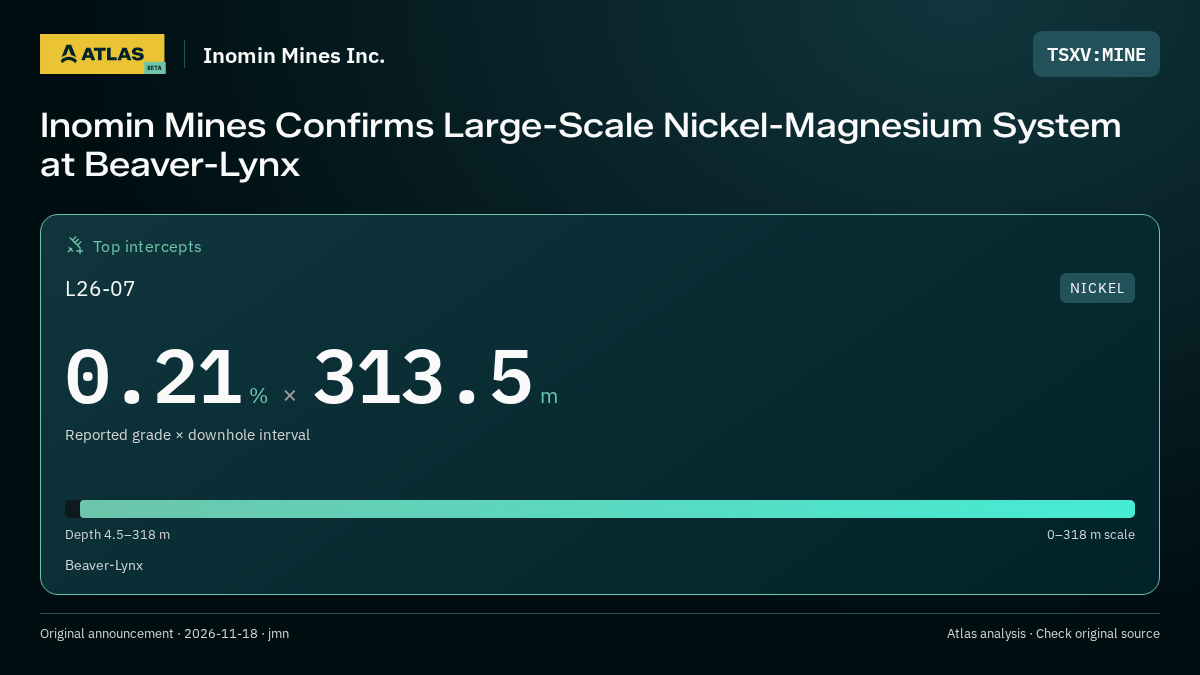
Inomin Mines has reported significant drill results from its maiden program at the Onuki Zone of the Beaver-Lynx project, confirming a large-scale nickel-magnesium system. The results include a 313.5 metre intercept grading 0.21% nickel and 21.84% magnesium, expanding the discovery footprint to approximately 1,000 metres along strike.
Reasoning: The maiden drilling at the Onuki Zone successfully confirmed a large-scale nickel-magnesium system, expanding the discovery footprint and identifying a second trend.
Positive factors
- Large-scale mineralization confirmed
- Discovery footprint expanded to 1km
- 100% hit rate in inaugural drilling
- Strong strategic funding from Sumitomo
Negative factors
- True widths not yet calculated
Facts used in scoring: 2
Classification and evidence
Step-Out Extensionpositive
Mineralization extended beyond the previously known limit.
Why it applies: The results enlarge the Onuki discovery footprint to approximately one kilometre along strike.
Evidence · text
“enlarge the Onuki discovery footprint to approximately one kilometre along strike”
QA/QC Disclosedpositive
Release includes QA/QC disclosure — certified lab, QP sign-off, or stated methods (blanks, standards, duplicates).
Why it applies: The release mentions industry standard QAQC protocols including blanks and standards, and names an ISO 17025-certified lab.
Evidence · text
“Industry standard QAQC protocols were followed, including the custody of the core, the insertion of blanks and standards”
Apparent Width Onlynegative
Interval given as downhole width with no true width or drill orientation — apparent width may overstate true thickness.
Why it applies: The document states that true thicknesses will be calculated once drilling density is increased.
Evidence · text
“The reported intervals are based on core length, and true thicknesses will be calculated once drilling density is increased”
Extracted facts
Stored fact records: 2. Some facts used in scoring do not have a stored record.
Drill Results (2)
L26-07Beaver-Lynx · nickelGrade: 0.21Grade Unit: %Intercept: 313.5 mView all detailsHide details
Identity
- Hole ID
- L26-07
- Project
- Beaver-Lynx
- Commodity
- nickel
- Region
- canada_bc
- Reported Region
- canada_bc
- Ticker
- MINE
Geometry
- Grade
- 0.21
- Grade Unit
- %
- Intercept
- 313.5 m
- From
- 4.5 m
- To
- 318 m
- Intercept Depth
- 4.5 m
Classification
- Program
- exploration
- Sample Type
- drill
- Group ID
- L26-07:4.5-318
- Mining Method
- unknown
Location
- Location
- Onuki Zone
- Loc. Source
- document
QA/QC
- Laboratory
- Actlabs
- QA/QC Disclosed
- Yes
- Lab Certified
- Yes
- QP Signed
- Yes
- QA/QC Methods
- standards, blanks
Review
- Needs Review
- No
- Interp. Status
- scored
- Historical
- No
Dates
- Event date
- 2026-11-18T00:00:00.000Z
Reasoning: Significant near-surface nickel intercept in a maiden program.
Positive factors
- Large intercept width
- Near-surface mineralization
Negative factors
- True width not disclosed
Evidence · text
“313.5 Metres Grading of 0.21% Nickel and 21.84% Magnesium beginning 4.5 metres From Surface”
Tags used in scoring
QA/QC Disclosedpositive
Release includes QA/QC disclosure — certified lab, QP sign-off, or stated methods (blanks, standards, duplicates).
Why it applies: qaqc_disclosed is true
Cut-off Undisclosednegative
High-grade interval reported without stating the cut-off grade used for compositing.
Why it applies: no cutoff_grade was stated
Nearology Playneutral
Value premise rests on proximity to a known deposit rather than own results.
Why it applies: proximity is offered as the value premise: "About Beaver-Lynx The 28,000-hectare Beaver-Lynx project is located approximately 50 kilometres north of Williams Lake a"
L26-07Beaver-Lynx · magnesiumGrade: 21.84Grade Unit: %Intercept: 313.5 mView all detailsHide details
Identity
- Hole ID
- L26-07
- Project
- Beaver-Lynx
- Commodity
- magnesium
- Region
- canada_bc
- Reported Region
- canada_bc
- Ticker
- MINE
Geometry
- Grade
- 21.84
- Grade Unit
- %
- Intercept
- 313.5 m
- From
- 4.5 m
- To
- 318 m
- Intercept Depth
- 4.5 m
Classification
- Program
- exploration
- Sample Type
- drill
- Group ID
- L26-07:4.5-318
- Mining Method
- unknown
Location
- Location
- Onuki Zone
- Loc. Source
- document
QA/QC
- Laboratory
- Actlabs
- QA/QC Disclosed
- Yes
- Lab Certified
- Yes
- QP Signed
- Yes
- QA/QC Methods
- standards, blanks
Review
- Needs Review
- No
- Interp. Status
- scored
- Historical
- No
Dates
- Event date
- 2026-11-18T00:00:00.000Z
Reasoning: Strong magnesium grade over a very wide interval.
Positive factors
- High magnesium grade
- Large intercept width
Negative factors
- True width not disclosed
Evidence · text
“313.5 Metres Grading of 0.21% Nickel and 21.84% Magnesium beginning 4.5 metres From Surface”
Tags used in scoring
QA/QC Disclosedpositive
Release includes QA/QC disclosure — certified lab, QP sign-off, or stated methods (blanks, standards, duplicates).
Why it applies: qaqc_disclosed is true
Cut-off Undisclosednegative
High-grade interval reported without stating the cut-off grade used for compositing.
Why it applies: no cutoff_grade was stated
Nearology Playneutral
Value premise rests on proximity to a known deposit rather than own results.
Why it applies: proximity is offered as the value premise: "About Beaver-Lynx The 28,000-hectare Beaver-Lynx project is located approximately 50 kilometres north of Williams Lake a"
How Atlas produces this analysis
Minestarters Atlas uses automated extraction to summarize mining announcements, identify reported measurements, and classify supporting evidence. Sentiment reflects the extracted narrative and classification rules; it is an interpretation, not a reported measurement. Evidence quotes and context are provided where available. Missing data, low-confidence results, and review flags indicate limitations. Check the original publisher announcement before relying on an interpretation.