
IMC Rare Earths plans deeper drilling at Brazil’s Itarantim project
Original announcement by miningtechnology on
- Company
- IMC Rare Earths
- Ticker
- Unavailable
- Exchange
- Unavailable
- Region
- Brazil
- Primary commodity
- Rare earths
- Secondary commodities
- Yttrium
- Document categories
- Other, Drill results, Metallurgy
- Extracted
- 2026-11-06 11:52:22 UTC
Analysis by Minestarters Atlas
Atlas analysis published:
Minestarters Atlas analysis
Summary
IMC Rare Earths has commenced a deeper diamond drilling programme at its Itarantim project in Brazil to investigate mineralisation depth on the Block D plateau. The company is also progressing in-situ recovery (ISR) field trials in Block A to evaluate low-cost extraction methods.
Reasoning: The announcement details the commencement of a new drilling campaign and metallurgical field trials, which are key de-risking steps for future resource assessment.
Positive factors
- Commencement of deeper drilling to verify mineralisation depth
- Expansion of field trials for in-situ recovery (ISR)
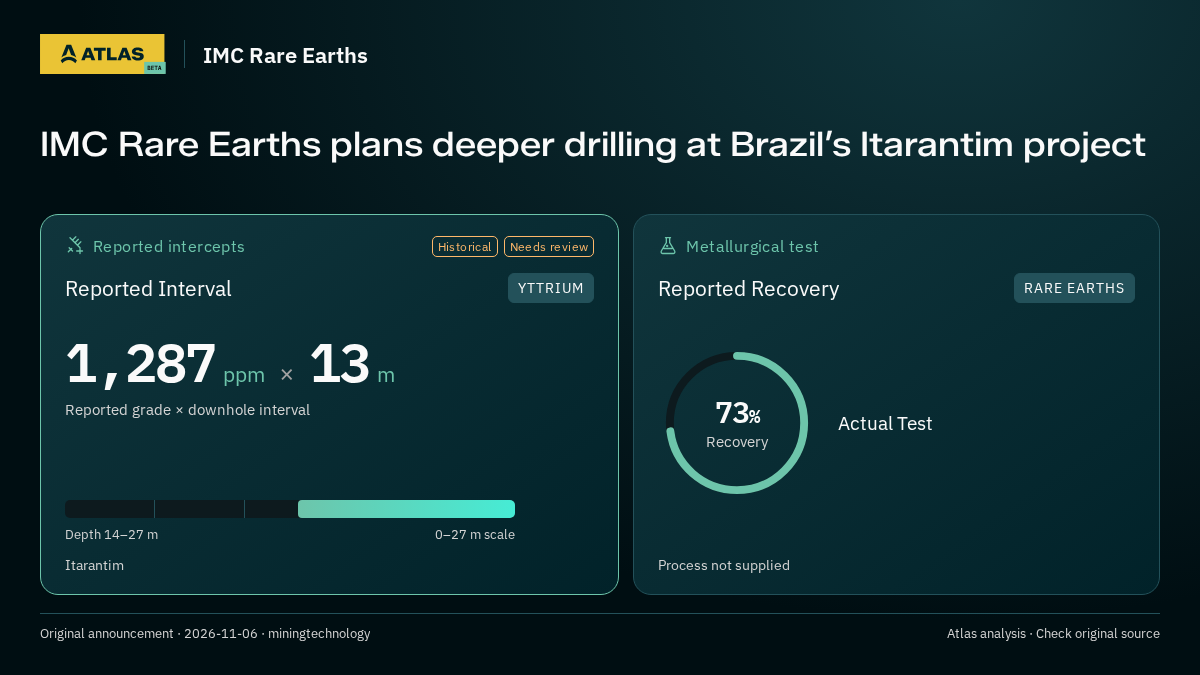
- Historical high-grade intercept reported (1,287ppm yttrium oxide)
- Successful laboratory extraction rates (73%)
Negative factors
- Drilling results are pending
Facts used in scoring: 2
Classification and evidence
Infill Drillingneutral
Confirmatory drilling to raise resource confidence, not new discovery.
Why it applies: The drilling is intended to establish extent, continuity, and grade, following previous mechanical auger drilling.
Evidence · text
“The drilling campaign is intended to establish the extent, continuity, and grade of these deposits”
Mill Routeneutral
Processing via mill or concentrator (CIL, CIP, tank leach, flotation).
Why it applies: the document describes a flotation route ("concentrate")
Single Domain Onlynegative
Testing limited to one composite or domain — representativeness not established.
Why it applies: only one composite was tested
Extracted facts
Stored fact records: 2. Some facts used in scoring do not have a stored record.
Drill Results (1)
Fact 1Itarantim · yttriumGrade: 1287Grade Unit: ppmIntercept: 13 mHistorical resultNeeds review: drill_no_hole_idView all detailsHide details
Identity
- Project
- Itarantim
- Commodity
- yttrium
- Region
- brazil
- Reported Region
- brazil
Geometry
- Grade
- 1287
- Grade Unit
- ppm
- Intercept
- 13 m
- From
- 14 m
- To
- 27 m
- Intercept Depth
- 14 m
Classification
- Sample Type
- drill
- Group ID
- Itarantim:14-27
QA/QC
- QA/QC Methods
- standards
Review
- Needs Review
- Yes
- Review Reason
- drill_no_hole_id
- Interp. Status
- scored
- Historical
- Yes
Dates
- Event date
- 2026-11-06T00:00:00.000Z
Reasoning: Historical intercept of 1,287ppm yttrium oxide over 13m is a strong indicator of mineralisation.
Positive factors
- High grade intercept
Evidence · text
“one hole returning 13m at 1,287ppm yttrium (III) oxide from 14m”
Tags used in scoring
No QA/QC Disclosurenegative
Release does not disclose QA/QC — lab certification, CP/QP sign-off and assay protocols cannot be checked from this document.
Why it applies: qaqc_disclosed is not true
Cut-off Undisclosednegative
High-grade interval reported without stating the cut-off grade used for compositing.
Why it applies: no cutoff_grade was stated
Stale Data Re-releasenegative
Historical results re-announced with no new assays or reinterpretation — low genuine novelty.
Why it applies: the fact restates a prior release
Metallurgical Results (1)
Fact 1Itarantim · rare_earthsRecovery: 73 %View all detailsHide details
Identity
- Project
- Itarantim
- Commodity
- rare_earths
- Region
- brazil
- Reported Region
- Brazil
Test Work
- Sample
- laboratory work using acidified magnesium sulphate
Recovery
- Recovery
- 73 %
- Recovery Basis
- actual_test
Review
- Needs Review
- No
- Historical
- No
Dates
- Event date
- 2026-11-06T00:00:00.000Z
Reasoning: Laboratory testing showed a 73% extraction rate for rare earth elements (excluding cerium).
Positive factors
- Solid extraction rate achieved in lab
Evidence · text
“earlier laboratory work using acidified magnesium sulphate achieved a 73% extraction rate for rare earth elements, excluding cerium”
How Atlas produces this analysis
Minestarters Atlas uses automated extraction to summarize mining announcements, identify reported measurements, and classify supporting evidence. Sentiment reflects the extracted narrative and classification rules; it is an interpretation, not a reported measurement. Evidence quotes and context are provided where available. Missing data, low-confidence results, and review flags indicate limitations. Check the original publisher announcement before relying on an interpretation.