
Goldgroup Reports Third Quarter 2026 Results: Revenue up More than 15-Fold, Cash Reaches $168 Million Following Merger and Financing
Original announcement by orestocks on
- Company
- Goldgroup Mining Inc.
- Ticker
- GORO
- Exchange
- Unavailable
- Region
- Mexico
- Primary commodity
- Gold
- Secondary commodities
- Silver, Zinc, Lead, Copper
- Document categories
- Production, Other, Metallurgy
- Extracted
- 2026-11-18 12:17:17 UTC
Analysis by Minestarters Atlas
Atlas analysis published:
Minestarters Atlas analysis
Summary
Goldgroup Mining Inc. reported strong third quarter 2026 results, highlighted by a 15-fold increase in revenue and a cash position of $168.4 million following a merger with Gold Resource Corporation and a $121.8 million private placement. The company now operates two producing gold mines in Mexico, Don David and Cerro Prieto, with increased production levels reported at both sites.
Reasoning: The company has undergone a major transformation via merger and financing, resulting in significantly higher revenue, a much stronger balance sheet, and increased production across its assets.
Positive factors
- Significant revenue growth following merger
- Substantial cash increase to $168.4 million
- Positive cash flow from operations
- Increased production at Don David and Cerro Prieto
Negative factors
- Reported net loss due to non-cash merger accounting charges
Facts used in scoring: 3
Classification and evidence
Production Increasepositive · Story-specific tag
No canonical definition is currently available.
Why it applies: Revenue grew 15-fold and gold-equivalent production doubled at Don David.
Evidence · text
“Revenue grew more than 15 times.”
Mergerpositive · Story-specific tag
No canonical definition is currently available.
Why it applies: Company completed a merger with Gold Resource Corporation on July 17, 2026.
Evidence · text
“Goldgroup completed a merger with Gold Resource Corporation.”
Single Domain Onlynegative
Testing limited to one composite or domain — representativeness not established.
Why it applies: only one composite was tested
Extracted facts
Stored fact records: 3. Some facts used in scoring do not have a stored record.
Metallurgical Results (3)
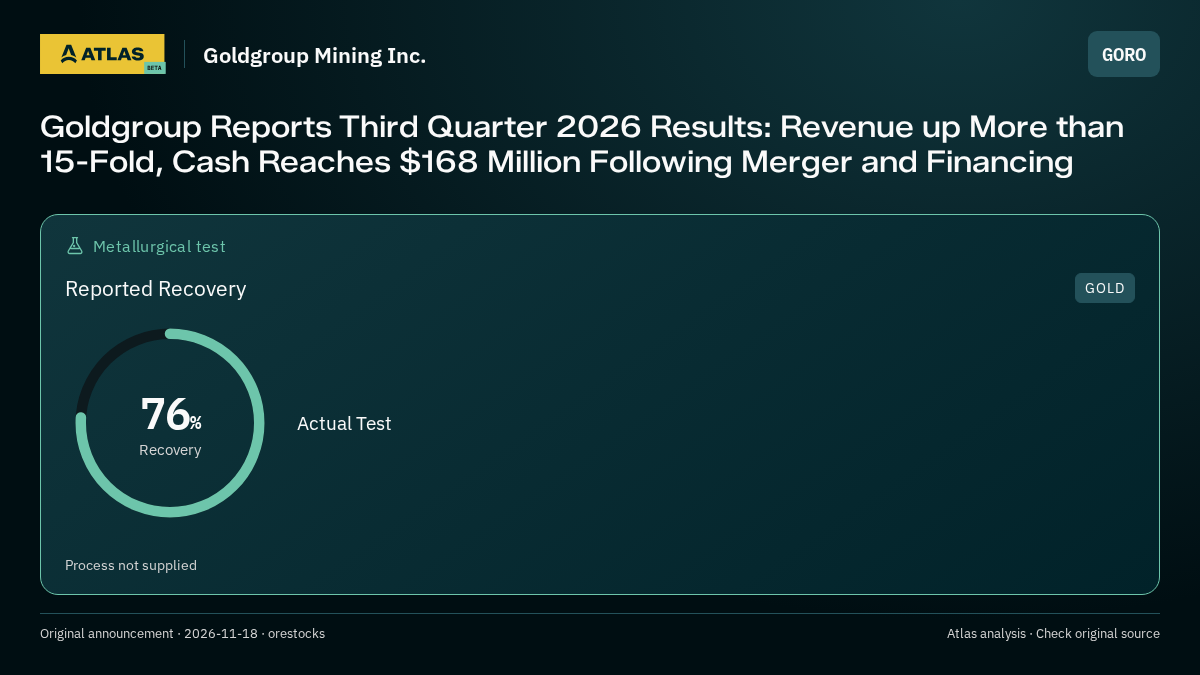
Fact 1Don David · goldRecovery: 76 %View all detailsHide details
Identity
- Project
- Don David
- Commodity
- gold
- Region
- mexico
- Reported Region
- Oaxaca, Mexico
- Ticker
- GORO
Test Work
- Sample
- Don David gold production in Q3 2026
Recovery
- Recovery
- 76 %
- Recovery Basis
- actual_test
Review
- Needs Review
- No
- Historical
- No
Dates
- Event date
- 2026-11-18T00:00:00.000Z
Reasoning: Reported gold recovery improvement at Don David.
Positive factors
- Recovery improved to 76% from 71%
Evidence · text
“Gold production rose 20% to 1,972 ounces, and gold recovery improved to 76% from 71%.”
Tags used in scoring
Low Recoverynegative
Recovery below the weak band for the commodity and processing route.
Why it applies: 76% is below the weak band (80%)
Fact 2Don David · zincView all detailsHide details
Identity
- Project
- Don David
- Commodity
- zinc
- Region
- mexico
- Reported Region
- Oaxaca, Mexico
- Ticker
- GORO
Test Work
- Sample
- Don David zinc production in Q3 2026
Review
- Needs Review
- No
- Historical
- No
Dates
- Event date
- 2026-11-18T00:00:00.000Z
Reasoning: Significant increase in zinc production at Don David.
Positive factors
- Zinc production more than doubled
Evidence · text
“Zinc production more than doubled (up 116%) to 1,698 tonnes”
Fact 3Don David · leadView all detailsHide details
Identity
- Project
- Don David
- Commodity
- lead
- Region
- mexico
- Reported Region
- Oaxaca, Mexico
- Ticker
- GORO
Test Work
- Sample
- Don David lead production in Q3 2026
Review
- Needs Review
- No
- Historical
- No
Dates
- Event date
- 2026-11-18T00:00:00.000Z
Reasoning: Significant increase in lead production at Don David.
Positive factors
- Lead production rose 131%
Evidence · text
“lead production rose 131% to 556 tonnes.”
How Atlas produces this analysis
Minestarters Atlas uses automated extraction to summarize mining announcements, identify reported measurements, and classify supporting evidence. Sentiment reflects the extracted narrative and classification rules; it is an interpretation, not a reported measurement. Evidence quotes and context are provided where available. Missing data, low-confidence results, and review flags indicate limitations. Check the original publisher announcement before relying on an interpretation.