
G88: Aurora Gold Prospect Drill Programme Scheduled
Original announcement by asx on
- Company
- Golden Mile Resources Ltd
- Ticker
- G88
- Exchange
- ASX
- Region
- Arizona
- Primary commodity
- Gold
- Secondary commodities
- Copper
- Document categories
- Other, Drill results
- Extracted
- 2026-11-15 23:14:26 UTC
Analysis by Minestarters Atlas
Atlas analysis published:
Minestarters Atlas analysis
Summary
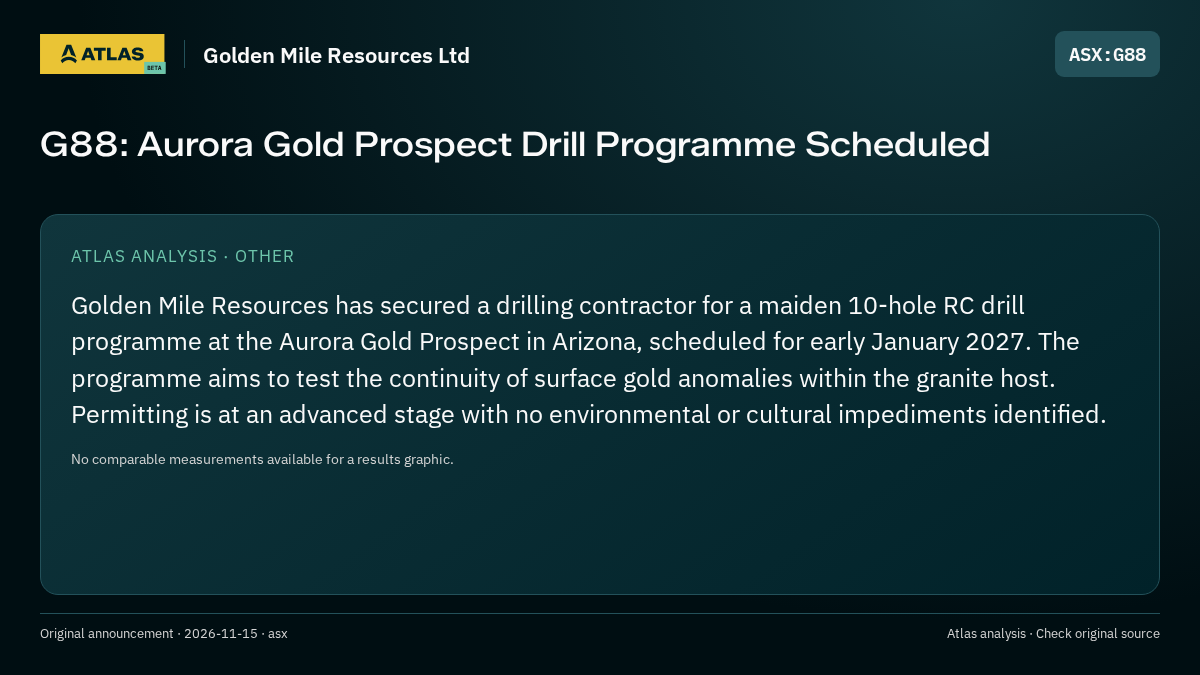
Golden Mile Resources has secured a drilling contractor for a maiden 10-hole RC drill programme at the Aurora Gold Prospect in Arizona, scheduled for early January 2027. The programme aims to test the continuity of surface gold anomalies within the granite host. Permitting is at an advanced stage with no environmental or cultural impediments identified.
Reasoning: The announcement marks a significant milestone by securing a contractor for the maiden drill programme at a virgin gold target, moving the project from surface sampling to testing vertical geometry.
Positive factors
- drilling contractor secured
- mobilisation scheduled for early 2027
- permitting at advanced stage
- surface sampling confirms gold anomaly
Negative factors
- subject to final permitting
Facts used in scoring: 5
Classification and evidence
Nearology Playneutral
Value premise rests on proximity to a known deposit rather than own results.
Why it applies: The Aurora Prospect is described as being part of the broader Pearl Project, located near the San Manuel-Kalamazoo copper mine.
Evidence · text
“immediately north of BHP’s San Manuel-Kalamazoo copper mine”
Extracted facts
Stored fact records: 0. Some facts used in scoring do not have a stored record.
No stored fact records are available for this extraction.
How Atlas produces this analysis
Minestarters Atlas uses automated extraction to summarize mining announcements, identify reported measurements, and classify supporting evidence. Sentiment reflects the extracted narrative and classification rules; it is an interpretation, not a reported measurement. Evidence quotes and context are provided where available. Missing data, low-confidence results, and review flags indicate limitations. Check the original publisher announcement before relying on an interpretation.