
Foremost Clean Energy Discovers Uranium Mineralization During Inaugural Drill Program at Turkey Lake
Original announcement by globenewswire on
- Company
- Foremost Clean Energy Ltd.
- Ticker
- FMST
- Exchange
- Unavailable
- Region
- northern Saskatchewan
- Primary commodity
- Uranium
- Secondary commodities
- None reported
- Document categories
- Drill results, Other
- Extracted
- 2026-11-18 00:36:15 UTC
Analysis by Minestarters Atlas
Atlas analysis published:
Minestarters Atlas analysis
Summary
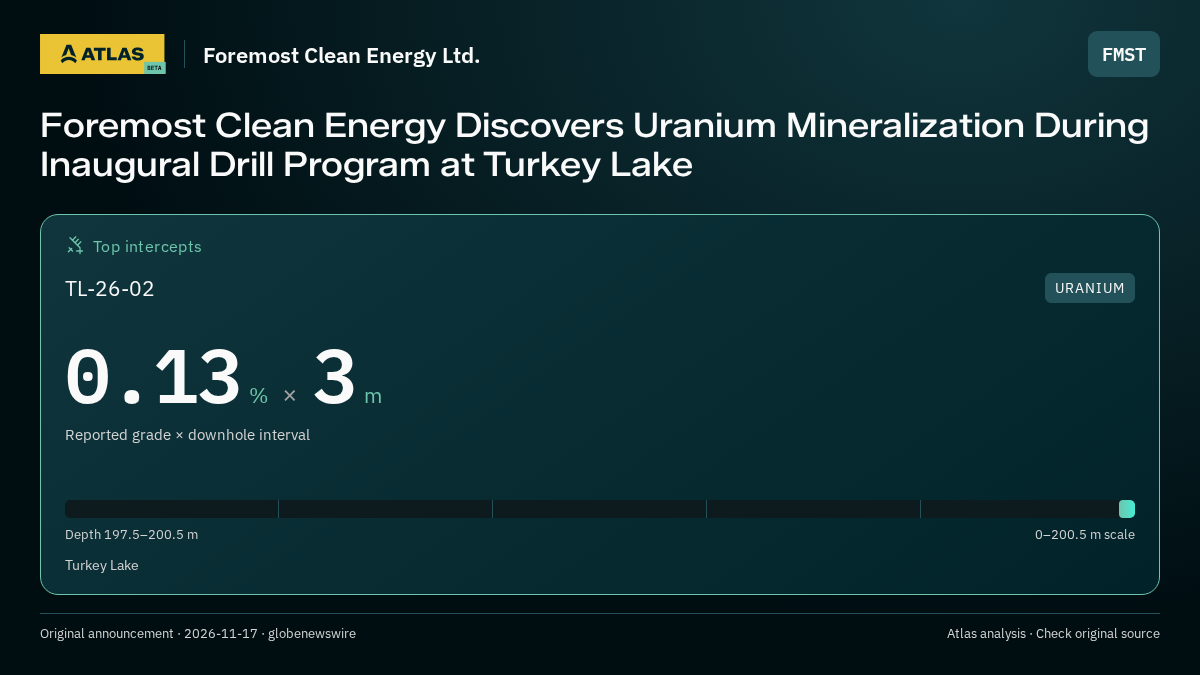
Foremost Clean Energy has discovered basement-hosted uranium mineralization at its Turkey Lake project in northern Saskatchewan during its inaugural drill program. Drill hole TL-26-02 returned a radiometric equivalent intercept of 0.13% eU3O8 over 3.0 metres, identifying a new mineralized trend outside of historical conductive zones.
Reasoning: The company reported its first discovery of uranium mineralization at Turkey Lake, though results are currently based on radiometric data rather than chemical assays.
Positive factors
- discovery of basement-hosted uranium mineralization
- intersection of a new mineralized trend outside historical conductors
- supports exploration concept of gravity low targets
Negative factors
- results are radiometric equivalent and pending chemical assays
- equipment failure prevented downhole gamma probe data for TL-26-03 and TL-26-04
- core loss in TL-26-03 near anomalous interval
Facts used in scoring: 2
Classification and evidence
QA/QC Disclosedpositive
Release includes QA/QC disclosure — certified lab, QP sign-off, or stated methods (blanks, standards, duplicates).
Why it applies: Release mentions insertion of control samples at 5% frequency and use of SRC laboratory.
Evidence · text
“Quality assurance and quality control procedures include the insertion of control samples at a frequency of approximately 5%.”
Apparent Width Onlynegative
Interval given as downhole width with no true width or drill orientation — apparent width may overstate true thickness.
Why it applies: Reported mineralized intervals represent downhole lengths and true widths have not been determined.
Evidence · text
“Reported mineralized intervals represent downhole lengths, and true widths have not been determined.”
Extracted facts
Stored fact records: 2. Some facts used in scoring do not have a stored record.
Drill Results (2)
TL-26-02Turkey Lake · uraniumGrade: 0.13Grade Unit: %Intercept: 3 mView all detailsHide details
Identity
- Hole ID
- TL-26-02
- Project
- Turkey Lake
- Commodity
- uranium
- Region
- canada_sk
- Reported Region
- canada_sk
- Ticker
- FMST
Geometry
- Grade
- 0.13
- Grade Unit
- %
- Intercept
- 3 m
- From
- 197.5 m
- To
- 200.5 m
- Intercept Depth
- 197.5 m
Classification
- Program
- exploration
- Sample Type
- drill
- Group ID
- TL-26-02:197.5-200.5
QA/QC
- Laboratory
- Saskatchewan Research Council (SRC) Geoanalytical Laboratories
- QA/QC Disclosed
- Yes
- QP Signed
- Yes
- QA/QC Methods
- standards
Compositing
- Cutoff Grade
- 0.05
- Cutoff Unit
- % eU3O8
- Dilution Disclosed
- Yes
- Max Dilution
- 0.4 m
Review
- Needs Review
- No
- Interp. Status
- scored
- Historical
- No
Dates
- Event date
- 2026-11-17T00:00:00.000Z
Reasoning: First discovery intercept at the project.
Positive factors
- discovery intercept
Negative factors
- radiometric equivalent only
- chemical assays pending
Evidence · text
“TL-26-02 intersected 0.13% eU3O8 over 3.0 metres”
Tags used in scoring
QA/QC Disclosedpositive
Release includes QA/QC disclosure — certified lab, QP sign-off, or stated methods (blanks, standards, duplicates).
Why it applies: qaqc_disclosed is true
Compositing Transparentpositive
Cut-off grade and internal dilution rules are clearly stated for reported intervals.
Why it applies: cutoff_grade and internal dilution are both stated
Nearology Playneutral
Value premise rests on proximity to a known deposit rather than own results.
Why it applies: proximity is offered as the value premise: "Basement-hosted uranium discovery in TL-26-02 Drill hole TL-26-02 returned 0.13% eU₃O₈ over 3.0 metres from 197.5 to 200"
TL-26-02Turkey Lake · uraniumGrade: 0.29Grade Unit: %Intercept: 0.5 mView all detailsHide details
Identity
- Hole ID
- TL-26-02
- Project
- Turkey Lake
- Commodity
- uranium
- Region
- canada_sk
- Reported Region
- canada_sk
- Ticker
- FMST
Geometry
- Grade
- 0.29
- Grade Unit
- %
- Intercept
- 0.5 m
- From
- 197.7 m
- To
- 198.2 m
- Intercept Depth
- 197.5 m
Classification
- Program
- exploration
- Sample Type
- drill
- Group ID
- TL-26-02:197.7-198.2
QA/QC
- Laboratory
- Saskatchewan Research Council (SRC) Geoanalytical Laboratories
- QA/QC Disclosed
- Yes
- QP Signed
- Yes
- QA/QC Methods
- standards
Compositing
- Cutoff Grade
- 0.05
- Cutoff Unit
- % eU3O8
- Dilution Disclosed
- Yes
- Max Dilution
- 0.4 m
Review
- Needs Review
- No
- Interp. Status
- scored
- Historical
- No
Dates
- Event date
- 2026-11-17T00:00:00.000Z
Reasoning: High-grade sub-interval within the discovery intercept.
Positive factors
- higher-grade subinterval
Negative factors
- radiometric equivalent only
Evidence · text
“including 0.29% eU3O8 over 0.5 metres”
Tags used in scoring
QA/QC Disclosedpositive
Release includes QA/QC disclosure — certified lab, QP sign-off, or stated methods (blanks, standards, duplicates).
Why it applies: qaqc_disclosed is true
Compositing Transparentpositive
Cut-off grade and internal dilution rules are clearly stated for reported intervals.
Why it applies: cutoff_grade and internal dilution are both stated
Nearology Playneutral
Value premise rests on proximity to a known deposit rather than own results.
Why it applies: proximity is offered as the value premise: "Basement-hosted uranium discovery in TL-26-02 Drill hole TL-26-02 returned 0.13% eU₃O₈ over 3.0 metres from 197.5 to 200"
How Atlas produces this analysis
Minestarters Atlas uses automated extraction to summarize mining announcements, identify reported measurements, and classify supporting evidence. Sentiment reflects the extracted narrative and classification rules; it is an interpretation, not a reported measurement. Evidence quotes and context are provided where available. Missing data, low-confidence results, and review flags indicate limitations. Check the original publisher announcement before relying on an interpretation.