
First Atlantic’s Awaruite Concentrate Achieves 98% Nickel and 82% Cobalt Extraction in 20 Minutes Using New Cerium Refining Technology
Original announcement by resourceworld on
- Company
- First Atlantic Nickel & Cobalt Corp.
- Ticker
- FAN
- Exchange
- Unavailable
- Region
- Newfoundland and Labrador
- Primary commodity
- Nickel
- Secondary commodities
- Cobalt, Iron ore
- Document categories
- Metallurgy
- Extracted
- 2026-11-18 16:24:49 UTC
Analysis by Minestarters Atlas
Atlas analysis published:
Minestarters Atlas analysis
Summary
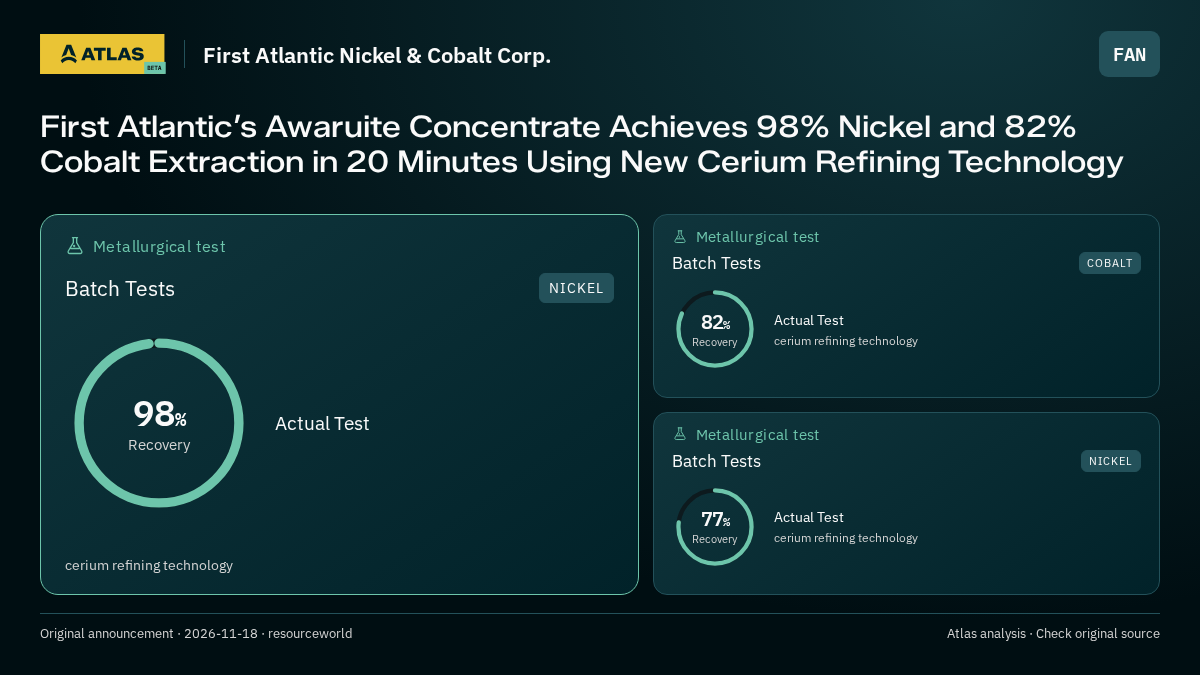
First Atlantic announced peer-reviewed research from Columbia University demonstrating 98% nickel and 82% cobalt extraction from its Pipestone XL awaruite concentrate in just 20 minutes. The new cerium refining technology operates at room temperature, avoids smelting and sulfuric acid, and uses a recyclable cerium solution.
Reasoning: The announcement reports exceptional metallurgical recovery results for nickel and cobalt using a novel, low-cost, and environmentally friendly cerium refining technology, which significantly outperforms traditional sulfide leaching methods.
Positive factors
- exceptional nickel recovery of 98% in 20 minutes
- high cobalt extraction of 82%
- novel cerium refining technology avoids smelting and sulfuric acid
- closed-loop process with electrochemical regeneration
- outperforms conventional nickel sulfide leaching
Negative factors
- results are from laboratory-scale batch tests
- continuous operation and commercial scale not yet demonstrated
- cerium losses and downstream recovery not yet demonstrated
Facts used in scoring: 8
Classification and evidence
High Recoverypositive
Recovery at or above the exceptional band for the commodity and processing route.
Why it applies: 98% nickel and 82% cobalt extraction achieved in 20 minutes.
Evidence · text
“extracted 98% of the nickel and 82% of the cobalt from awaruite (Ni-Fe-Co alloy) concentrate”
Mill Routeneutral
Processing via mill or concentrator (CIL, CIP, tank leach, flotation).
Why it applies: The process uses an agitated-tank operation in a closed-loop oxidative leaching strategy.
Evidence · text
“suggests the fast awaruite leaching kinetics could be compatible with practical agitated-tank operation.”
POX/BIOX Routeneutral
Pressure or bio-oxidation for refractory ore — high CAPEX and OPEX.
Why it applies: the document describes a pox_biox route ("roasting")
Multi-Domain Testedpositive
Variability across ore domains (oxide, transition, fresh) has been addressed.
Why it applies: 2 distinct composites were tested
Extracted facts
Stored fact records: 8. Some facts used in scoring do not have a stored record.
Metallurgical Results (8)
batch testsPipestone XL Nickel-Cobalt Alloy Project · nickelRecovery: 98 %View all detailsHide details
Identity
- Project
- Pipestone XL Nickel-Cobalt Alloy Project
- Commodity
- nickel
- Region
- canada_nl
- Reported Region
- Newfoundland and Labrador
- Ticker
- FAN
Test Work
- Program Status
- preliminary
- Test Type
- batch tests
- Processing Route
- cerium refining technology
- Sample
- Pipestone XL awaruite concentrate (AWC)
- Leach Time
- 0.33 hours
Recovery
- Recovery
- 98 %
- Recovery Basis
- actual_test
Lab
- Laboratory
- Columbia University
Review
- Needs Review
- No
- Historical
- No
Dates
- Event date
- 2026-11-18T00:00:00.000Z
Reasoning: 98% recovery in 20 minutes is exceptional for this commodity and process type.
Positive factors
- exceptional recovery
- extremely rapid kinetics
Negative factors
- batch scale only
Evidence · text
“extracted 98% of the nickel and 82% of the cobalt from awaruite (Ni-Fe-Co alloy) concentrate from the Company’s Pipestone XL Nickel-Cobalt Alloy Project in 20 minutes”
Tags used in scoring
High Recoverypositive
Recovery at or above the exceptional band for the commodity and processing route.
Why it applies: 98% is at or above the exceptional band (90%)
batch testsPipestone XL Nickel-Cobalt Alloy Project · cobaltRecovery: 82 %View all detailsHide details
Identity
- Project
- Pipestone XL Nickel-Cobalt Alloy Project
- Commodity
- cobalt
- Region
- canada_nl
- Reported Region
- Newfoundland and Labrador
- Ticker
- FAN
Test Work
- Program Status
- preliminary
- Test Type
- batch tests
- Processing Route
- cerium refining technology
- Sample
- Pipestone XL awaruite concentrate (AWC)
- Leach Time
- 0.33 hours
Recovery
- Recovery
- 82 %
- Recovery Basis
- actual_test
Lab
- Laboratory
- Columbia University
Review
- Needs Review
- No
- Historical
- No
Dates
- Event date
- 2026-11-18T00:00:00.000Z
Reasoning: 82% cobalt extraction in 20 minutes is a strong result for a new technology.
Positive factors
- strong cobalt extraction
Evidence · text
“82% cobalt extraction in 20 minutes”
batch testsPipestone XL Nickel-Cobalt Alloy Project · nickelRecovery: 77 %View all detailsHide details
Identity
- Project
- Pipestone XL Nickel-Cobalt Alloy Project
- Commodity
- nickel
- Region
- canada_nl
- Reported Region
- Newfoundland and Labrador
- Ticker
- FAN
Test Work
- Program Status
- preliminary
- Test Type
- batch tests
- Processing Route
- cerium refining technology
- Sample
- Pipestone XL pre-flotation magnetic-only concentrate (AW-PF)
- Leach Time
- 0.33 hours
Recovery
- Recovery
- 77 %
- Recovery Basis
- actual_test
Lab
- Laboratory
- Columbia University
Review
- Needs Review
- No
- Historical
- No
Dates
- Event date
- 2026-11-18T00:00:00.000Z
Reasoning: 77% recovery from a pre-flotation concentrate is a solid result showing phase selectivity.
Positive factors
- good recovery from magnetite-rich material
Evidence · table
“77 %”
Context: 20 minutes
batch testsTamarack Nickel-Copper Project · nickelRecovery: 82.5 %View all detailsHide details
Identity
- Project
- Tamarack Nickel-Copper Project
- Commodity
- nickel
- Region
- minnesota
- Reported Region
- Minnesota
- Ticker
- FAN
Test Work
- Program Status
- preliminary
- Test Type
- batch tests
- Processing Route
- conventional leaching
- Sample
- Tamarack sulfide concentrate 1 (SMSU-C)
- Leach Time
- 1 hours
Recovery
- Recovery
- 82.5 %
- Recovery Basis
- actual_test
Lab
- Laboratory
- Columbia University
Review
- Needs Review
- No
- Historical
- No
Dates
- Event date
- 2026-11-18T00:00:00.000Z
Reasoning: While 82.5% is high, it took 60 minutes compared to 20 minutes for awaruite.
Negative factors
- slower kinetics
- lower recovery than awaruite
Evidence · table
“82.5%”
Context: 60 minutes
batch testsTamarack Nickel-Copper Project · nickelRecovery: 66.1 %View all detailsHide details
Identity
- Project
- Tamarack Nickel-Copper Project
- Commodity
- nickel
- Region
- minnesota
- Reported Region
- Minnesota
- Ticker
- FAN
Test Work
- Program Status
- preliminary
- Test Type
- batch tests
- Processing Route
- conventional leaching
- Sample
- Tamarack sulfide concentrate 2 (CGO-C)
- Leach Time
- 1 hours
Recovery
- Recovery
- 66.1 %
- Recovery Basis
- actual_test
Lab
- Laboratory
- Columbia University
Review
- Needs Review
- No
- Historical
- No
Dates
- Event date
- 2026-11-18T00:00:00.000Z
Reasoning: 66.1% recovery after 60 minutes is significantly lower than the awaruite results.
Negative factors
- low recovery
Evidence · table
“66.1%”
Context: 60 minutes
Tags used in scoring
Low Recoverynegative
Recovery below the weak band for the commodity and processing route.
Why it applies: 66.1% is below the weak band (75%)
batch testsTamarack Nickel-Copper Project · nickelRecovery: 70.5 %View all detailsHide details
Identity
- Project
- Tamarack Nickel-Copper Project
- Commodity
- nickel
- Region
- minnesota
- Reported Region
- Minnesota
- Ticker
- FAN
Test Work
- Program Status
- preliminary
- Test Type
- batch tests
- Processing Route
- conventional leaching
- Sample
- Tamarack high-magnesium sulfide 1 (SMSU-HM)
- Leach Time
- 1 hours
Recovery
- Recovery
- 70.5 %
- Recovery Basis
- actual_test
Lab
- Laboratory
- Columbia University
Review
- Needs Review
- No
- Historical
- No
Dates
- Event date
- 2026-11-18T00:00:00.000Z
Reasoning: 70.5% recovery after 60 minutes is mediocre compared to the awaruite benchmark.
Negative factors
- moderate recovery
Evidence · table
“70.5%”
Context: 60 minutes
Tags used in scoring
Low Recoverynegative
Recovery below the weak band for the commodity and processing route.
Why it applies: 70.5% is below the weak band (75%)
batch testsTamarack Nickel-Copper Project · nickelRecovery: 59 %View all detailsHide details
Identity
- Project
- Tamarack Nickel-Copper Project
- Commodity
- nickel
- Region
- minnesota
- Reported Region
- Minnesota
- Ticker
- FAN
Test Work
- Program Status
- preliminary
- Test Type
- batch tests
- Processing Route
- conventional leaching
- Sample
- Tamarack high-magnesium sulfide 2 (CGO-HM)
- Leach Time
- 1 hours
Recovery
- Recovery
- 59 %
- Recovery Basis
- actual_test
Lab
- Laboratory
- Columbia University
Review
- Needs Review
- No
- Historical
- No
Dates
- Event date
- 2026-11-18T00:00:00.000Z
Reasoning: 59% recovery after 60 minutes is poor.
Negative factors
- low recovery
Evidence · table
“59%”
Context: 60 minutes
Tags used in scoring
Low Recoverynegative
Recovery below the weak band for the commodity and processing route.
Why it applies: 59% is below the weak band (75%)
batch testsTamarack Nickel-Copper Project · nickelRecovery: 84 %View all detailsHide details
Identity
- Project
- Tamarack Nickel-Copper Project
- Commodity
- nickel
- Region
- minnesota
- Reported Region
- Minnesota
- Ticker
- FAN
Test Work
- Program Status
- preliminary
- Test Type
- batch tests
- Processing Route
- hot sulfuric acid pretreatment
- Sample
- Tamarack high-magnesium sulfide 1 (SMSU-HM), acid pretreated
- Leach Time
- 1 hours
Recovery
- Recovery
- 84 %
- Recovery Basis
- actual_test
Lab
- Laboratory
- Columbia University
Review
- Needs Review
- No
- Historical
- No
Dates
- Event date
- 2026-11-18T00:00:00.000Z
Reasoning: Achieves 84% recovery but requires hot sulfuric acid pretreatment, unlike the cerium process.
Positive factors
- high recovery with pretreatment
Negative factors
- requires acid pretreatment
Evidence · table
“84%”
Context: 60 minutes
How Atlas produces this analysis
Minestarters Atlas uses automated extraction to summarize mining announcements, identify reported measurements, and classify supporting evidence. Sentiment reflects the extracted narrative and classification rules; it is an interpretation, not a reported measurement. Evidence quotes and context are provided where available. Missing data, low-confidence results, and review flags indicate limitations. Check the original publisher announcement before relying on an interpretation.