
Electra Advances North American Nickel Strategy, Expanding pCAM Collaboration with Positive Materials
Original announcement by orestocks on
- Company
- Electra Battery Materials Corporation
- Ticker
- ELBM
- Exchange
- Unavailable
- Region
- North America
- Primary commodity
- Nickel
- Secondary commodities
- Cobalt, Lithium, Graphite
- Document categories
- Agreement transaction, Other, Metallurgy
- Extracted
- 2026-11-17 13:36:17 UTC
Analysis by Minestarters Atlas
Atlas analysis published:
Minestarters Atlas analysis
Summary
Electra Battery Materials has expanded its Supply Chain Cooperation Agreement with Positive Materials to include future production of battery-grade nickel sulfate and nickel metal. This collaboration aims to align Electra's proposed North American nickel refinery with Positive's planned pCAM facility to support integrated regional supply chains.
Reasoning: The expansion of a supply chain agreement with a downstream partner (Positive Materials) de-risks the commercial pathway for Electra's proposed nickel refinery.
Positive factors
- Expansion of existing supply chain collaboration
- Strategic alignment with downstream pCAM manufacturer
- Integration of nickel and cobalt into the commercial framework
- Potential for integrated North American supply chain
Negative factors
- Project remains in engineering/preliminary stage
- Future production is potential/proposed, not yet operational
Facts used in scoring: 2
Classification and evidence
Nearology Playneutral · Story-specific tag
Value premise rests on proximity to a known deposit rather than own results.
Why it applies: The strategy focuses on connecting refining with downstream pCAM production in North America.
Evidence · text
“The companies will collaborate to ensure Electra’s battery-grade nickel and cobalt products are compatible with Positive’s planned high-energy and high-power pCAM facility”
Single Domain Onlynegative
Testing limited to one composite or domain — representativeness not established.
Why it applies: only one composite was tested
Extracted facts
Stored fact records: 2. Some facts used in scoring do not have a stored record.
Metallurgical Results (2)
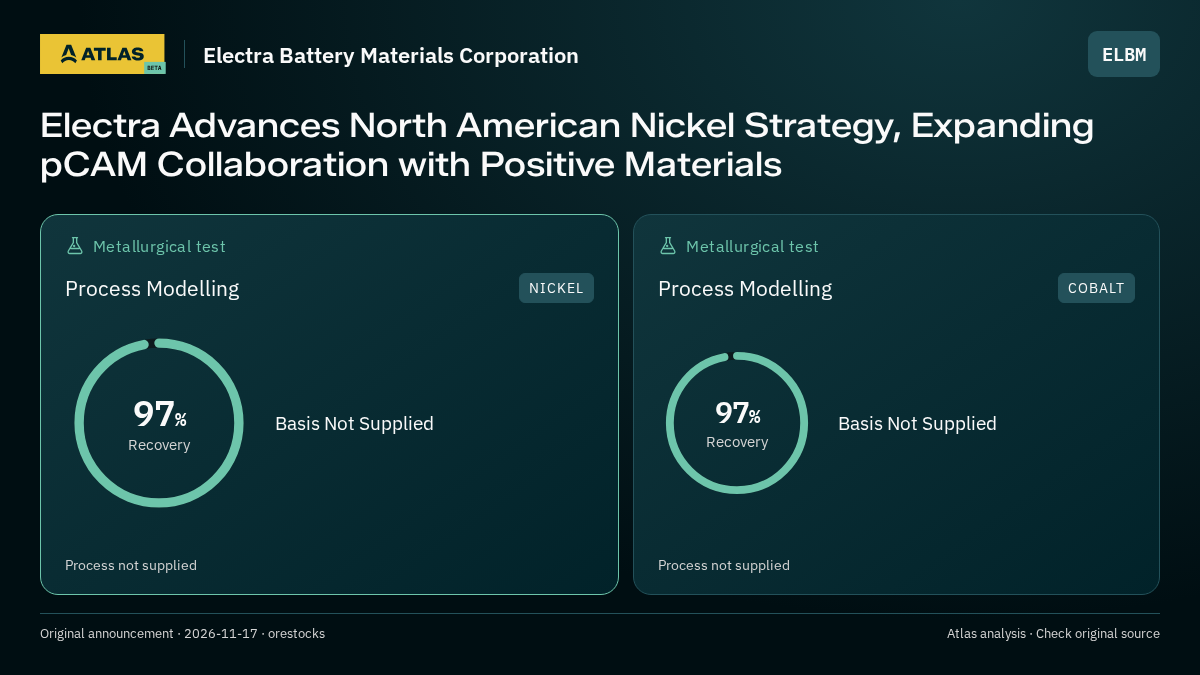
process modellingNorth American nickel refinery · nickelRecovery: 97 %View all detailsHide details
Identity
- Project
- North American nickel refinery
- Commodity
- nickel
- Region
- north america
- Reported Region
- North America
- Ticker
- ELBM
Test Work
- Program Status
- preliminary
- Test Type
- process modelling
- Sample
- proposed nickel refinery phase 1 (mine-derived feedstock)
Recovery
- Recovery
- 97 %
Review
- Needs Review
- No
- Historical
- No
Dates
- Event date
- 2026-11-17T00:00:00.000Z
Reasoning: 97% recovery is a strong technical indicator for the proposed refinery process.
Positive factors
- High projected recovery
Negative factors
- Based on preliminary process modelling
Evidence · text
“preliminary process modelling indicating nickel and cobalt recoveries of 97% or higher”
Tags used in scoring
High Recoverypositive
Recovery at or above the exceptional band for the commodity and processing route.
Why it applies: 97% is at or above the exceptional band (90%)
process modellingNorth American nickel refinery · cobaltRecovery: 97 %View all detailsHide details
Identity
- Project
- North American nickel refinery
- Commodity
- cobalt
- Region
- north america
- Reported Region
- North America
- Ticker
- ELBM
Test Work
- Program Status
- preliminary
- Test Type
- process modelling
- Sample
- proposed nickel refinery phase 1 (mine-derived feedstock)
Recovery
- Recovery
- 97 %
Review
- Needs Review
- No
- Historical
- No
Dates
- Event date
- 2026-11-17T00:00:00.000Z
Reasoning: 97% recovery is a strong technical indicator for the proposed refinery process.
Positive factors
- High projected recovery
Negative factors
- Based on preliminary process modelling
Evidence · text
“preliminary process modelling indicating nickel and cobalt recoveries of 97% or higher”
How Atlas produces this analysis
Minestarters Atlas uses automated extraction to summarize mining announcements, identify reported measurements, and classify supporting evidence. Sentiment reflects the extracted narrative and classification rules; it is an interpretation, not a reported measurement. Evidence quotes and context are provided where available. Missing data, low-confidence results, and review flags indicate limitations. Check the original publisher announcement before relying on an interpretation.