
CRI: Jupiter Metallurgical Testwork Advances Gallium & Scandium
Original announcement by asx on
- Company
- Critica Limited
- Ticker
- CRI
- Exchange
- ASX
- Region
- Western Australia
- Primary commodity
- Unavailable
- Secondary commodities
- None reported
- Document categories
- Metallurgy, Resource update
- Extracted
- 2026-11-08 22:27:17 UTC
Analysis by Minestarters Atlas
Atlas analysis published:
Minestarters Atlas analysis
Summary
Critica Limited announced significant progress in metallurgical testwork for its Jupiter Rare Earth Elements Project in Western Australia, achieving up to 91.9% gallium and 84.7% scandium extraction into solution. These results materially advance the potential recovery pathway for these strategic critical minerals, which are not currently valued in the project's A$2.0 billion NPV Scoping Study. Further downstream testwork is underway to assess final product recovery and separation.
Reasoning: Critica Limited reported strong metallurgical extraction results for gallium (up to 91.9%) and scandium (up to 84.7%) into the pregnant leach solution from its Jupiter Rare Earth Elements Project. These results represent a material improvement for gallium from previously reported figures and highlight potential new value streams for critical minerals not yet incorporated into the project's economic studies. While promising, the results are for extraction into solution, and further downstream processing and economic viability are still aspirational.
Positive factors
- High extraction rates for gallium and scandium
- Material improvement in gallium extraction from previous results
- Potential for new value streams not included in current NPV
- Gallium and scandium are critical minerals with strategic applications
- JORC compliant reporting for resource information
Negative factors
- Extraction into solution, not final product recovery
- Economic viability of by-products is aspirational and not yet confirmed
- Downstream testwork for separation and purification is still preliminary
- Resource information for gallium and scandium is based on existing, not new, estimates
Facts used in scoring: 19
Classification and evidence
High Recoverypositive
Recovery at or above the exceptional band for the commodity and processing route.
Why it applies: Gallium extraction achieved up to 91.9% and scandium up to 84.7%, which are strong results for by-product extraction into solution.
Evidence · text
“Up to 91.9% gallium and 84.7% scandium extraction achieved”
Recovery Improvingpositive
Recovery improved versus a like-for-like prior test program on the same domain and route.
Why it applies: Gallium extraction materially improved from ~63% previously reported to up to 91.9% in current testwork.
Evidence · text
“Gallium extraction materially improved from ~63% previously reported.”
Bench Scale Onlynegative
Only preliminary bench tests completed — no locked-cycle or pilot work.
Why it applies: The testwork involves preliminary resin adsorption trials and is focused on extraction into solution, not final product recovery, indicating an early stage of metallurgical development.
Evidence · text
“Downstream recovery from the pregnant leach solution is the focus of the next stages of testwork.”
Refractory Orenegative
Ore requires oxidation/pressure treatment before recovery — a processing and recovery risk.
Why it applies: The processing route involves acid baking and subsequent water leaching, which is often used for refractory or complex ores to liberate metals.
Evidence · text
“As part of the acid baking and subsequent water leaching stages of the Jupiter hydrometallurgical flowsheet, gallium and scandium are extracted into the pregnant leach solution (PLS)”
Single Domain Onlynegative
Testing limited to one composite or domain — representativeness not established.
Why it applies: The metallurgical composite used for testwork is from the iron-clay mineralisation type, which is only one of four dominant mineralisation types at Jupiter, indicating limited domain coverage.
Evidence · text
“The QTC sample is a composite of the iron-clay mineralisation type which has formed part of ongoing bulk-flotation and hydrometallurgical test work programs... The iron-clay mineralisation type is one of four dominant mineralisation types at Jupiter.”
Indicated Resourcepositive
Reasonable geological confidence based on adequate drilling; continuity can be assumed. Basis for Probable Reserves.
Why it applies: The document reports gallium and scandium content within the Indicated Mineral Resource classification.
Evidence · table
“Indicated”
Context: 160 Mt
Inferred Resourcenegative
Speculative category — limited drilling, geological continuity assumed but not confirmed. Cannot support economic studies alone.
Why it applies: The document reports gallium and scandium content within the Inferred Mineral Resource classification.
Evidence · table
“Inferred”
Context: 1.5 Bt
QP/CP Signedpositive
Qualified Person (QP) or Competent Person (CP) named and signed off — a member of a recognized professional association (e.g., AusIMM, SME, AIG, P.Geo) with relevant experience.
Why it applies: The metallurgical testwork and resource information are based on work compiled by Dr. Stuart Owen, a Member of the Australian Institute of Geoscientists, who qualifies as a Competent Person under JORC Code.
Evidence · text
“The information in this report that relates to exploration results including geological interpretation, data preparation and data quality, and the metallurgical testwork and results reported for the Jupiter Project, is based on work compiled by Dr. Stuart Owen who is a Member of the Australian Institute of Geoscientists.”
JORC Compliantpositive
Resource estimate prepared in compliance with JORC Code (Australia) — high reporting standard.
Why it applies: The metallurgical testwork and resource information are reported in accordance with the JORC Code (2012 Edition).
Evidence · text
“Competent Person as defined in the 2012 Edition of the Australasian Code for Reporting of Exploration Results, Mineral Resources and Ore Reserves (JORC Code).”
Stale Data Re-releasenegative · Story-specific tag
Historical results re-announced with no new assays or reinterpretation — low genuine novelty.
Why it applies: The gallium and scandium resource content is based on existing Mineral Resource estimates, with no new resource information contained in this report.
Evidence · text
“No new Mineral Resource information is contained in this report.”
Mill Routeneutral
Processing via mill or concentrator (CIL, CIP, tank leach, flotation).
Why it applies: the document describes a flotation route ("flotation")
Multi-Domain Testedpositive
Variability across ore domains (oxide, transition, fresh) has been addressed.
Why it applies: 2 distinct composites were tested
Extracted facts
Stored fact records: 19. Some facts used in scoring do not have a stored record.
Resource Estimates (4)
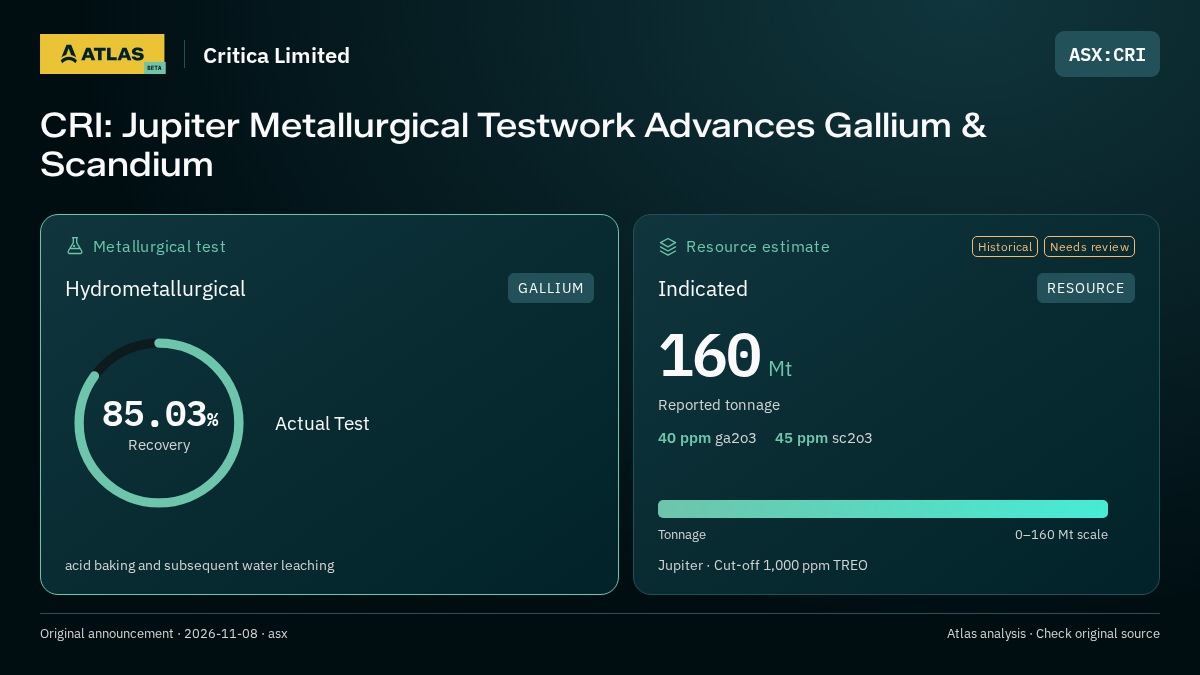
indicatedJupiter · ga2o3Tonnes: 160000000Grade: 40Grade Unit: ppmContained Metal: 6400Contained Unit: tHistorical resultNeeds review: historical_restatementView all detailsHide details
Identity
- Project
- Jupiter
- Commodity
- ga2o3
- Region
- australia_wa
- Reported Region
- Western Australia
- Ticker
- CRI
Resource scope
- Estimate type
- resource
- Reporting standards
- jorc
- QP Signed
- Yes
- Qualified person names
- Dr Stuart Owen, Dr Natalee Bonnici, Mr Rodney Brown
- Resource group id
- resource:052d917b2bbaf78a3303
- Ownership percent
- 100 %
Resource Data
- Category
- indicated
- Tonnes
- 160000000
- Grade
- 40
- Grade Unit
- ppm
- Contained Metal
- 6400
- Contained Unit
- t
- Cutoff Grade
- 1000
- Cutoff Unit
- ppm TREO
Prior Estimate
- Resource Date
- 2026-10-20
Review
- Needs Review
- Yes
- Review Reason
- historical_restatement
- Historical
- Yes
- Historical Source Date
- 2026-10-20T00:00:00.000Z
Dates
- Event date
- 2026-11-08T00:00:00.000Z
Reasoning: Reports the contained Ga₂O₃ within the existing Jupiter Indicated Mineral Resource, highlighting potential additional value streams for a critical mineral.
Positive factors
- Significant contained tonnage of a critical mineral in Indicated category
- JORC compliant and QP signed
Negative factors
- Gallium not currently valued in economic studies
- Resource is previously reported, not new information
Evidence · table
“40 ppm”
Context: 160 Mt
Tags used in scoring
Indicated Resourcepositive
Reasonable geological confidence based on adequate drilling; continuity can be assumed. Basis for Probable Reserves.
Why it applies: category is "indicated"
Cut-off Disclosedpositive
Cut-off grade used for resource reporting is clearly stated, enabling like-for-like comparison.
Why it applies: cutoff_grade is stated
QP/CP Signedpositive
Qualified Person (QP) or Competent Person (CP) named and signed off — a member of a recognized professional association (e.g., AusIMM, SME, AIG, P.Geo) with relevant experience.
Why it applies: qp_signed is true
JORC Compliantpositive
Resource estimate prepared in compliance with JORC Code (Australia) — high reporting standard.
Why it applies: reporting_standards includes jorc
PEA-Supportingneutral
Resource estimate prepared to support a Preliminary Economic Assessment — early-stage study.
Why it applies: the release names the study this estimate supports
PFS-Supportingneutral
Resource estimate prepared to support a Pre-Feasibility Study — requires adequate M&I component.
Why it applies: the release names the study this estimate supports
DFS-Supportingneutral
Resource estimate prepared to support a Definitive Feasibility Study — requires high M&I confidence.
Why it applies: the release names the study this estimate supports
indicatedJupiter · sc2o3Tonnes: 160000000Grade: 45Grade Unit: ppmContained Metal: 7200Contained Unit: tHistorical resultNeeds review: historical_restatementView all detailsHide details
Identity
- Project
- Jupiter
- Commodity
- sc2o3
- Region
- australia_wa
- Reported Region
- Western Australia
- Ticker
- CRI
Resource scope
- Estimate type
- resource
- Reporting standards
- jorc
- QP Signed
- Yes
- Qualified person names
- Dr Stuart Owen, Dr Natalee Bonnici, Mr Rodney Brown
- Resource group id
- resource:052d917b2bbaf78a3303
- Ownership percent
- 100 %
Resource Data
- Category
- indicated
- Tonnes
- 160000000
- Grade
- 45
- Grade Unit
- ppm
- Contained Metal
- 7200
- Contained Unit
- t
- Cutoff Grade
- 1000
- Cutoff Unit
- ppm TREO
Prior Estimate
- Resource Date
- 2026-10-20
Review
- Needs Review
- Yes
- Review Reason
- historical_restatement
- Historical
- Yes
- Historical Source Date
- 2026-10-20T00:00:00.000Z
Dates
- Event date
- 2026-11-08T00:00:00.000Z
Reasoning: Reports the contained Sc₂O₃ within the existing Jupiter Indicated Mineral Resource, highlighting potential additional value streams for a critical mineral.
Positive factors
- Significant contained tonnage of a critical mineral in Indicated category
- JORC compliant and QP signed
Negative factors
- Scandium not currently valued in economic studies
- Resource is previously reported, not new information
Evidence · table
“45 ppm”
Context: 160 Mt
Tags used in scoring
Indicated Resourcepositive
Reasonable geological confidence based on adequate drilling; continuity can be assumed. Basis for Probable Reserves.
Why it applies: category is "indicated"
Cut-off Disclosedpositive
Cut-off grade used for resource reporting is clearly stated, enabling like-for-like comparison.
Why it applies: cutoff_grade is stated
QP/CP Signedpositive
Qualified Person (QP) or Competent Person (CP) named and signed off — a member of a recognized professional association (e.g., AusIMM, SME, AIG, P.Geo) with relevant experience.
Why it applies: qp_signed is true
JORC Compliantpositive
Resource estimate prepared in compliance with JORC Code (Australia) — high reporting standard.
Why it applies: reporting_standards includes jorc
PEA-Supportingneutral
Resource estimate prepared to support a Preliminary Economic Assessment — early-stage study.
Why it applies: the release names the study this estimate supports
PFS-Supportingneutral
Resource estimate prepared to support a Pre-Feasibility Study — requires adequate M&I component.
Why it applies: the release names the study this estimate supports
DFS-Supportingneutral
Resource estimate prepared to support a Definitive Feasibility Study — requires high M&I confidence.
Why it applies: the release names the study this estimate supports
inferredJupiter · ga2o3Tonnes: 1500000000Grade: 40Grade Unit: ppmContained Metal: 60000Contained Unit: tHistorical resultNeeds review: historical_restatementView all detailsHide details
Identity
- Project
- Jupiter
- Commodity
- ga2o3
- Region
- australia_wa
- Reported Region
- Western Australia
- Ticker
- CRI
Resource scope
- Estimate type
- resource
- Reporting standards
- jorc
- QP Signed
- Yes
- Qualified person names
- Dr Stuart Owen, Dr Natalee Bonnici, Mr Rodney Brown
- Resource group id
- resource:f182eb5767f0c15b5f2f
- Ownership percent
- 100 %
Resource Data
- Category
- inferred
- Tonnes
- 1500000000
- Grade
- 40
- Grade Unit
- ppm
- Contained Metal
- 60000
- Contained Unit
- t
- Cutoff Grade
- 1000
- Cutoff Unit
- ppm TREO
Prior Estimate
- Resource Date
- 2026-10-20
Review
- Needs Review
- Yes
- Review Reason
- historical_restatement
- Historical
- Yes
- Historical Source Date
- 2026-10-20T00:00:00.000Z
Dates
- Event date
- 2026-11-08T00:00:00.000Z
Reasoning: Reports the contained Ga₂O₃ within the existing Jupiter Inferred Mineral Resource, highlighting potential additional value streams for a critical mineral, though with lower confidence.
Positive factors
- Large contained tonnage of a critical mineral
- JORC compliant and QP signed
Negative factors
- Gallium not currently valued in economic studies
- Resource is previously reported, not new information
- Inferred category has lower geological confidence
Evidence · table
“40 ppm”
Context: 1.5 Bt
Tags used in scoring
Inferred Resourcenegative
Speculative category — limited drilling, geological continuity assumed but not confirmed. Cannot support economic studies alone.
Why it applies: category is "inferred"
Cut-off Disclosedpositive
Cut-off grade used for resource reporting is clearly stated, enabling like-for-like comparison.
Why it applies: cutoff_grade is stated
QP/CP Signedpositive
Qualified Person (QP) or Competent Person (CP) named and signed off — a member of a recognized professional association (e.g., AusIMM, SME, AIG, P.Geo) with relevant experience.
Why it applies: qp_signed is true
JORC Compliantpositive
Resource estimate prepared in compliance with JORC Code (Australia) — high reporting standard.
Why it applies: reporting_standards includes jorc
PEA-Supportingneutral
Resource estimate prepared to support a Preliminary Economic Assessment — early-stage study.
Why it applies: the release names the study this estimate supports
PFS-Supportingneutral
Resource estimate prepared to support a Pre-Feasibility Study — requires adequate M&I component.
Why it applies: the release names the study this estimate supports
DFS-Supportingneutral
Resource estimate prepared to support a Definitive Feasibility Study — requires high M&I confidence.
Why it applies: the release names the study this estimate supports
inferredJupiter · sc2o3Tonnes: 1500000000Grade: 36Grade Unit: ppmContained Metal: 54000Contained Unit: tHistorical resultNeeds review: historical_restatementView all detailsHide details
Identity
- Project
- Jupiter
- Commodity
- sc2o3
- Region
- australia_wa
- Reported Region
- Western Australia
- Ticker
- CRI
Resource scope
- Estimate type
- resource
- Reporting standards
- jorc
- QP Signed
- Yes
- Qualified person names
- Dr Stuart Owen, Dr Natalee Bonnici, Mr Rodney Brown
- Resource group id
- resource:f182eb5767f0c15b5f2f
- Ownership percent
- 100 %
Resource Data
- Category
- inferred
- Tonnes
- 1500000000
- Grade
- 36
- Grade Unit
- ppm
- Contained Metal
- 54000
- Contained Unit
- t
- Cutoff Grade
- 1000
- Cutoff Unit
- ppm TREO
Prior Estimate
- Resource Date
- 2026-10-20
Review
- Needs Review
- Yes
- Review Reason
- historical_restatement
- Historical
- Yes
- Historical Source Date
- 2026-10-20T00:00:00.000Z
Dates
- Event date
- 2026-11-08T00:00:00.000Z
Reasoning: Reports the contained Sc₂O₃ within the existing Jupiter Inferred Mineral Resource, highlighting potential additional value streams for a critical mineral, though with lower confidence.
Positive factors
- Large contained tonnage of a critical mineral
- JORC compliant and QP signed
Negative factors
- Scandium not currently valued in economic studies
- Resource is previously reported, not new information
- Inferred category has lower geological confidence
Evidence · table
“36 ppm”
Context: 1.5 Bt
Tags used in scoring
Inferred Resourcenegative
Speculative category — limited drilling, geological continuity assumed but not confirmed. Cannot support economic studies alone.
Why it applies: category is "inferred"
Cut-off Disclosedpositive
Cut-off grade used for resource reporting is clearly stated, enabling like-for-like comparison.
Why it applies: cutoff_grade is stated
QP/CP Signedpositive
Qualified Person (QP) or Competent Person (CP) named and signed off — a member of a recognized professional association (e.g., AusIMM, SME, AIG, P.Geo) with relevant experience.
Why it applies: qp_signed is true
JORC Compliantpositive
Resource estimate prepared in compliance with JORC Code (Australia) — high reporting standard.
Why it applies: reporting_standards includes jorc
PEA-Supportingneutral
Resource estimate prepared to support a Preliminary Economic Assessment — early-stage study.
Why it applies: the release names the study this estimate supports
PFS-Supportingneutral
Resource estimate prepared to support a Pre-Feasibility Study — requires adequate M&I component.
Why it applies: the release names the study this estimate supports
DFS-Supportingneutral
Resource estimate prepared to support a Definitive Feasibility Study — requires high M&I confidence.
Why it applies: the release names the study this estimate supports
Metallurgical Results (15)
hydrometallurgicalJupiter · galliumRecovery: 85.03 %View all detailsHide details
Identity
- Project
- Jupiter
- Commodity
- gallium
- Region
- australia_wa
- Reported Region
- Western Australia
- Ticker
- CRI
Test Work
- Program Status
- optimization
- Test Type
- hydrometallurgical
- Processing Route
- acid baking and subsequent water leaching
- Sample
- QTC metallurgical composite from iron-clay mineralisation
Recovery
- Recovery
- 85.03 %
- Recovery Basis
- actual_test
Lab
- Laboratory
- AMML, ALS Geochemistry, Intertek
Review
- Needs Review
- No
- Historical
- No
Dates
- Event date
- 2026-11-08T00:00:00.000Z
Reasoning: Achieved high extraction of gallium into solution, representing a potential new value stream for a critical mineral.
Positive factors
- High extraction percentage for a critical mineral
- Potential for new value stream
Negative factors
- Extraction into solution, not final product recovery
- Economic viability aspirational
- Preliminary downstream testwork
Evidence · table
“85.03”
Context: QTC R1A
Tags used in scoring
Byproduct Commodityneutral
The tested commodity is a byproduct rather than the primary economic driver.
Why it applies: the release describes a byproduct credit
hydrometallurgicalJupiter · scandiumRecovery: 81.05 %View all detailsHide details
Identity
- Project
- Jupiter
- Commodity
- scandium
- Region
- australia_wa
- Reported Region
- Western Australia
- Ticker
- CRI
Test Work
- Program Status
- optimization
- Test Type
- hydrometallurgical
- Processing Route
- acid baking and subsequent water leaching
- Sample
- QTC metallurgical composite from iron-clay mineralisation
Recovery
- Recovery
- 81.05 %
- Recovery Basis
- actual_test
Lab
- Laboratory
- AMML, ALS Geochemistry, Intertek
Review
- Needs Review
- No
- Historical
- No
Dates
- Event date
- 2026-11-08T00:00:00.000Z
Reasoning: Achieved high extraction of scandium into solution, representing a potential new value stream for a critical mineral.
Positive factors
- High extraction percentage for a critical mineral
- Potential for new value stream
Negative factors
- Extraction into solution, not final product recovery
- Economic viability aspirational
- Preliminary downstream testwork
Evidence · table
“81.05”
Context: QTC R1A
Tags used in scoring
Byproduct Commodityneutral
The tested commodity is a byproduct rather than the primary economic driver.
Why it applies: the release describes a byproduct credit
hydrometallurgicalJupiter · galliumRecovery: 85.85 %View all detailsHide details
Identity
- Project
- Jupiter
- Commodity
- gallium
- Region
- australia_wa
- Reported Region
- Western Australia
- Ticker
- CRI
Test Work
- Program Status
- optimization
- Test Type
- hydrometallurgical
- Processing Route
- acid baking and subsequent water leaching
- Sample
- QTC metallurgical composite from iron-clay mineralisation
Recovery
- Recovery
- 85.85 %
- Recovery Basis
- actual_test
Lab
- Laboratory
- AMML, ALS Geochemistry, Intertek
Review
- Needs Review
- No
- Historical
- No
Dates
- Event date
- 2026-11-08T00:00:00.000Z
Reasoning: Achieved high extraction of gallium into solution, representing a potential new value stream for a critical mineral.
Positive factors
- High extraction percentage for a critical mineral
- Potential for new value stream
Negative factors
- Extraction into solution, not final product recovery
- Economic viability aspirational
- Preliminary downstream testwork
Evidence · table
“85.85”
Context: QTC R1B
Tags used in scoring
Byproduct Commodityneutral
The tested commodity is a byproduct rather than the primary economic driver.
Why it applies: the release describes a byproduct credit
hydrometallurgicalJupiter · scandiumRecovery: 82.82 %View all detailsHide details
Identity
- Project
- Jupiter
- Commodity
- scandium
- Region
- australia_wa
- Reported Region
- Western Australia
- Ticker
- CRI
Test Work
- Program Status
- optimization
- Test Type
- hydrometallurgical
- Processing Route
- acid baking and subsequent water leaching
- Sample
- QTC metallurgical composite from iron-clay mineralisation
Recovery
- Recovery
- 82.82 %
- Recovery Basis
- actual_test
Lab
- Laboratory
- AMML, ALS Geochemistry, Intertek
Review
- Needs Review
- No
- Historical
- No
Dates
- Event date
- 2026-11-08T00:00:00.000Z
Reasoning: Achieved high extraction of scandium into solution, representing a potential new value stream for a critical mineral.
Positive factors
- High extraction percentage for a critical mineral
- Potential for new value stream
Negative factors
- Extraction into solution, not final product recovery
- Economic viability aspirational
- Preliminary downstream testwork
Evidence · table
“82.82”
Context: QTC R1B
Tags used in scoring
Byproduct Commodityneutral
The tested commodity is a byproduct rather than the primary economic driver.
Why it applies: the release describes a byproduct credit
hydrometallurgicalJupiter · galliumRecovery: 87.33 %View all detailsHide details
Identity
- Project
- Jupiter
- Commodity
- gallium
- Region
- australia_wa
- Reported Region
- Western Australia
- Ticker
- CRI
Test Work
- Program Status
- optimization
- Test Type
- hydrometallurgical
- Processing Route
- acid baking and subsequent water leaching
- Sample
- QTC metallurgical composite from iron-clay mineralisation
Recovery
- Recovery
- 87.33 %
- Recovery Basis
- actual_test
Lab
- Laboratory
- AMML, ALS Geochemistry, Intertek
Review
- Needs Review
- No
- Historical
- No
Dates
- Event date
- 2026-11-08T00:00:00.000Z
Reasoning: Achieved high extraction of gallium into solution, representing a potential new value stream for a critical mineral.
Positive factors
- High extraction percentage for a critical mineral
- Potential for new value stream
Negative factors
- Extraction into solution, not final product recovery
- Economic viability aspirational
- Preliminary downstream testwork
Evidence · table
“87.33”
Context: QTC R1C
Tags used in scoring
Byproduct Commodityneutral
The tested commodity is a byproduct rather than the primary economic driver.
Why it applies: the release describes a byproduct credit
hydrometallurgicalJupiter · scandiumRecovery: 84.68 %View all detailsHide details
Identity
- Project
- Jupiter
- Commodity
- scandium
- Region
- australia_wa
- Reported Region
- Western Australia
- Ticker
- CRI
Test Work
- Program Status
- optimization
- Test Type
- hydrometallurgical
- Processing Route
- acid baking and subsequent water leaching
- Sample
- QTC metallurgical composite from iron-clay mineralisation
Recovery
- Recovery
- 84.68 %
- Recovery Basis
- actual_test
Lab
- Laboratory
- AMML, ALS Geochemistry, Intertek
Review
- Needs Review
- No
- Historical
- No
Dates
- Event date
- 2026-11-08T00:00:00.000Z
Reasoning: Achieved high extraction of scandium into solution, representing a potential new value stream for a critical mineral.
Positive factors
- High extraction percentage for a critical mineral
- Potential for new value stream
Negative factors
- Extraction into solution, not final product recovery
- Economic viability aspirational
- Preliminary downstream testwork
Evidence · table
“84.68”
Context: QTC R1C
Tags used in scoring
Byproduct Commodityneutral
The tested commodity is a byproduct rather than the primary economic driver.
Why it applies: the release describes a byproduct credit
hydrometallurgicalJupiter · galliumRecovery: 67.78 %View all detailsHide details
Identity
- Project
- Jupiter
- Commodity
- gallium
- Region
- australia_wa
- Reported Region
- Western Australia
- Ticker
- CRI
Test Work
- Program Status
- optimization
- Test Type
- hydrometallurgical
- Processing Route
- acid baking and subsequent water leaching
- Sample
- QTC metallurgical composite from iron-clay mineralisation
Recovery
- Recovery
- 67.78 %
- Recovery Basis
- actual_test
Lab
- Laboratory
- AMML, ALS Geochemistry, Intertek
Review
- Needs Review
- No
- Historical
- No
Dates
- Event date
- 2026-11-08T00:00:00.000Z
Reasoning: Achieved gallium extraction into solution, contributing to the assessment of a potential new value stream for a critical mineral, though at a lower rate than other tests.
Positive factors
- Extraction achieved for a critical mineral
- Potential for new value stream
Negative factors
- Lower extraction percentage compared to other tests
- Extraction into solution, not final product recovery
- Economic viability aspirational
- Preliminary downstream testwork
Evidence · table
“67.78”
Context: QTC R2A
Tags used in scoring
Byproduct Commodityneutral
The tested commodity is a byproduct rather than the primary economic driver.
Why it applies: the release describes a byproduct credit
hydrometallurgicalJupiter · scandiumRecovery: 60.9 %View all detailsHide details
Identity
- Project
- Jupiter
- Commodity
- scandium
- Region
- australia_wa
- Reported Region
- Western Australia
- Ticker
- CRI
Test Work
- Program Status
- optimization
- Test Type
- hydrometallurgical
- Processing Route
- acid baking and subsequent water leaching
- Sample
- QTC metallurgical composite from iron-clay mineralisation
Recovery
- Recovery
- 60.9 %
- Recovery Basis
- actual_test
Lab
- Laboratory
- AMML, ALS Geochemistry, Intertek
Review
- Needs Review
- No
- Historical
- No
Dates
- Event date
- 2026-11-08T00:00:00.000Z
Reasoning: Achieved scandium extraction into solution, contributing to the assessment of a potential new value stream for a critical mineral, though at a lower rate than other tests.
Positive factors
- Extraction achieved for a critical mineral
- Potential for new value stream
Negative factors
- Lower extraction percentage compared to other tests
- Extraction into solution, not final product recovery
- Economic viability aspirational
- Preliminary downstream testwork
Evidence · table
“60.90”
Context: QTC R2A
Tags used in scoring
Byproduct Commodityneutral
The tested commodity is a byproduct rather than the primary economic driver.
Why it applies: the release describes a byproduct credit
hydrometallurgicalJupiter · galliumRecovery: 72.57 %View all detailsHide details
Identity
- Project
- Jupiter
- Commodity
- gallium
- Region
- australia_wa
- Reported Region
- Western Australia
- Ticker
- CRI
Test Work
- Program Status
- optimization
- Test Type
- hydrometallurgical
- Processing Route
- acid baking and subsequent water leaching
- Sample
- QTC metallurgical composite from iron-clay mineralisation
Recovery
- Recovery
- 72.57 %
- Recovery Basis
- actual_test
Lab
- Laboratory
- AMML, ALS Geochemistry, Intertek
Review
- Needs Review
- No
- Historical
- No
Dates
- Event date
- 2026-11-08T00:00:00.000Z
Reasoning: Achieved gallium extraction into solution, contributing to the assessment of a potential new value stream for a critical mineral, though at a lower rate than other tests.
Positive factors
- Extraction achieved for a critical mineral
- Potential for new value stream
Negative factors
- Lower extraction percentage compared to other tests
- Extraction into solution, not final product recovery
- Economic viability aspirational
- Preliminary downstream testwork
Evidence · table
“72.57”
Context: QTC R3A
Tags used in scoring
Byproduct Commodityneutral
The tested commodity is a byproduct rather than the primary economic driver.
Why it applies: the release describes a byproduct credit
hydrometallurgicalJupiter · scandiumRecovery: 40.96 %View all detailsHide details
Identity
- Project
- Jupiter
- Commodity
- scandium
- Region
- australia_wa
- Reported Region
- Western Australia
- Ticker
- CRI
Test Work
- Program Status
- optimization
- Test Type
- hydrometallurgical
- Processing Route
- acid baking and subsequent water leaching
- Sample
- QTC metallurgical composite from iron-clay mineralisation
Recovery
- Recovery
- 40.96 %
- Recovery Basis
- actual_test
Lab
- Laboratory
- AMML, ALS Geochemistry, Intertek
Review
- Needs Review
- No
- Historical
- No
Dates
- Event date
- 2026-11-08T00:00:00.000Z
Reasoning: Achieved scandium extraction into solution, contributing to the assessment of a potential new value stream for a critical mineral, though at a significantly lower rate than other tests.
Positive factors
- Extraction achieved for a critical mineral
- Potential for new value stream
Negative factors
- Significantly lower extraction percentage compared to other tests
- Extraction into solution, not final product recovery
- Economic viability aspirational
- Preliminary downstream testwork
Evidence · table
“40.96”
Context: QTC R3A
Tags used in scoring
Byproduct Commodityneutral
The tested commodity is a byproduct rather than the primary economic driver.
Why it applies: the release describes a byproduct credit
hydrometallurgicalJupiter · galliumRecovery: 84.86 %View all detailsHide details
Identity
- Project
- Jupiter
- Commodity
- gallium
- Region
- australia_wa
- Reported Region
- Western Australia
- Ticker
- CRI
Test Work
- Program Status
- optimization
- Test Type
- hydrometallurgical
- Processing Route
- acid baking and subsequent water leaching
- Sample
- QTC metallurgical composite from iron-clay mineralisation
Recovery
- Recovery
- 84.86 %
- Recovery Basis
- actual_test
Lab
- Laboratory
- AMML, ALS Geochemistry, Intertek
Review
- Needs Review
- No
- Historical
- No
Dates
- Event date
- 2026-11-08T00:00:00.000Z
Reasoning: Achieved high extraction of gallium into solution, representing a potential new value stream for a critical mineral.
Positive factors
- High extraction percentage for a critical mineral
- Potential for new value stream
Negative factors
- Extraction into solution, not final product recovery
- Economic viability aspirational
- Preliminary downstream testwork
Evidence · table
“84.86”
Context: QTC R4A
Tags used in scoring
Byproduct Commodityneutral
The tested commodity is a byproduct rather than the primary economic driver.
Why it applies: the release describes a byproduct credit
hydrometallurgicalJupiter · scandiumRecovery: 72.53 %View all detailsHide details
Identity
- Project
- Jupiter
- Commodity
- scandium
- Region
- australia_wa
- Reported Region
- Western Australia
- Ticker
- CRI
Test Work
- Program Status
- optimization
- Test Type
- hydrometallurgical
- Processing Route
- acid baking and subsequent water leaching
- Sample
- QTC metallurgical composite from iron-clay mineralisation
Recovery
- Recovery
- 72.53 %
- Recovery Basis
- actual_test
Lab
- Laboratory
- AMML, ALS Geochemistry, Intertek
Review
- Needs Review
- No
- Historical
- No
Dates
- Event date
- 2026-11-08T00:00:00.000Z
Reasoning: Achieved good extraction of scandium into solution, representing a potential new value stream for a critical mineral.
Positive factors
- Good extraction percentage for a critical mineral
- Potential for new value stream
Negative factors
- Extraction into solution, not final product recovery
- Economic viability aspirational
- Preliminary downstream testwork
Evidence · table
“72.53”
Context: QTC R4A
Tags used in scoring
Byproduct Commodityneutral
The tested commodity is a byproduct rather than the primary economic driver.
Why it applies: the release describes a byproduct credit
hydrometallurgicalJupiter · galliumRecovery: 91.93 %View all detailsHide details
Identity
- Project
- Jupiter
- Commodity
- gallium
- Region
- australia_wa
- Reported Region
- Western Australia
- Ticker
- CRI
Test Work
- Program Status
- optimization
- Test Type
- hydrometallurgical
- Processing Route
- acid baking and subsequent water leaching
- Sample
- QTC metallurgical composite from iron-clay mineralisation
Recovery
- Recovery
- 91.93 %
- Recovery Basis
- actual_test
Lab
- Laboratory
- AMML, ALS Geochemistry, Intertek
Review
- Needs Review
- No
- Historical
- No
Dates
- Event date
- 2026-11-08T00:00:00.000Z
Reasoning: Achieved exceptional extraction of gallium into solution, representing a significant improvement and a strong potential new value stream for a critical mineral.
Positive factors
- Exceptional extraction percentage for a critical mineral
- Potential for new value stream
- Materially improved from previous results
Negative factors
- Extraction into solution, not final product recovery
- Economic viability aspirational
- Preliminary downstream testwork
Evidence · table
“91.93”
Context: QTC R5
Tags used in scoring
Byproduct Commodityneutral
The tested commodity is a byproduct rather than the primary economic driver.
Why it applies: the release describes a byproduct credit
hydrometallurgicalJupiter · scandiumRecovery: 82.15 %View all detailsHide details
Identity
- Project
- Jupiter
- Commodity
- scandium
- Region
- australia_wa
- Reported Region
- Western Australia
- Ticker
- CRI
Test Work
- Program Status
- optimization
- Test Type
- hydrometallurgical
- Processing Route
- acid baking and subsequent water leaching
- Sample
- QTC metallurgical composite from iron-clay mineralisation
Recovery
- Recovery
- 82.15 %
- Recovery Basis
- actual_test
Lab
- Laboratory
- AMML, ALS Geochemistry, Intertek
Review
- Needs Review
- No
- Historical
- No
Dates
- Event date
- 2026-11-08T00:00:00.000Z
Reasoning: Achieved high extraction of scandium into solution, representing a potential new value stream for a critical mineral.
Positive factors
- High extraction percentage for a critical mineral
- Potential for new value stream
Negative factors
- Extraction into solution, not final product recovery
- Economic viability aspirational
- Preliminary downstream testwork
Evidence · table
“82.15”
Context: QTC R5
Tags used in scoring
Byproduct Commodityneutral
The tested commodity is a byproduct rather than the primary economic driver.
Why it applies: the release describes a byproduct credit
leachJupiter · galliumRecovery: 63 %Historical resultNeeds review: historical_restatementView all detailsHide details
Identity
- Project
- Jupiter
- Commodity
- gallium
- Region
- australia_wa
- Reported Region
- Western Australia
- Ticker
- CRI
Test Work
- Program Status
- preliminary
- Test Type
- leach
- Processing Route
- MREP flowsheet
- Sample
- previously reported
Recovery
- Recovery
- 63 %
- Recovery Basis
- actual_test
Review
- Needs Review
- Yes
- Review Reason
- historical_restatement
- Historical
- Yes
- Historical Source Date
- 2025-11-10T00:00:00.000Z
Dates
- Event date
- 2026-11-08T00:00:00.000Z
Reasoning: Represents a previously reported gallium extraction result, providing context for current improvements in metallurgical testwork.
Positive factors
- Provides a baseline for comparison and demonstrates prior work
Negative factors
- Lower recovery compared to current results
- Previously reported, not new information
Evidence · text
“Gallium extraction materially improved from ~63% previously reported.”
Tags used in scoring
Byproduct Commodityneutral
The tested commodity is a byproduct rather than the primary economic driver.
Why it applies: the release describes a byproduct credit
How Atlas produces this analysis
Minestarters Atlas uses automated extraction to summarize mining announcements, identify reported measurements, and classify supporting evidence. Sentiment reflects the extracted narrative and classification rules; it is an interpretation, not a reported measurement. Evidence quotes and context are provided where available. Missing data, low-confidence results, and review flags indicate limitations. Check the original publisher announcement before relying on an interpretation.