
Copper One Resources Completes First Hole of 10,000-Foot Phase 2 Drill Program, Intersecting Visually Identified Native Copper in MHB-39 at Flagship Majuba Hill Project, Nevada
Original announcement by jmn on
- Company
- Copper One Resources Corp.
- Ticker
- CEXY
- Exchange
- CSE
- Region
- Nevada
- Primary commodity
- Copper
- Secondary commodities
- Silver, Gold
- Document categories
- Drill results, Other
- Extracted
- 2026-10-31 00:16:37 UTC
Analysis by Minestarters Atlas
Atlas analysis published:
Minestarters Atlas analysis
Summary
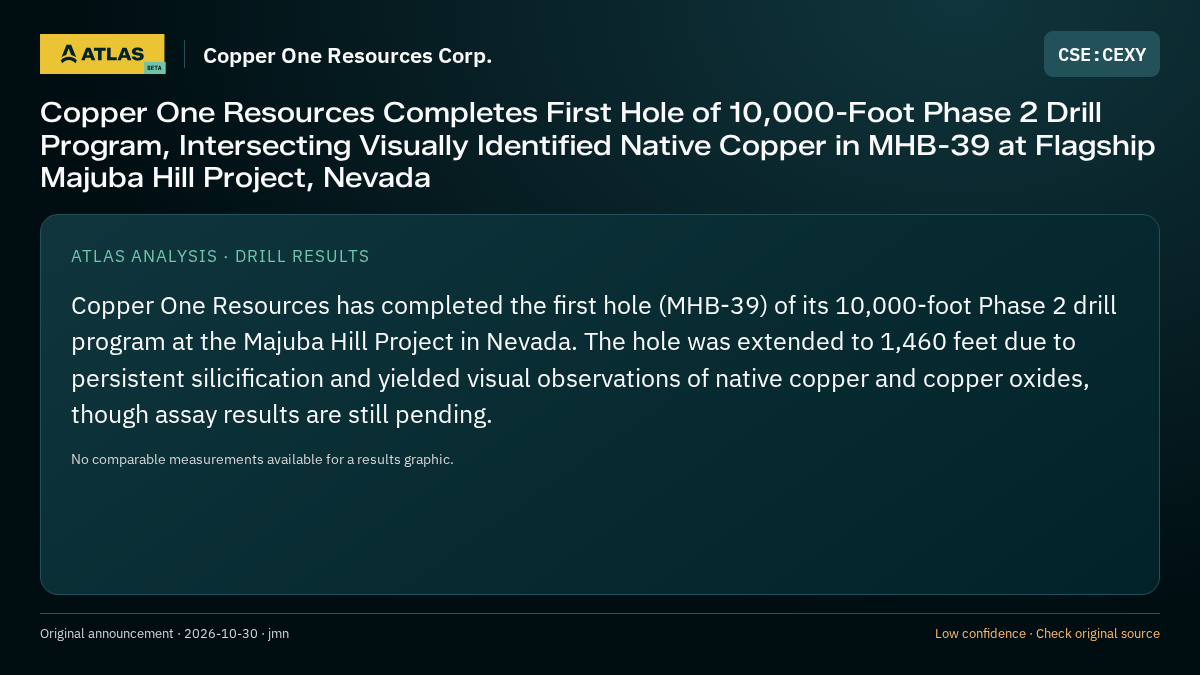
Copper One Resources has completed the first hole (MHB-39) of its 10,000-foot Phase 2 drill program at the Majuba Hill Project in Nevada. The hole was extended to 1,460 feet due to persistent silicification and yielded visual observations of native copper and copper oxides, though assay results are still pending.
Reasoning: The announcement reports the completion of a drill hole with visual mineral observations (native copper and oxides) but lacks actual assay grades or widths, making it a qualitative update rather than a quantitative one.
Positive factors
- visual identification of native copper
- persistent silicification suggesting continued alteration at depth
- hole extended beyond planned depth providing more geological data
Negative factors
- no assay results reported yet
- visual observations are preliminary and unconfirmed by laboratory
Low confidence — this extraction should be reviewed alongside the original source.
Facts used in scoring: 1
Classification and evidence
No QA/QC Disclosurenegative
Release does not disclose QA/QC — lab certification, CP/QP sign-off and assay protocols cannot be checked from this document.
Why it applies: While a QP is named, no specific assay protocols, standards, or laboratory results are provided in this release to verify the visual observations.
Evidence · text
“Visual mineral observations are preliminary and do not establish metal grades”
Infill Drillingneutral
Confirmatory drilling to raise resource confidence, not new discovery.
Why it applies: The program is part of a Phase 2 systematic testing of priority targets to support a maiden resource estimate.
Evidence · text
“intended to accelerate systematic testing of priority targets at Majuba Hill and support the Company’s objective of advancing the Project toward a maiden mineral resource estimate”
Extracted facts
Stored fact records: 1. Some facts used in scoring do not have a stored record.
Drill Results (1)
MHB-39Majuba Hill · copperIntercept: 445 mView all detailsHide details
Identity
- Hole ID
- MHB-39
- Project
- Majuba Hill
- Commodity
- copper
- Region
- usa_nv
- Reported Region
- usa_nv
- Ticker
- CEXY
Geometry
- Intercept
- 445 m
- Hole Depth
- 445 m
Classification
- Deposit Type
- porphyry
- Program
- exploration
- Sample Type
- drill
- Mining Method
- porphyry
Location
- Location
- Main Zone
- Loc. Source
- document
QA/QC
- QP Signed
- Yes
- QA/QC Methods
- standards
Review
- Needs Review
- No
- Interp. Status
- scored
- Historical
- No
Dates
- Event date
- 2026-10-30T00:00:00.000Z
Reasoning: Visual identification of native copper is a positive qualitative indicator but lacks quantitative grade/width data.
Positive factors
- visual identification of native copper
Negative factors
- no assay grades reported
- visual identification is preliminary
Evidence · text
“Visually identified native copper was observed earlier in the hole.”
Tags used in scoring
No QA/QC Disclosurenegative
Release does not disclose QA/QC — lab certification, CP/QP sign-off and assay protocols cannot be checked from this document.
Why it applies: qaqc_disclosed is not true
Cut-off Undisclosednegative
High-grade interval reported without stating the cut-off grade used for compositing.
Why it applies: no cutoff_grade was stated
How Atlas produces this analysis
Minestarters Atlas uses automated extraction to summarize mining announcements, identify reported measurements, and classify supporting evidence. Sentiment reflects the extracted narrative and classification rules; it is an interpretation, not a reported measurement. Evidence quotes and context are provided where available. Missing data, low-confidence results, and review flags indicate limitations. Check the original publisher announcement before relying on an interpretation.