
Cerrado Gold Announces Third Quarter 2026 Financial Results
Original announcement by globenewswire on
- Company
- Cerrado Gold Inc.
- Ticker
- CERT
- Exchange
- Unavailable
- Region
- Santa Cruz Province, Argentina
- Primary commodity
- Gold
- Secondary commodities
- Silver, Iron ore
- Document categories
- Metallurgy, Production, Agreement transaction
- Extracted
- 2026-11-20 14:36:57 UTC
Analysis by Minestarters Atlas
Atlas analysis published:
Minestarters Atlas analysis
Summary
Cerrado Gold reported Q3 2026 gold equivalent production of 16,685 GEO at AISC of $1,546/oz, up 21% from Q3 2025, generating revenue of $67.9M and net income of $25.2M versus a net loss of $12.2M in the prior year period. The company completed the repurchase of its Sprott streaming obligations for ~$31.3M and acquired the past-producing Manantial Espejo mine in Santa Cruz, Argentina from Pan American Silver for $20M. Full year 2026 production is expected at the upper end of guidance of 50,000–60,000 GEO, with a new PEA for MDN targeted for end of Q1 2027.
Reasoning: Strong quarter with significant YoY improvement in production, costs and profitability driven by higher gold prices, CIL ramp-up and stream repurchase. Heap leach recovery decline is a watch item but offset by CIL routing strategy. Acquisition of Manantial Espejo adds near-term growth optionality.
Positive factors
- Q3 2026 GEO production of 16,685 oz up 21% YoY
- AISC declined to $1,546/oz from $1,915/oz in Q3 2025
- Average realized gold price of $4,211/oz driving strong margins
- Adjusted EBITDA of $33.8M in Q3 and $90.8M YTD
- Net income of $25.2M vs net loss of $12.2M in Q3 2025
- Stream repurchase removes streaming obligation, improving future cash flow retention
- Full year production guided to upper end of 50,000-60,000 GEO
- CIL production up 107% YoY driven by high-grade underground feed
- New tailings dam operational, new crushing plant commissioning
- Acquisition of Manantial Espejo adds production growth optionality
Negative factors
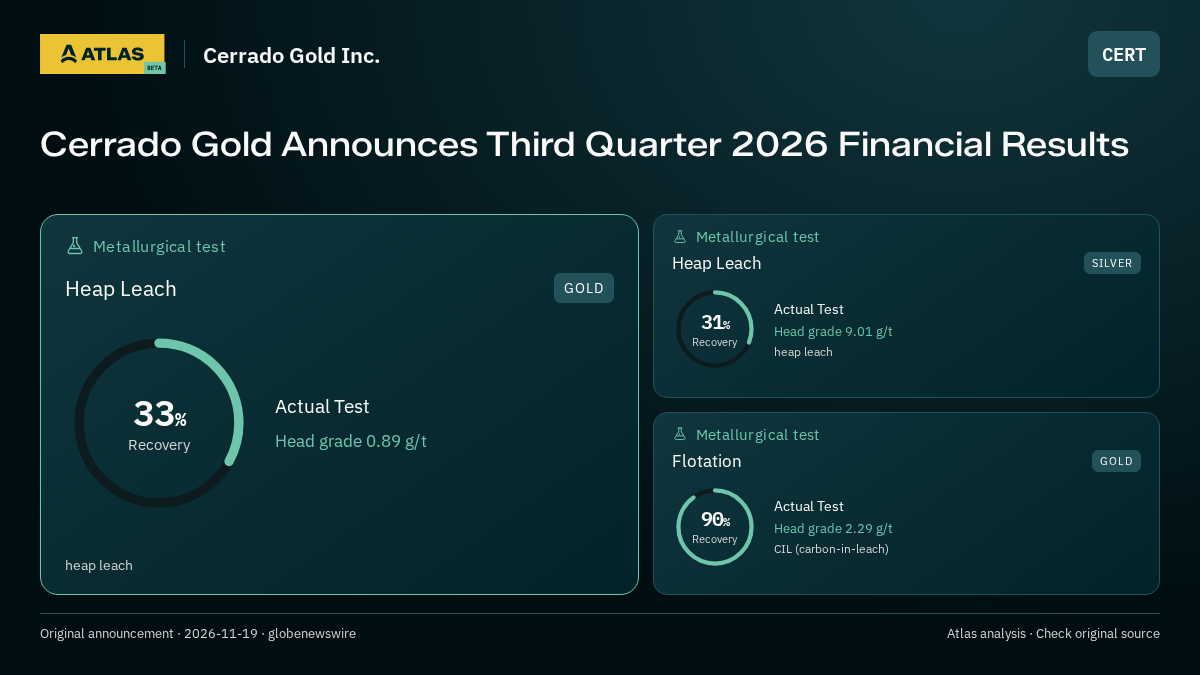
- Heap leach gold recovery declined to 33% in Q3 2026 from 47% in Q3 2025
- Working capital deficiency of $11.9M at quarter end
- $12M January 2027 Note still outstanding
- Capital expenditures of $17.6M in Q3 elevated due to expansion program
- Heap leach pad completion delayed to late Q1 2027
- PEA completion targeted Q1 2027 — no updated resource yet
Facts used in scoring: 4
Classification and evidence
Mill Routeneutral · Story-specific tag
Processing via mill or concentrator (CIL, CIP, tank leach, flotation).
Why it applies: High Grade CIL operations at Martinetas mill processing selective high-grade Calandrias material via carbon-in-leach route achieving 90% gold recovery in Q3 2026.
Evidence · text
“Selected high-grade material from Calandrias, generally above 2.5 g/t gold, was transported to Martinetas for carbon-in-leach ("CIL") processing”
Heap Leach Routeneutral · Story-specific tag
Processing via heap leach — lower CAPEX and OPEX, lower recovery expected.
Why it applies: Heap leach operations at MDN processing bulk low-grade material with 33% gold recovery in Q3 2026, below the weak band for heap leach gold.
Evidence · table
“33%”
Context: 8,453
High Recoverypositive · Story-specific tag
Recovery at or above the exceptional band for the commodity and processing route.
Why it applies: CIL gold recovery of 90% in Q3 2026 meets the exceptional band (≥95% exceptional, ≥90% strong) for mill CIL route, representing strong metallurgical performance.
Evidence · table
“90%”
Context: 6,607
Low Recoverynegative · Story-specific tag
Recovery below the weak band for the commodity and processing route.
Why it applies: Heap leach gold recovery of 33% in Q3 2026 is below the weak band of 45% for heap leach gold, though partly explained by deliberate routing of high-grade material to CIL.
Evidence · table
“33%”
Context: 8,453
Multi-Domain Testedpositive · Story-specific tag
Variability across ore domains (oxide, transition, fresh) has been addressed.
Why it applies: MDN operates dual processing routes (heap leach for low-grade and CIL for high-grade material), with routing decisions supported by laboratory bottle-roll testing on milled samples.
Evidence · text
“Routing decisions are supported by laboratory bottle-roll testing on milled samples, with selected material achieving gold recoveries of up to 95%”
Gravity Routeneutral
Gravity separation forms a material part of the flowsheet.
Why it applies: the document describes a gravity route ("Falcon")
Extracted facts
Stored fact records: 4. Some facts used in scoring do not have a stored record.
Metallurgical Results (4)
heap leachMinera Don Nicolas · goldRecovery: 33 %Head Grade: 0.89Head Grade Unit: g/tView all detailsHide details
Identity
- Project
- Minera Don Nicolas
- Commodity
- gold
- Region
- argentina
- Reported Region
- Santa Cruz Province, Argentina
- Ticker
- CERT
Test Work
- Program Status
- detailed
- Test Type
- heap leach
- Processing Route
- heap leach
- Sample
- Heap leach operations Q3 2026
Recovery
- Recovery
- 33 %
- Recovery Basis
- actual_test
- Head Grade
- 0.89
- Head Grade Unit
- g/t
Review
- Needs Review
- No
- Historical
- No
Dates
- Event date
- 2026-11-19T00:00:00.000Z
Reasoning: Heap leach gold recovery of 33% is below the weak threshold of 45% for heap leach gold, though the decline is partly explained by deliberate routing of higher-grade material to CIL. The strategy is rational but the standalone heap leach recovery is a concern.
Positive factors
- Ore mined increased to 1,150 kt from 759 kt YoY
- Mining rate improved to 24.63 ktpd from 19.13 ktpd
- Head grade improved to 0.89 g/t from 0.81 g/t YoY
Negative factors
- Gold recovery declined sharply to 33% from 47% in Q3 2025
- Recovery below weak band for heap leach gold (45%)
- High-grade material redirected to CIL reduces heap leach feed quality
Evidence · table
“33%”
Context: 8,453
Tags used in scoring
Heap Leach Routeneutral
Processing via heap leach — lower CAPEX and OPEX, lower recovery expected.
Why it applies: processing_route matches the heap_leach signal
Low Recoverynegative
Recovery below the weak band for the commodity and processing route.
Why it applies: 33% is below the weak band (45%)
heap leachMinera Don Nicolas · silverRecovery: 31 %Head Grade: 9.01Head Grade Unit: g/tView all detailsHide details
Identity
- Project
- Minera Don Nicolas
- Commodity
- silver
- Region
- argentina
- Reported Region
- Santa Cruz Province, Argentina
- Ticker
- CERT
Test Work
- Program Status
- detailed
- Test Type
- heap leach
- Processing Route
- heap leach
- Sample
- Heap leach operations Q3 2026
Recovery
- Recovery
- 31 %
- Recovery Basis
- actual_test
- Head Grade
- 9.01
- Head Grade Unit
- g/t
Review
- Needs Review
- No
- Historical
- No
Dates
- Event date
- 2026-11-19T00:00:00.000Z
Reasoning: Silver heap leach recovery improved YoY but remains low; silver is a byproduct at MDN.
Positive factors
- Silver recovery improved from 23% in Q3 2025 to 31% in Q3 2026
Negative factors
- Silver head grade declined to 9.01 g/t from 11.68 g/t YoY
- Silver recovery remains low in absolute terms
Evidence · table
“31%”
Context: 82,231
Tags used in scoring
Heap Leach Routeneutral
Processing via heap leach — lower CAPEX and OPEX, lower recovery expected.
Why it applies: processing_route matches the heap_leach signal
Low Recoverynegative
Recovery below the weak band for the commodity and processing route.
Why it applies: 31% is below the weak band (75%)
flotationMinera Don Nicolas · goldRecovery: 90 %Head Grade: 2.29Head Grade Unit: g/tView all detailsHide details
Identity
- Project
- Minera Don Nicolas
- Commodity
- gold
- Region
- argentina
- Reported Region
- Santa Cruz Province, Argentina
- Ticker
- CERT
Test Work
- Program Status
- detailed
- Test Type
- flotation
- Processing Route
- CIL (carbon-in-leach)
- Sample
- High Grade CIL Operations Q3 2026
Recovery
- Recovery
- 90 %
- Recovery Basis
- actual_test
- Head Grade
- 2.29
- Head Grade Unit
- g/t
Review
- Needs Review
- No
- Historical
- No
Dates
- Event date
- 2026-11-19T00:00:00.000Z
Reasoning: CIL gold recovery of 90% meets the exceptional threshold for mill CIL operations. Combined with a significantly higher head grade from selective routing of high-grade Calandrias material, this drove a doubling of CIL gold production YoY.
Positive factors
- CIL gold recovery of 90% is at the exceptional band for mill CIL route
- Head grade of 2.29 g/t significantly higher than Q3 2025 (1.31 g/t)
- CIL gold production of 6,607 oz up 103% from 3,253 oz in Q3 2025
- Mill throughput increased to 1,093 tpd from 1,006 tpd
Evidence · table
“90%”
Context: 6,607
Tags used in scoring
Mill Routeneutral
Processing via mill or concentrator (CIL, CIP, tank leach, flotation).
Why it applies: processing_route matches the mill_cil signal
flotationMinera Don Nicolas · silverRecovery: 70 %Head Grade: 11.63Head Grade Unit: g/tView all detailsHide details
Identity
- Project
- Minera Don Nicolas
- Commodity
- silver
- Region
- argentina
- Reported Region
- Santa Cruz Province, Argentina
- Ticker
- CERT
Test Work
- Program Status
- detailed
- Test Type
- flotation
- Processing Route
- CIL (carbon-in-leach)
- Sample
- High Grade CIL Operations Q3 2026
Recovery
- Recovery
- 70 %
- Recovery Basis
- actual_test
- Head Grade
- 11.63
- Head Grade Unit
- g/t
Review
- Needs Review
- No
- Historical
- No
Dates
- Event date
- 2026-11-19T00:00:00.000Z
Reasoning: Silver CIL recovery improved materially YoY and silver is a byproduct; 70% is acceptable for a CIL circuit where silver is secondary.
Positive factors
- Silver CIL recovery improved to 70% from 55% in Q3 2025
- Silver production from CIL up 124% YoY
Negative factors
- Silver CIL recovery of 70% is below the strong band for flotation silver (85%)
Evidence · table
“70%”
Context: 29,523
Tags used in scoring
Mill Routeneutral
Processing via mill or concentrator (CIL, CIP, tank leach, flotation).
Why it applies: processing_route matches the mill_cil signal
Low Recoverynegative
Recovery below the weak band for the commodity and processing route.
Why it applies: 70% is below the weak band (75%)
How Atlas produces this analysis
Minestarters Atlas uses automated extraction to summarize mining announcements, identify reported measurements, and classify supporting evidence. Sentiment reflects the extracted narrative and classification rules; it is an interpretation, not a reported measurement. Evidence quotes and context are provided where available. Missing data, low-confidence results, and review flags indicate limitations. Check the original publisher announcement before relying on an interpretation.