
Boron One Reports Metallurgical Study Results and Identifies Preferred Concentration Process for Third-Party Borate Materials
Original announcement by jmn on
- Company
- Boron One Holdings Inc.
- Ticker
- BONE
- Exchange
- TSXV
- Region
- Serbia
- Primary commodity
- Boron
- Secondary commodities
- None reported
- Document categories
- Metallurgy
- Extracted
- 2026-11-19 14:19:25 UTC
Analysis by Minestarters Atlas
Atlas analysis published:
Minestarters Atlas analysis
Summary
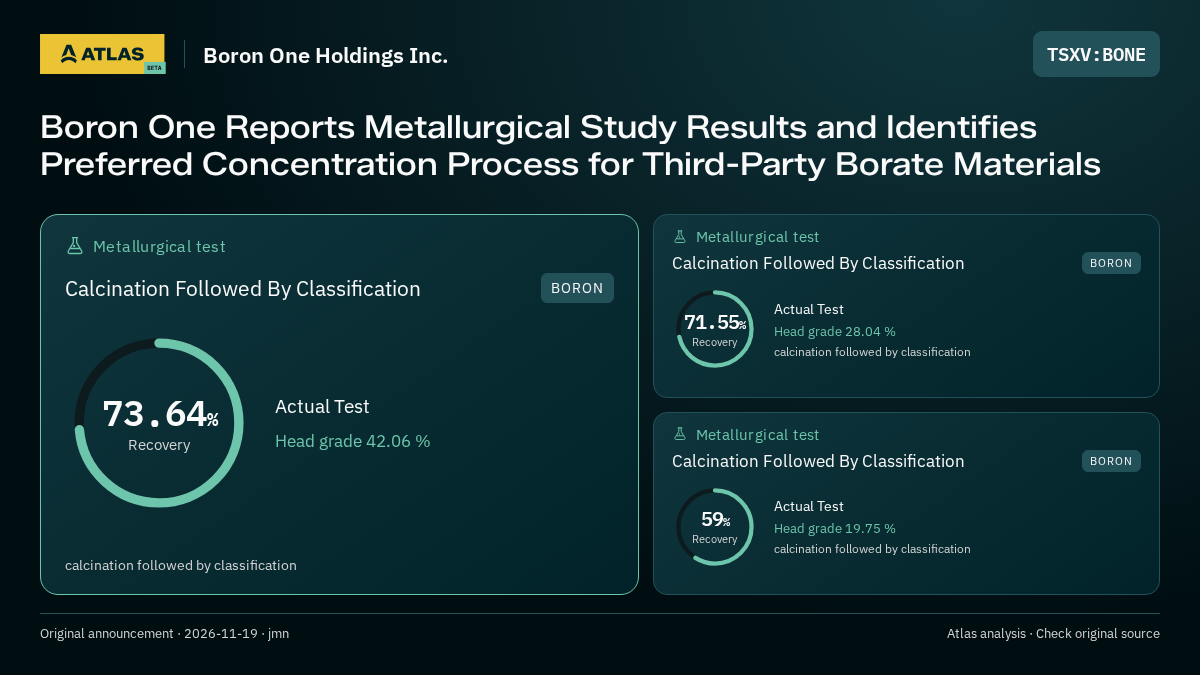
Boron One has completed a metallurgical study on third-party borate materials, identifying calcination followed by classification as the preferred concentration method. The study demonstrated that commercial-grade concentrates (44.81% to 55.25% B2O3) can be produced from feed grades ranging from approximately 19.75% to 42.06% B2O3.
Reasoning: The study successfully identifies a viable processing route for various boron grades, providing a de-risking signal for potential third-party material processing and strategic partnerships.
Positive factors
- Demonstrated ability to produce commercial-grade concentrates from a range of feed grades
- Identified preferred concentration method (calcination followed by classification)
- Supports potential strategic alliance with third-party material supplier
- Pilot-scale testing mentioned
Negative factors
- Results are based on third-party materials, not the company's primary Piskanja deposit
Facts used in scoring: 3
Classification and evidence
Mill Routeneutral
Processing via mill or concentrator (CIL, CIP, tank leach, flotation).
Why it applies: The study identifies calcination and classification as the preferred concentration method.
Evidence · text
“Calcination followed by classification was identified as the preferred concentration method”
Pilot Scale Completepositive
Pilot or demonstration plant testing completed under continuous operation.
Why it applies: The document explicitly mentions that results are based on laboratory and pilot-scale testing.
Evidence · text
“Metallurgical recoveries and concentrate grades presented in the Study are based on laboratory and pilot-scale testing”
Multi-Domain Testedpositive
Variability across ore domains (oxide, transition, fresh) has been addressed.
Why it applies: 3 distinct composites were tested
Extracted facts
Stored fact records: 3. Some facts used in scoring do not have a stored record.
Metallurgical Results (3)
calcination followed by classificationthird-party borate materials · boronRecovery: 73.64 %Head Grade: 42.06Head Grade Unit: %View all detailsHide details
Identity
- Project
- third-party borate materials
- Commodity
- boron
- Region
- serbia
- Reported Region
- Serbia
- Ticker
- BONE
Test Work
- Program Status
- detailed
- Test Type
- calcination followed by classification
- Processing Route
- calcination followed by classification
- Sample
- High grade (run of mine) composite borate Material
Recovery
- Recovery
- 73.64 %
- Recovery Basis
- actual_test
- Head Grade
- 42.06
- Head Grade Unit
- %
- Conc. Grade
- 55.25
- Conc. Grade Unit
- %
Lab
- Laboratory
- Institute for Technology of Nuclear and Other Mineral Raw Materials
- Consultant
- Mineral & Mine Backfill Technologies
Review
- Needs Review
- No
- Historical
- No
Dates
- Event date
- 2026-11-19T00:00:00.000Z
Reasoning: Strong recovery and high concentrate grade from high-grade feed.
Positive factors
- High recovery for high-grade feed
Evidence · table
“73.64”
Context: 42.06%
calcination followed by classificationthird-party borate materials · boronRecovery: 71.55 %Head Grade: 28.04Head Grade Unit: %View all detailsHide details
Identity
- Project
- third-party borate materials
- Commodity
- boron
- Region
- serbia
- Reported Region
- Serbia
- Ticker
- BONE
Test Work
- Program Status
- detailed
- Test Type
- calcination followed by classification
- Processing Route
- calcination followed by classification
- Sample
- Medium test grade composite borate Material
Recovery
- Recovery
- 71.55 %
- Recovery Basis
- actual_test
- Head Grade
- 28.04
- Head Grade Unit
- %
- Conc. Grade
- 50.84
- Conc. Grade Unit
- %
Lab
- Laboratory
- Institute for Technology of Nuclear and Other Mineral Raw Materials
- Consultant
- Mineral & Mine Backfill Technologies
Review
- Needs Review
- No
- Historical
- No
Dates
- Event date
- 2026-11-19T00:00:00.000Z
Reasoning: Effective upgrading of medium-grade material to commercial concentrate.
Positive factors
- Good recovery and grade upgrade from medium feed
Evidence · table
“71.55”
Context: 28.04%
calcination followed by classificationthird-party borate materials · boronRecovery: 59 %Head Grade: 19.75Head Grade Unit: %View all detailsHide details
Identity
- Project
- third-party borate materials
- Commodity
- boron
- Region
- serbia
- Reported Region
- Serbia
- Ticker
- BONE
Test Work
- Program Status
- detailed
- Test Type
- calcination followed by classification
- Processing Route
- calcination followed by classification
- Sample
- Low test grade composite borate Material
Recovery
- Recovery
- 59 %
- Recovery Basis
- actual_test
- Head Grade
- 19.75
- Head Grade Unit
- %
- Conc. Grade
- 44.81
- Conc. Grade Unit
- %
Lab
- Laboratory
- Institute for Technology of Nuclear and Other Mineral Raw Materials
- Consultant
- Mineral & Mine Backfill Technologies
Review
- Needs Review
- No
- Historical
- No
Dates
- Event date
- 2026-11-19T00:00:00.000Z
Reasoning: Lower recovery observed on low-grade material, though still produces commercial grade.
Positive factors
- Still achieves commercial-grade concentrate from low-grade feed
Negative factors
- Lower recovery on low-grade feed
Evidence · table
“59.0”
Context: 19.75%
How Atlas produces this analysis
Minestarters Atlas uses automated extraction to summarize mining announcements, identify reported measurements, and classify supporting evidence. Sentiment reflects the extracted narrative and classification rules; it is an interpretation, not a reported measurement. Evidence quotes and context are provided where available. Missing data, low-confidence results, and review flags indicate limitations. Check the original publisher announcement before relying on an interpretation.