
BAK: IMARC Conference Presentation
Original announcement by asx on
- Company
- Barkly Rare Earths Limited
- Ticker
- BAK
- Exchange
- ASX
- Region
- Northern Territory
- Primary commodity
- Unavailable
- Secondary commodities
- None reported
- Document categories
- Resource update, Metallurgy, Drill results
- Extracted
- 2026-10-28 22:46:04 UTC
Analysis by Minestarters Atlas
Atlas analysis published:
Minestarters Atlas analysis
Summary
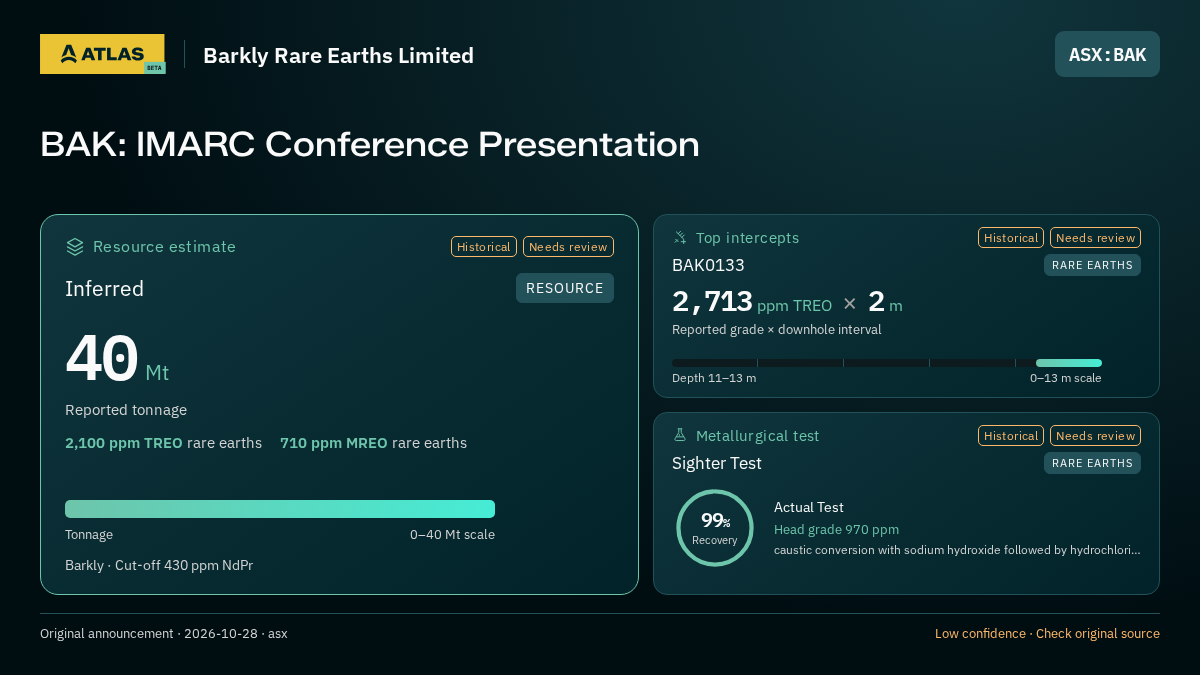
Barkly Rare Earths presented an update on its Barkly Project, highlighting a JORC-compliant Inferred Mineral Resource of 40 Mt at 2,100 ppm TREO and 200 Mt at 0.12% V2O5. Recent sighter metallurgical testwork achieved 99% MREO extraction, a significant improvement over previous tests, and initial drill results from an ongoing campaign returned high-grade intercepts. The company emphasizes the project's high MREO ratio, low radioactivity, and substantial resource growth potential within the Northern Territory.
Reasoning: The presentation highlights strong metallurgical results and significant drill intercepts, alongside a JORC-compliant Inferred Resource with high MREO content and substantial growth potential. While some results are re-stated and metallurgical tests are early-stage, the overall picture is positive for the project's development.
Positive factors
- High MREO ratio (34%) driving commercial returns for rare earths.
- Exceptional MREO extraction (99%) in sighter leach tests, showing significant improvement over prior tests.
- Significant drill intercepts, including high-grade sub-intervals, confirming mineralization continuity.
- Large Inferred Mineral Resource (40 Mt TREO, 200 Mt V2O5) with substantial exploration upside.
- Low uranium and thorium content, advantageous for processing and environment.
- Shallow, flat-lying mineralization suitable for bulk mining methods.
- Experienced board and management team with performance-based incentives.
Negative factors
- Mineral Resource is entirely Inferred, limiting engineering confidence.
- Metallurgical sighter tests are small-scale and not yet confirmed as representative of the full resource.
- Exploration Targets are conceptual and do not constitute a Mineral Resource.
- Drill results for BAK0133 are re-stated from a prior announcement, reducing novelty.
Low confidence — this extraction should be reviewed alongside the original source.
Facts used in scoring: 11
Classification and evidence
Nearology Playneutral
Value premise rests on proximity to a known deposit rather than own results.
Why it applies: The company highlights its location in an 'emerging rare earth region' and its proximity to existing infrastructure, suggesting value derived from its strategic position.
Evidence · text
“Commanding land position secured across an emerging rare earth region in the Northern Territory”
Tonnage Growthpositive
Significant tonnage increase (≥15%) vs prior estimate with grade maintained or improved.
Why it applies: The document presents an Exploration Target of 200–1,000 Mt TREO, significantly larger than the current 40 Mt Inferred Resource, indicating substantial growth potential.
Evidence · text
“Exploration Target of 200–1,000 Mt @ 1,600–1,900 ppm TREO”
Mill Routeneutral
Processing via mill or concentrator (CIL, CIP, tank leach, flotation).
Why it applies: the document describes a flotation route ("concentrate")
Multi-Domain Testedpositive
Variability across ore domains (oxide, transition, fresh) has been addressed.
Why it applies: 2 distinct composites were tested
Extracted facts
Stored fact records: 11. Some facts used in scoring do not have a stored record.
Drill Results (4)
BAK0133Barkly · rare_earthsGrade: 2713Grade Unit: ppm TREOIntercept: 2 mHistorical resultNeeds review: historical_restatementView all detailsHide details
Identity
- Hole ID
- BAK0133
- Project
- Barkly
- Commodity
- rare_earths
- Region
- australia_nt
- Reported Region
- australia_nt
- Ticker
- BAK
Geometry
- Grade
- 2713
- Grade Unit
- ppm TREO
- Intercept
- 2 m
- From
- 11 m
- To
- 13 m
- Intercept Depth
- 11 m
Classification
- Program
- exploration
- Sample Type
- drill
- Group ID
- BAK0133:11-13
- Mining Method
- open_pit
QA/QC
- QP Signed
- Yes
Review
- Needs Review
- Yes
- Review Reason
- historical_restatement
- Interp. Status
- scored
- Historical
- Yes
- Historical Source Date
- 2026-10-19T00:00:00.000Z
Dates
- Event date
- 2026-10-28T00:00:00.000Z
Reasoning: This intercept shows good grade and width at a shallow depth, but its historical nature and lack of true width disclosure reduce its novelty and confidence.
Positive factors
- Good grade (2,713 ppm TREO) over a reasonable width (2 m).
- QP sign-off and lab analyses provide credibility.
- Shallow intercept (from 11 m) is favorable for potential open-pit mining.
Negative factors
- Result is historical, having been reported in a prior announcement.
- Only apparent width is given; true width is pending further assay.
- No specific QA/QC methods are disclosed beyond 'lab analyses'.
Evidence · text
“BAK0133 2,713 ppm TREO (948 ppm MREO): 2 m from 11 m”
Tags used in scoring
No QA/QC Disclosurenegative
Release does not disclose QA/QC — lab certification, CP/QP sign-off and assay protocols cannot be checked from this document.
Why it applies: qaqc_disclosed is not true
Cut-off Undisclosednegative
High-grade interval reported without stating the cut-off grade used for compositing.
Why it applies: no cutoff_grade was stated
Stale Data Re-releasenegative
Historical results re-announced with no new assays or reinterpretation — low genuine novelty.
Why it applies: the fact restates a prior release
Nearology Playneutral
Value premise rests on proximity to a known deposit rather than own results.
Why it applies: proximity is offered as the value premise: "Exploration Targets were interpreted based on possible extensions of mineralisation in mapped, laterally extensive, near"
Rejected tags
Rejected tags — excluded from scoring because their label or evidence could not be verified.
Apparent Width OnlyRejected · negative
Interval given as downhole width with no true width or drill orientation — apparent width may overstate true thickness.
Reason: The interval is given as downhole width, with 'determination of full widths pending further assay', meaning true width is not yet stated.
Evidence · text
“determination of full widths pending further assay”
QA/QC DisclosedRejected · positive
Release includes QA/QC disclosure — certified lab, QP sign-off, or stated methods (blanks, standards, duplicates).
Reason: The release mentions 'lab analyses of pXRF-screened intervals', indicating some QA/QC procedures.
Evidence · text
“from lab analyses of pXRF-screened intervals”
QP/CP SignedRejected · positive · Story-specific tag
Qualified Person (QP) or Competent Person (CP) named and signed off — a member of a recognized professional association (e.g., AusIMM, SME, AIG, P.Geo) with relevant experience.
Reason: The drill results are based on information evaluated by Competent Person Richard Hall.
Evidence · text
“Competent Person: Richard Hall.”
BAK0133Barkly · rare_earthsGrade: 6057Grade Unit: ppm TREOIntercept: 0.5 mHistorical resultNeeds review: historical_restatementView all detailsHide details
Identity
- Hole ID
- BAK0133
- Project
- Barkly
- Commodity
- rare_earths
- Region
- australia_nt
- Reported Region
- australia_nt
- Ticker
- BAK
Geometry
- Grade
- 6057
- Grade Unit
- ppm TREO
- Intercept
- 0.5 m
- From
- 11.5 m
- To
- 12 m
- Intercept Depth
- 11 m
Classification
- Program
- exploration
- Sample Type
- drill
- Group ID
- BAK0133:11.5-12
- Mining Method
- open_pit
QA/QC
- QP Signed
- Yes
Review
- Needs Review
- Yes
- Review Reason
- historical_restatement
- Interp. Status
- scored
- Historical
- Yes
- Historical Source Date
- 2026-10-19T00:00:00.000Z
Dates
- Event date
- 2026-10-28T00:00:00.000Z
Reasoning: This high-grade sub-interval is a strong indicator of mineralization quality, but its narrow width, historical nature, and lack of true width disclosure temper its overall impact.
Positive factors
- Very high grade (6,057 ppm TREO) for a rare earths intercept.
- QP sign-off and lab analyses provide credibility.
- Shallow intercept (from 11.5 m) is favorable for potential open-pit mining.
Negative factors
- Result is historical, having been reported in a prior announcement.
- Only apparent width is given; true width is pending further assay.
- Narrow intercept (0.5 m) limits overall contained metal.
- No specific QA/QC methods are disclosed beyond 'lab analyses'.
Evidence · text
“including 6,057 ppm TREO (2,266 ppm MREO): 0.5 m from 11.5 m”
Tags used in scoring
No QA/QC Disclosurenegative
Release does not disclose QA/QC — lab certification, CP/QP sign-off and assay protocols cannot be checked from this document.
Why it applies: qaqc_disclosed is not true
Cut-off Undisclosednegative
High-grade interval reported without stating the cut-off grade used for compositing.
Why it applies: no cutoff_grade was stated
Stale Data Re-releasenegative
Historical results re-announced with no new assays or reinterpretation — low genuine novelty.
Why it applies: the fact restates a prior release
Nearology Playneutral
Value premise rests on proximity to a known deposit rather than own results.
Why it applies: proximity is offered as the value premise: "Exploration Targets were interpreted based on possible extensions of mineralisation in mapped, laterally extensive, near"
Rejected tags
Rejected tags — excluded from scoring because their label or evidence could not be verified.
Bonanza InterceptRejected · positive
Exceptionally high-grade zone, well above the deposit-type norm.
Reason: The grade of 6,057 ppm TREO is exceptionally high for a rare earths intercept, well above the deposit-type norm.
Evidence · text
“6,057 ppm TREO”
Apparent Width OnlyRejected · negative
Interval given as downhole width with no true width or drill orientation — apparent width may overstate true thickness.
Reason: The interval is given as downhole width, with 'determination of full widths pending further assay', meaning true width is not yet stated.
Evidence · text
“determination of full widths pending further assay”
QA/QC DisclosedRejected · positive
Release includes QA/QC disclosure — certified lab, QP sign-off, or stated methods (blanks, standards, duplicates).
Reason: The release mentions 'lab analyses of pXRF-screened intervals', indicating some QA/QC procedures.
Evidence · text
“from lab analyses of pXRF-screened intervals”
QP/CP SignedRejected · positive · Story-specific tag
Qualified Person (QP) or Competent Person (CP) named and signed off — a member of a recognized professional association (e.g., AusIMM, SME, AIG, P.Geo) with relevant experience.
Reason: The drill results are based on information evaluated by Competent Person Richard Hall.
Evidence · text
“Competent Person: Richard Hall.”
BAK0080Barkly · rare_earthsGrade: 2581Grade Unit: ppm TREOIntercept: 2 mHistorical resultNeeds review: historical_restatementView all detailsHide details
Identity
- Hole ID
- BAK0080
- Project
- Barkly
- Commodity
- rare_earths
- Region
- australia_nt
- Reported Region
- australia_nt
- Ticker
- BAK
Geometry
- Grade
- 2581
- Grade Unit
- ppm TREO
- Intercept
- 2 m
- From
- 14.5 m
- To
- 16.5 m
- Intercept Depth
- 14.5 m
Classification
- Program
- exploration
- Sample Type
- drill
- Group ID
- BAK0080:14.5-16.5
- Mining Method
- open_pit
QA/QC
- QP Signed
- Yes
Review
- Needs Review
- Yes
- Review Reason
- historical_restatement
- Interp. Status
- scored
- Historical
- Yes
- Historical Source Date
- 2026-10-19T00:00:00.000Z
Dates
- Event date
- 2026-10-28T00:00:00.000Z
Reasoning: This intercept shows good grade and width at a shallow depth, contributing to the understanding of the mineralization, but the lack of true width disclosure reduces confidence.
Positive factors
- Good grade (2,581 ppm TREO) over a reasonable width (2 m).
- QP sign-off and lab analyses provide credibility.
- Shallow intercept (from 14.5 m) is favorable for potential open-pit mining.
Negative factors
- Result is historical, having been reported in a prior announcement.
- Only apparent width is given; true width is pending further assay.
- No specific QA/QC methods are disclosed beyond 'lab analyses'.
Evidence · text
“BAK0080 2,581 ppm TREO (929 ppm MREO): 2 m from 14.5 m”
Tags used in scoring
No QA/QC Disclosurenegative
Release does not disclose QA/QC — lab certification, CP/QP sign-off and assay protocols cannot be checked from this document.
Why it applies: qaqc_disclosed is not true
Cut-off Undisclosednegative
High-grade interval reported without stating the cut-off grade used for compositing.
Why it applies: no cutoff_grade was stated
Stale Data Re-releasenegative
Historical results re-announced with no new assays or reinterpretation — low genuine novelty.
Why it applies: the fact restates a prior release
Nearology Playneutral
Value premise rests on proximity to a known deposit rather than own results.
Why it applies: proximity is offered as the value premise: "Exploration Targets were interpreted based on possible extensions of mineralisation in mapped, laterally extensive, near"
Rejected tags
Rejected tags — excluded from scoring because their label or evidence could not be verified.
Apparent Width OnlyRejected · negative
Interval given as downhole width with no true width or drill orientation — apparent width may overstate true thickness.
Reason: The interval is given as downhole width, with 'determination of full widths pending further assay', meaning true width is not yet stated.
Evidence · text
“determination of full widths pending further assay”
QA/QC DisclosedRejected · positive
Release includes QA/QC disclosure — certified lab, QP sign-off, or stated methods (blanks, standards, duplicates).
Reason: The release mentions 'lab analyses of pXRF-screened intervals', indicating some QA/QC procedures.
Evidence · text
“from lab analyses of pXRF-screened intervals”
QP/CP SignedRejected · positive · Story-specific tag
Qualified Person (QP) or Competent Person (CP) named and signed off — a member of a recognized professional association (e.g., AusIMM, SME, AIG, P.Geo) with relevant experience.
Reason: The drill results are based on information evaluated by Competent Person Richard Hall.
Evidence · text
“Competent Person: Richard Hall.”
BAK0080Barkly · rare_earthsGrade: 5163Grade Unit: ppm TREOIntercept: 0.5 mHistorical resultNeeds review: historical_restatementView all detailsHide details
Identity
- Hole ID
- BAK0080
- Project
- Barkly
- Commodity
- rare_earths
- Region
- australia_nt
- Reported Region
- australia_nt
- Ticker
- BAK
Geometry
- Grade
- 5163
- Grade Unit
- ppm TREO
- Intercept
- 0.5 m
- From
- 15.5 m
- To
- 16 m
- Intercept Depth
- 14.5 m
Classification
- Program
- exploration
- Sample Type
- drill
- Group ID
- BAK0080:15.5-16
- Mining Method
- open_pit
QA/QC
- QP Signed
- Yes
Review
- Needs Review
- Yes
- Review Reason
- historical_restatement
- Interp. Status
- scored
- Historical
- Yes
- Historical Source Date
- 2026-10-19T00:00:00.000Z
Dates
- Event date
- 2026-10-28T00:00:00.000Z
Reasoning: This high-grade sub-interval is a strong indicator of mineralization quality, but its narrow width and lack of true width disclosure temper its overall impact.
Positive factors
- Very high grade (5,163 ppm TREO) for a rare earths intercept.
- QP sign-off and lab analyses provide credibility.
- Shallow intercept (from 15.5 m) is favorable for potential open-pit mining.
Negative factors
- Result is historical, having been reported in a prior announcement.
- Only apparent width is given; true width is pending further assay.
- Narrow intercept (0.5 m) limits overall contained metal.
- No specific QA/QC methods are disclosed beyond 'lab analyses'.
Evidence · text
“including 5,163 ppm TREO (2,048 ppm MREO): 0.5 m from 15.5 m”
Tags used in scoring
No QA/QC Disclosurenegative
Release does not disclose QA/QC — lab certification, CP/QP sign-off and assay protocols cannot be checked from this document.
Why it applies: qaqc_disclosed is not true
Cut-off Undisclosednegative
High-grade interval reported without stating the cut-off grade used for compositing.
Why it applies: no cutoff_grade was stated
Stale Data Re-releasenegative
Historical results re-announced with no new assays or reinterpretation — low genuine novelty.
Why it applies: the fact restates a prior release
Nearology Playneutral
Value premise rests on proximity to a known deposit rather than own results.
Why it applies: proximity is offered as the value premise: "Exploration Targets were interpreted based on possible extensions of mineralisation in mapped, laterally extensive, near"
Rejected tags
Rejected tags — excluded from scoring because their label or evidence could not be verified.
Bonanza InterceptRejected · positive
Exceptionally high-grade zone, well above the deposit-type norm.
Reason: The grade of 5,163 ppm TREO is exceptionally high for a rare earths intercept, well above the deposit-type norm.
Evidence · text
“5,163 ppm TREO”
Apparent Width OnlyRejected · negative
Interval given as downhole width with no true width or drill orientation — apparent width may overstate true thickness.
Reason: The interval is given as downhole width, with 'determination of full widths pending further assay', meaning true width is not yet stated.
Evidence · text
“determination of full widths pending further assay”
QA/QC DisclosedRejected · positive
Release includes QA/QC disclosure — certified lab, QP sign-off, or stated methods (blanks, standards, duplicates).
Reason: The release mentions 'lab analyses of pXRF-screened intervals', indicating some QA/QC procedures.
Evidence · text
“from lab analyses of pXRF-screened intervals”
QP/CP SignedRejected · positive · Story-specific tag
Qualified Person (QP) or Competent Person (CP) named and signed off — a member of a recognized professional association (e.g., AusIMM, SME, AIG, P.Geo) with relevant experience.
Reason: The drill results are based on information evaluated by Competent Person Richard Hall.
Evidence · text
“Competent Person: Richard Hall.”
Resource Estimates (3)
inferredBarkly · rare_earthsTonnes: 40000000Grade: 2100Grade Unit: ppm TREOContained Metal: 82000Contained Unit: tHistorical resultNeeds review: historical_restatementView all detailsHide details
Identity
- Project
- Barkly
- Commodity
- rare_earths
- Region
- australia_nt
- Reported Region
- Northern Territory
- Ticker
- BAK
Resource scope
- Estimate type
- resource
- Reporting standards
- jorc
- QP Signed
- Yes
- Qualified person names
- Paul Teniere
- Resource group id
- resource:23af94f5306e128756f1
Resource Data
- Category
- inferred
- Tonnes
- 40000000
- Grade
- 2100
- Grade Unit
- ppm TREO
- Contained Metal
- 82000
- Contained Unit
- t
- Cutoff Grade
- 430
- Cutoff Unit
- ppm NdPr
Prior Estimate
- Resource Date
- 2025-12-01
Review
- Needs Review
- Yes
- Review Reason
- historical_restatement
- Historical
- Yes
- Historical Source Date
- 2025-12-01T00:00:00.000Z
Dates
- Event date
- 2026-10-28T00:00:00.000Z
Reasoning: The Inferred Resource provides a substantial baseline for the project, but its early-stage classification and historical nature temper its novelty and confidence, despite the high MREO content.
Positive factors
- Significant tonnage and grade for a rare earths project.
- JORC 2012 compliant, providing a recognized reporting standard.
- High MREO ratio (34%) indicates valuable rare earth composition.
Negative factors
- Resource is entirely Inferred, indicating lower geological confidence.
- Estimate is historical, having been reported in December 2025.
Evidence · table
“2,100”
Context: 40
Tags used in scoring
Resource Updateneutral
Revised estimate for an existing resource — compare to prior to assess progress.
Why it applies: the release compares against a previous estimate
PEA-Supportingneutral
Resource estimate prepared to support a Preliminary Economic Assessment — early-stage study.
Why it applies: the release names the study this estimate supports
PFS-Supportingneutral
Resource estimate prepared to support a Pre-Feasibility Study — requires adequate M&I component.
Why it applies: the release names the study this estimate supports
DFS-Supportingneutral
Resource estimate prepared to support a Definitive Feasibility Study — requires high M&I confidence.
Why it applies: the release names the study this estimate supports
inferredBarkly · rare_earthsTonnes: 40000000Grade: 710Grade Unit: ppm MREOContained Metal: 28000Contained Unit: tHistorical resultNeeds review: historical_restatementView all detailsHide details
Identity
- Project
- Barkly
- Commodity
- rare_earths
- Region
- australia_nt
- Reported Region
- Northern Territory
- Ticker
- BAK
Resource scope
- Estimate type
- resource
- Reporting standards
- jorc
- QP Signed
- Yes
- Qualified person names
- Paul Teniere
- Resource group id
- resource:23af94f5306e128756f1
Resource Data
- Category
- inferred
- Tonnes
- 40000000
- Grade
- 710
- Grade Unit
- ppm MREO
- Contained Metal
- 28000
- Contained Unit
- t
- Cutoff Grade
- 430
- Cutoff Unit
- ppm NdPr
Prior Estimate
- Resource Date
- 2025-12-01
Review
- Needs Review
- Yes
- Review Reason
- historical_restatement
- Historical
- Yes
- Historical Source Date
- 2025-12-01T00:00:00.000Z
Dates
- Event date
- 2026-10-28T00:00:00.000Z
Reasoning: The Inferred MREO resource provides a substantial baseline for the project, but its early-stage classification and historical nature temper its novelty and confidence, despite the high MREO content.
Positive factors
- High MREO grade (710 ppm) and contained metal (28,000 t) for a rare earths project.
- JORC 2012 compliant, providing a recognized reporting standard.
- High MREO ratio (34%) indicates valuable rare earth composition.
Negative factors
- Resource is entirely Inferred, indicating lower geological confidence.
- Estimate is historical, having been reported in December 2025.
Evidence · table
“710”
Context: 40
Tags used in scoring
Resource Updateneutral
Revised estimate for an existing resource — compare to prior to assess progress.
Why it applies: the release compares against a previous estimate
PEA-Supportingneutral
Resource estimate prepared to support a Preliminary Economic Assessment — early-stage study.
Why it applies: the release names the study this estimate supports
PFS-Supportingneutral
Resource estimate prepared to support a Pre-Feasibility Study — requires adequate M&I component.
Why it applies: the release names the study this estimate supports
DFS-Supportingneutral
Resource estimate prepared to support a Definitive Feasibility Study — requires high M&I confidence.
Why it applies: the release names the study this estimate supports
inferredBarkly · vanadiumTonnes: 200000000Grade: 0.12Grade Unit: % V2O5Contained Metal: 240000Contained Unit: tHistorical resultNeeds review: historical_restatementView all detailsHide details
Identity
- Project
- Barkly
- Commodity
- vanadium
- Region
- australia_nt
- Reported Region
- Northern Territory
- Ticker
- BAK
Resource scope
- Estimate type
- resource
- Reporting standards
- jorc
- QP Signed
- Yes
- Qualified person names
- Paul Teniere
- Resource group id
- resource:b05a8d138be3d7f8ccf8
Resource Data
- Category
- inferred
- Tonnes
- 200000000
- Grade
- 0.12
- Grade Unit
- % V2O5
- Contained Metal
- 240000
- Contained Unit
- t
- Cutoff Grade
- 0.1
- Cutoff Unit
- % V2O5
Prior Estimate
- Resource Date
- 2025-12-01
Review
- Needs Review
- Yes
- Review Reason
- historical_restatement
- Historical
- Yes
- Historical Source Date
- 2025-12-01T00:00:00.000Z
Dates
- Event date
- 2026-10-28T00:00:00.000Z
Reasoning: The Inferred Vanadium Resource adds significant scale and a secondary commodity to the project, but its early-stage classification and historical nature temper its novelty and confidence.
Positive factors
- Large tonnage (200 Mt) for a vanadium resource.
- JORC 2012 compliant, providing a recognized reporting standard.
- Contained metal of 240,000 t V2O5 is significant.
Negative factors
- Resource is entirely Inferred, indicating lower geological confidence.
- Estimate is historical, having been reported in December 2025.
Evidence · table
“0.12”
Context: 200
Tags used in scoring
Resource Updateneutral
Revised estimate for an existing resource — compare to prior to assess progress.
Why it applies: the release compares against a previous estimate
PEA-Supportingneutral
Resource estimate prepared to support a Preliminary Economic Assessment — early-stage study.
Why it applies: the release names the study this estimate supports
PFS-Supportingneutral
Resource estimate prepared to support a Pre-Feasibility Study — requires adequate M&I component.
Why it applies: the release names the study this estimate supports
DFS-Supportingneutral
Resource estimate prepared to support a Definitive Feasibility Study — requires high M&I confidence.
Why it applies: the release names the study this estimate supports
Metallurgical Results (4)
sighter testBarkly · rare_earthsRecovery: 99 %Head Grade: 970Head Grade Unit: ppmHistorical resultNeeds review: historical_restatementView all detailsHide details
Identity
- Project
- Barkly
- Commodity
- rare_earths
- Region
- australia_nt
- Reported Region
- Northern Territory
- Ticker
- BAK
Test Work
- Program Status
- preliminary
- Test Type
- sighter test
- Processing Route
- caustic conversion with sodium hydroxide followed by hydrochloric acid leaching
- Sample
- composite sample not yet determined as representative of the Inferred Mineral Resource
Recovery
- Recovery
- 99 %
- Recovery Basis
- actual_test
- Head Grade
- 970
- Head Grade Unit
- ppm
Review
- Needs Review
- Yes
- Review Reason
- historical_restatement
- Historical
- Yes
- Historical Source Date
- 2026-08-31T00:00:00.000Z
Dates
- Event date
- 2026-10-28T00:00:00.000Z
Reasoning: The 99% MREO extraction is an outstanding result, demonstrating strong metallurgical potential, but the preliminary nature of the testwork and small sample size warrant caution.
Positive factors
- Exceptional recovery (99%) for MREO, well above typical benchmarks.
- Significant improvement over prior test results (74% extraction).
- QP/CP sign-off adds credibility to the results.
Negative factors
- Test is a sighter-scale, small composite, not yet confirmed as representative.
- Reagent consumption, solution recycle, and water requirements are yet to be defined.
Evidence · text
“Sighter leach test on composite sample returned 99% MREO extraction”
sighter testBarkly · yttriumRecovery: 94 %Head Grade: 39Head Grade Unit: ppmHistorical resultNeeds review: historical_restatementView all detailsHide details
Identity
- Project
- Barkly
- Commodity
- yttrium
- Region
- australia_nt
- Reported Region
- Northern Territory
- Ticker
- BAK
Test Work
- Program Status
- preliminary
- Test Type
- sighter test
- Processing Route
- caustic conversion with sodium hydroxide followed by hydrochloric acid leaching
- Sample
- composite sample not yet determined as representative of the Inferred Mineral Resource
Recovery
- Recovery
- 94 %
- Recovery Basis
- actual_test
- Head Grade
- 39
- Head Grade Unit
- ppm
Review
- Needs Review
- Yes
- Review Reason
- historical_restatement
- Historical
- Yes
- Historical Source Date
- 2026-08-31T00:00:00.000Z
Dates
- Event date
- 2026-10-28T00:00:00.000Z
Reasoning: The 94% yttrium extraction is a strong result, but the preliminary nature of the testwork and small sample size warrant caution, and it is a re-statement of prior results.
Positive factors
- High recovery (94%) for yttrium, indicating good extractability.
- QP/CP sign-off adds credibility to the results.
Negative factors
- Test is a sighter-scale, small composite, not yet confirmed as representative.
- Reagent consumption, solution recycle, and water requirements are yet to be defined.
Evidence · text
“alongside 94% yttrium”
sighter testBarkly · phosphorusRecovery: 92 %Head Grade: 0.28Head Grade Unit: %Historical resultNeeds review: historical_restatementView all detailsHide details
Identity
- Project
- Barkly
- Commodity
- phosphorus
- Region
- australia_nt
- Reported Region
- Northern Territory
- Ticker
- BAK
Test Work
- Program Status
- preliminary
- Test Type
- sighter test
- Processing Route
- caustic conversion
- Sample
- composite sample not yet determined as representative of the Inferred Mineral Resource
Recovery
- Recovery
- 92 %
- Recovery Basis
- actual_test
- Head Grade
- 0.28
- Head Grade Unit
- %
Review
- Needs Review
- Yes
- Review Reason
- historical_restatement
- Historical
- Yes
- Historical Source Date
- 2026-08-31T00:00:00.000Z
Dates
- Event date
- 2026-10-28T00:00:00.000Z
Reasoning: The effective separation of phosphorus is a positive for downstream processing, but the preliminary nature of the testwork and small sample size warrant caution, and it is a re-statement of prior results.
Positive factors
- High separation (92%) of phosphorus into the caustic conversion solution, indicating effective impurity removal.
- No detectable rare earths lost to the phosphorus stream, preserving payable metal.
- QP/CP sign-off adds credibility to the results.
Negative factors
- Test is a sighter-scale, small composite, not yet confirmed as representative.
- Reagent consumption, solution recycle, and water requirements are yet to be defined.
Evidence · text
“92% of phosphorus separated cleanly and early into the caustic conversion solution”
leach testBarkly · rare_earthsRecovery: 74 %Historical resultNeeds review: historical_restatementView all detailsHide details
Identity
- Project
- Barkly
- Commodity
- rare_earths
- Region
- australia_nt
- Reported Region
- Northern Territory
- Ticker
- BAK
Test Work
- Program Status
- preliminary
- Test Type
- leach test
- Processing Route
- NaOH treatment followed by HCl leaching
- Sample
- earlier testwork
Recovery
- Recovery
- 74 %
- Recovery Basis
- actual_test
Review
- Needs Review
- Yes
- Review Reason
- historical_restatement
- Historical
- Yes
- Historical Source Date
- 2026-09-30T00:00:00.000Z
Dates
- Event date
- 2026-10-28T00:00:00.000Z
Reasoning: This historical recovery figure provides context for the improvement seen in later testwork, but is not a strong result on its own and is superseded.
Negative factors
- Recovery is lower compared to the latest sighter test (99%).
- Test is historical and superseded by more recent, improved results.
Evidence · text
“74% extraction announced from prior leach tests”
How Atlas produces this analysis
Minestarters Atlas uses automated extraction to summarize mining announcements, identify reported measurements, and classify supporting evidence. Sentiment reflects the extracted narrative and classification rules; it is an interpretation, not a reported measurement. Evidence quotes and context are provided where available. Missing data, low-confidence results, and review flags indicate limitations. Check the original publisher announcement before relying on an interpretation.