
ASEAN’s First Nuclear Deals Put Uranium Fuel Sourcing in Focus
Original announcement by cruxinvestor on
- Company
- Crux Investor
- Ticker
- Unavailable
- Exchange
- Unavailable
- Region
- Unavailable
- Primary commodity
- Uranium
- Secondary commodities
- None reported
- Document categories
- Other, Resource update, Metallurgy
- Extracted
- 2026-10-26 13:47:55 UTC
Analysis by Minestarters Atlas
Atlas analysis published:
Minestarters Atlas analysis
Summary
The article analyzes how emerging nuclear energy plans in Southeast Asia, particularly in Indonesia, Vietnam, and the Philippines, are set to drive long-term uranium demand. It highlights specific uranium producers and explorers, such as enCore Energy and IsoEnergy, that are positioned to benefit from this shifting energy landscape.
Reasoning: The document is a market intelligence roundup/analysis piece discussing macro trends in the uranium sector rather than a single corporate announcement.
Positive factors
- ASEAN nuclear expansion creates long-term demand tailwinds
- Specific company mentions (enCore, Atomic Eagle, IsoEnergy, ATHA) provide actionable context
Negative factors
- Market roundup format lacks single-event focus
Facts used in scoring: 2
Classification and evidence
Inferred Resourcenegative · Story-specific tag
Speculative category — limited drilling, geological continuity assumed but not confirmed. Cannot support economic studies alone.
Why it applies: The article discusses exploration potential and resource definition for several projects, but does not report a specific inferred resource quantity.
Evidence · text
“strengthen the case for explorers defining future uranium resources”
Single Domain Onlynegative
Testing limited to one composite or domain — representativeness not established.
Why it applies: only one composite was tested
Extracted facts
Stored fact records: 2. Some facts used in scoring do not have a stored record.
Resource Estimates (1)
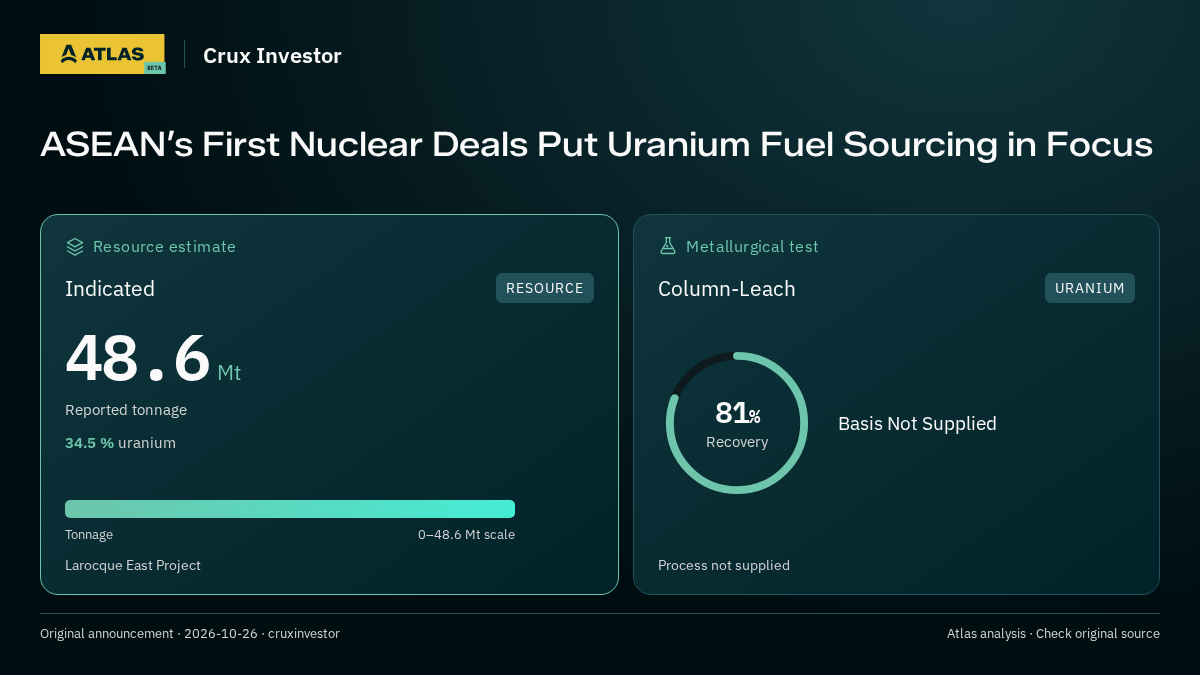
indicatedLarocque East Project · uraniumTonnes: 48600000Grade: 34.5Grade Unit: %Contained Metal: 48.6Contained Unit: million poundsView all detailsHide details
Identity
- Project
- Larocque East Project
- Commodity
- uranium
- Region
- canada_sk
- Reported Region
- Saskatchewan
Resource scope
- Estimate type
- resource
- Resource group id
- resource:75068fc6dbce4d6ea77e
Resource Data
- Category
- indicated
- Tonnes
- 48600000
- Grade
- 34.5
- Grade Unit
- %
- Contained Metal
- 48.6
- Contained Unit
- million pounds
Review
- Needs Review
- No
- Historical
- No
Dates
- Event date
- 2026-10-26T00:00:00.000Z
Reasoning: High-grade indicated resource reported by IsoEnergy.
Positive factors
- Strong grade of 34.5% U3O8
- Indicated category provides geological confidence
Evidence · text
“Larocque East Project in Saskatchewan, which contains 48.6 million pounds of indicated uranium oxide resources at an average grade of 34.5%”
Tags used in scoring
Indicated Resourcepositive
Reasonable geological confidence based on adequate drilling; continuity can be assumed. Basis for Probable Reserves.
Why it applies: category is "indicated"
Cut-off Undisclosednegative
High-grade interval reported without stating the cut-off grade used for compositing.
Why it applies: no cutoff_grade was stated
Metallurgical Results (1)
column-leachMuntanga Project · uraniumRecovery: 81 %View all detailsHide details
Identity
- Project
- Muntanga Project
- Commodity
- uranium
- Region
- zambia
- Reported Region
- Zambia
Test Work
- Test Type
- column-leach
- Sample
- Muntanga East deposit, column-leach tests
Recovery
- Recovery
- 81 %
Review
- Needs Review
- No
- Historical
- No
Dates
- Event date
- 2026-10-26T00:00:00.000Z
Reasoning: Atomic Eagle reported strong recovery in column-leach tests.
Positive factors
- Strong recovery rate of 81%
- Low acid consumption noted
Evidence · text
“Atomic Eagle reported approximately 81% uranium recovery in column-leach tests at its Muntanga East deposit in Zambia”
How Atlas produces this analysis
Minestarters Atlas uses automated extraction to summarize mining announcements, identify reported measurements, and classify supporting evidence. Sentiment reflects the extracted narrative and classification rules; it is an interpretation, not a reported measurement. Evidence quotes and context are provided where available. Missing data, low-confidence results, and review flags indicate limitations. Check the original publisher announcement before relying on an interpretation.