
Arrow secures option to acquire Pannawonica iron ore project
Original announcement by miningtechnology on
- Company
- Arrow Minerals
- Ticker
- Unavailable
- Exchange
- Unavailable
- Region
- Western Australia
- Primary commodity
- Iron ore
- Secondary commodities
- None reported
- Document categories
- Agreement transaction, Resource update
- Extracted
- 2026-11-10 16:32:03 UTC
Analysis by Minestarters Atlas
Atlas analysis published:
Minestarters Atlas analysis
Summary
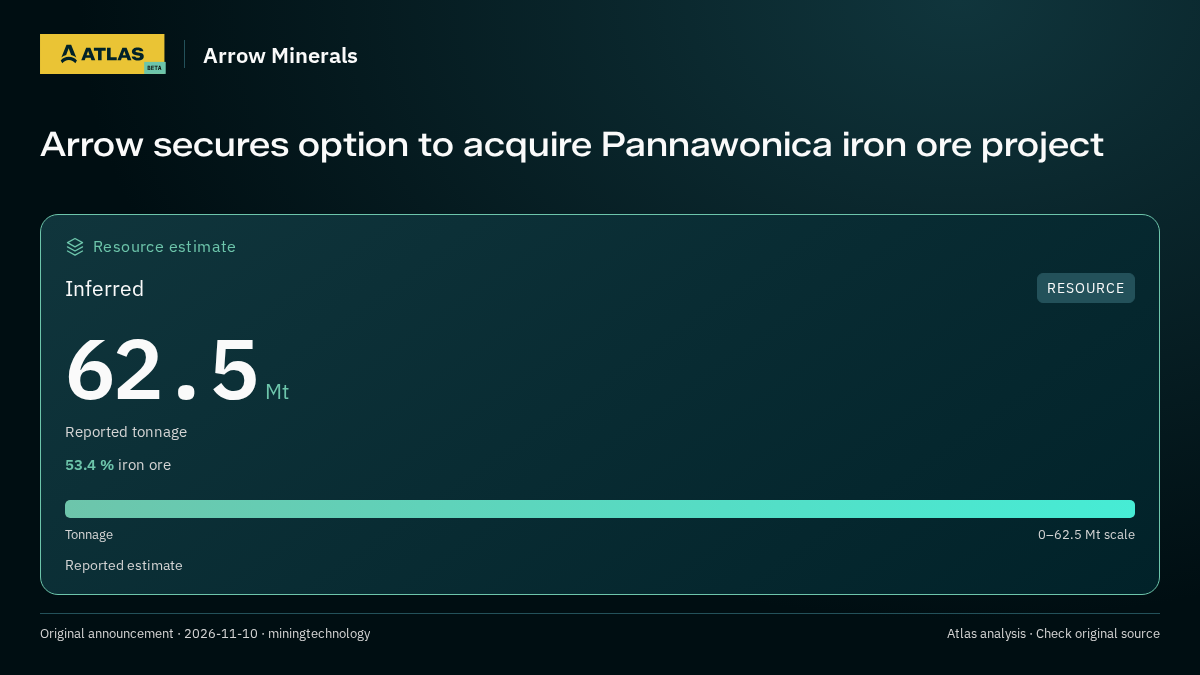
Arrow Minerals has signed a binding agreement for a 12-month exclusive option to acquire 100% of the Pannawonica Iron Ore Project from Red Hill Minerals. The project features a reported 62.5 Mt iron ore resource at 53.4% Fe and is located in the West Pilbara region of Western Australia.
Reasoning: Arrow Minerals has secured a binding option to acquire a significant iron ore project with existing resources and advanced permitting status.
Positive factors
- Exclusive 12-month option to acquire 100% of the project
- Project contains a reported 62.5 Mt iron resource
- Strategic location near port in West Pilbara
- Existing mining leases and advanced environmental studies
Negative factors
- Transaction subject to A$5m capital raise
- Red Hill Minerals retains 1.5% gross sales royalty
Facts used in scoring: 1
Classification and evidence
Maiden Resourceneutral
First formal MRE for the project — establishes baseline but typically exploration-stage with high Inferred component.
Why it applies: The document mentions a reported total mineral resource estimate but does not explicitly state it is a maiden resource; however, it establishes the baseline for the acquisition.
Evidence · text
“contains a reported total mineral resource estimate of 62.5 million tonnes (mt) at 53.4% iron”
Inferred Resourcenegative
Speculative category — limited drilling, geological continuity assumed but not confirmed. Cannot support economic studies alone.
Why it applies: The resource is described as a 'reported total mineral resource estimate' without specific category breakdown, implying early stage/inferred status in this context.
Evidence · text
“contains a reported total mineral resource estimate of 62.5 million tonnes (mt) at 53.4% iron”
Extracted facts
Stored fact records: 1. Some facts used in scoring do not have a stored record.
Resource Estimates (1)
inferrediron_oreTonnes: 62500000Grade: 53.4Grade Unit: %View all detailsHide details
Identity
- Commodity
- iron_ore
- Region
- australia_wa
- Reported Region
- Western Australia
Resource scope
- Estimate type
- resource
- Resource group id
- resource:d3c84d8f98d1ea516a18
- Mining method
- underground
Resource Data
- Category
- inferred
- Tonnes
- 62500000
- Grade
- 53.4
- Grade Unit
- %
Review
- Needs Review
- No
- Historical
- No
Dates
- Event date
- 2026-11-10T00:00:00.000Z
Reasoning: Reported total mineral resource estimate of 62.5 Mt at 53.4% Fe.
Evidence · text
“contains a reported total mineral resource estimate of 62.5 million tonnes (mt) at 53.4% iron”
Tags used in scoring
Inferred Resourcenegative
Speculative category — limited drilling, geological continuity assumed but not confirmed. Cannot support economic studies alone.
Why it applies: category is "inferred"
Cut-off Undisclosednegative
High-grade interval reported without stating the cut-off grade used for compositing.
Why it applies: no cutoff_grade was stated
No Contained Metalnegative
Tonnage and grade reported but contained metal not calculated or disclosed — incomplete reporting.
Why it applies: contained_metal was not reported
No QP/CP Disclosurenegative
No Qualified Person or Competent Person named — lower credibility for the estimate. A QP/CP should be a member of a recognized professional association with relevant experience.
Why it applies: no Qualified or Competent Person is named anywhere in the release
How Atlas produces this analysis
Minestarters Atlas uses automated extraction to summarize mining announcements, identify reported measurements, and classify supporting evidence. Sentiment reflects the extracted narrative and classification rules; it is an interpretation, not a reported measurement. Evidence quotes and context are provided where available. Missing data, low-confidence results, and review flags indicate limitations. Check the original publisher announcement before relying on an interpretation.