
African Critical Elements acquires Lepidico Canada, Namibian lithium asset
Original announcement by miningweekly on
- Company
- African Critical Elements
- Ticker
- Unavailable
- Exchange
- Unavailable
- Region
- Namibia
- Primary commodity
- Unavailable
- Secondary commodities
- None reported
- Document categories
- Agreement transaction, Resource update
- Extracted
- 2026-10-22 11:46:57 UTC
Analysis by Minestarters Atlas
Atlas analysis published:
Minestarters Atlas analysis
Summary
African Critical Elements (ACE) has completed the full acquisition of Lepidico Canada, gaining 100% equity and secured debts. The deal includes an 80% interest in the Karibib lithium, rubidium, and caesium project in Namibia, which previously reached a DFS stage with a positive NPV.
Reasoning: Significant acquisition of a DFS-stage lithium, rubidium, and caesium project in Namibia.
Positive factors
- Acquisition of 100% equity in Lepidico Canada
- Acquisition of 80% interest in Karibib project
- Project has reached DFS stage
- Positive NPV of $221-million reported in 2020 DFS
Negative factors
- Acquisition includes 100% of secured debts
Facts used in scoring: 5
Classification and evidence
QP/CP Signedpositive
Qualified Person (QP) or Competent Person (CP) named and signed off — a member of a recognized professional association (e.g., AusIMM, SME, AIG, P.Geo) with relevant experience.
Why it applies: The 2020 DFS was reported as Jorc-compliant.
Evidence · text
“reached the DFS stage under Joint Ore Reserves Committee (Jorc) in 2020”
Extracted facts
Stored fact records: 1. Some facts used in scoring do not have a stored record.
Resource Estimates (1)
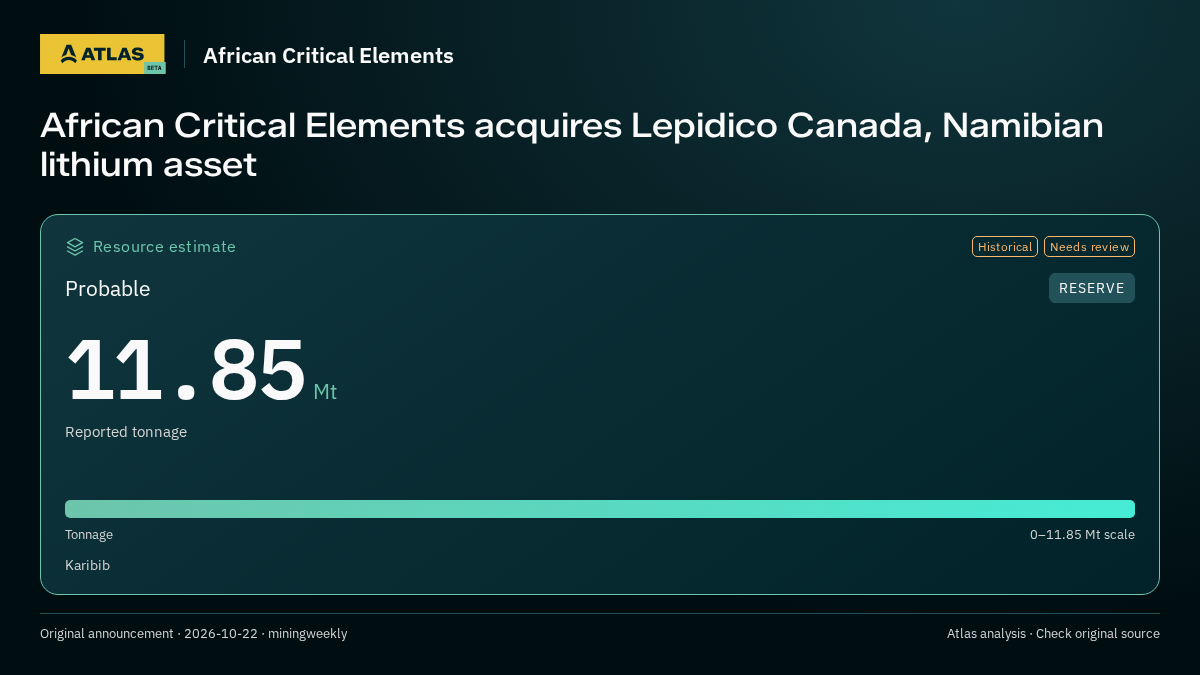
probableKaribib · lithiumTonnes: 11850000Historical resultNeeds review: historical_restatementView all detailsHide details
Identity
- Project
- Karibib
- Commodity
- lithium
- Region
- namibia
- Reported Region
- Namibia
Resource scope
- Estimate type
- reserve
- Resource group id
- resource:58f901e8d6da0a9215ba
Resource Data
- Category
- probable
- Tonnes
- 11850000
Review
- Needs Review
- Yes
- Review Reason
- historical_restatement
- Historical
- Yes
- Historical Source Date
- 2020-01-01T00:00:00.000Z
Dates
- Event date
- 2026-10-22T00:00:00.000Z
Reasoning: Historical reserve figure from 2020 DFS.
Positive factors
- Jorc-compliant reserves
Evidence · text
“The 2020 DFS reported Jorc-compliant ore reserves of 11.85-million tonnes at the Karibib project”
Tags used in scoring
Probable Reservepositive
Indicated Resource with demonstrated economic viability after applying modifying factors.
Why it applies: category is "probable"
Cut-off Undisclosednegative
High-grade interval reported without stating the cut-off grade used for compositing.
Why it applies: no cutoff_grade was stated
No Contained Metalnegative
Tonnage and grade reported but contained metal not calculated or disclosed — incomplete reporting.
Why it applies: contained_metal was not reported
No QP/CP Disclosurenegative
No Qualified Person or Competent Person named — lower credibility for the estimate. A QP/CP should be a member of a recognized professional association with relevant experience.
Why it applies: no Qualified or Competent Person is named anywhere in the release
DFS-Supportingneutral
Resource estimate prepared to support a Definitive Feasibility Study — requires high M&I confidence.
Why it applies: the release names the study this estimate supports
Stale Estimatenegative
Effective date is >2 years old — data currency concern, may not reflect current geological understanding.
Why it applies: effective date is 6.8 years before this release
How Atlas produces this analysis
Minestarters Atlas uses automated extraction to summarize mining announcements, identify reported measurements, and classify supporting evidence. Sentiment reflects the extracted narrative and classification rules; it is an interpretation, not a reported measurement. Evidence quotes and context are provided where available. Missing data, low-confidence results, and review flags indicate limitations. Check the original publisher announcement before relying on an interpretation.