
Abcourt Mines Produces 740 Ounces of Gold in September
Original announcement by jmn on
- Company
- Abcourt Mines Inc.
- Ticker
- ABI
- Exchange
- TSXV
- Region
- Quebec
- Primary commodity
- Unavailable
- Secondary commodities
- None reported
- Document categories
- Production, Metallurgy
- Extracted
- 2026-10-26 12:34:16 UTC
Analysis by Minestarters Atlas
Atlas analysis published:
Minestarters Atlas analysis
Summary
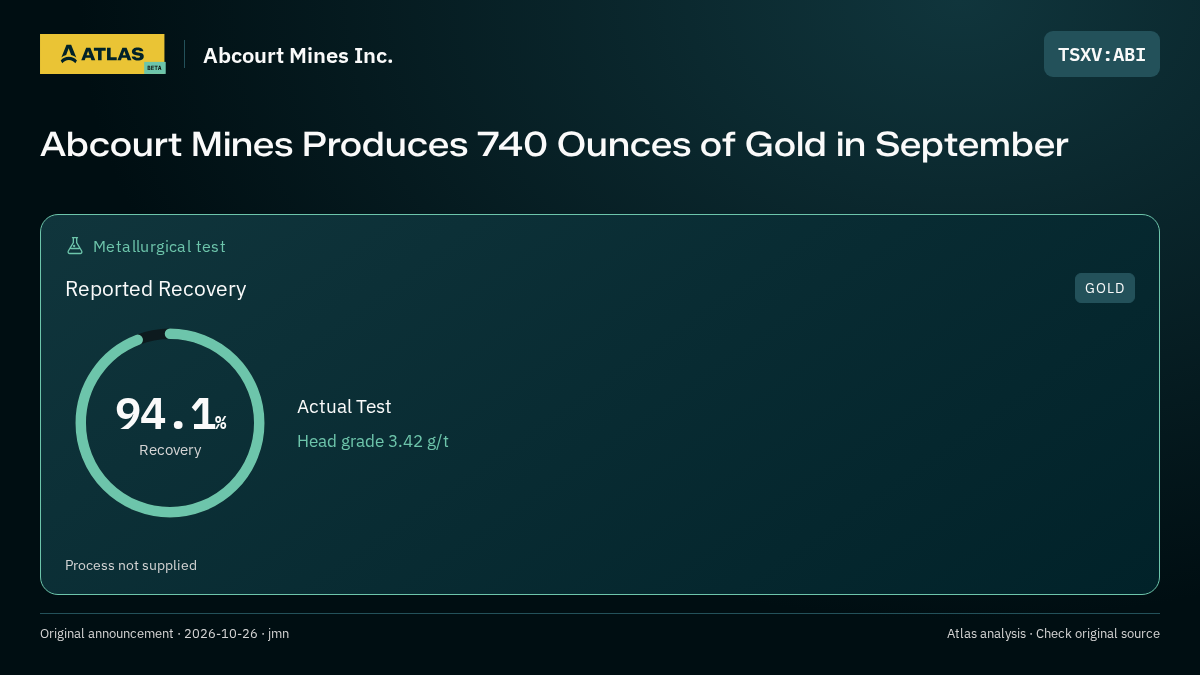
Abcourt Mines reported strong gold production for September, producing 740 ounces from 6,739 milled tonnes at an average grade of 3.42 g/t gold. This represents a significant increase in both tonnage and grade compared to August results, supported by a 94.1% recovery rate.
Reasoning: The company reported a substantial month-over-month increase in gold production and recovery rates, demonstrating operational efficiency gains.
Positive factors
- significant increase in gold production compared to August
- strong recovery rate of 94.1%
- improvement in mill feed grade
- successful blending of underground ore and stockpiles
Facts used in scoring: 3
Classification and evidence
High Recoverypositive · Story-specific tag
Recovery at or above the exceptional band for the commodity and processing route.
Why it applies: The reported 94.1% gold recovery is exceptionally strong for a mill route.
Evidence · text
“supported by a strong recovery rate of 94.1%”
Single Domain Onlynegative
Testing limited to one composite or domain — representativeness not established.
Why it applies: only one composite was tested
Extracted facts
Stored fact records: 3. Some facts used in scoring do not have a stored record.
Metallurgical Results (3)
Fact 1Sleeping Giant · goldRecovery: 94.1 %Head Grade: 3.42Head Grade Unit: g/tView all detailsHide details
Identity
- Project
- Sleeping Giant
- Commodity
- gold
- Region
- canada_qc
- Reported Region
- Quebec
- Ticker
- ABI
Test Work
- Program Status
- optimization
- Sample
- September mill feed (total)
Recovery
- Recovery
- 94.1 %
- Recovery Basis
- actual_test
- Head Grade
- 3.42
- Head Grade Unit
- g/t
Review
- Needs Review
- No
- Historical
- No
Dates
- Event date
- 2026-10-26T00:00:00.000Z
Reasoning: Strong monthly production performance with high recovery.
Positive factors
- high recovery rate
- improved grade vs previous month
Evidence · text
“The mill generated 740 oz of gold, supported by a strong recovery rate of 94.1%.”
Fact 2Sleeping Giant · goldHead Grade: 3.62Head Grade Unit: g/tView all detailsHide details
Identity
- Project
- Sleeping Giant
- Commodity
- gold
- Region
- canada_qc
- Reported Region
- Quebec
- Ticker
- ABI
Test Work
- Sample
- September underground production
Recovery
- Head Grade
- 3.62
- Head Grade Unit
- g/t
Review
- Needs Review
- No
- Historical
- No
Dates
- Event date
- 2026-10-26T00:00:00.000Z
Reasoning: Underground ore is driving the higher grade component of the mill feed.
Positive factors
- higher grade than total mill feed
Evidence · text
“Underground Production: 5,582 tonnes extracted directly from the underground deposit, averaging 3.62 g/t gold.”
Fact 3Sleeping Giant · goldHead Grade: 2.41Head Grade Unit: g/tView all detailsHide details
Identity
- Project
- Sleeping Giant
- Commodity
- gold
- Region
- canada_qc
- Reported Region
- Quebec
- Ticker
- ABI
Test Work
- Sample
- September low-grade stockpile
Recovery
- Head Grade
- 2.41
- Head Grade Unit
- g/t
Review
- Needs Review
- No
- Historical
- No
Dates
- Event date
- 2026-10-26T00:00:00.000Z
Reasoning: Reclaimed stockpile provides lower grade feed to support volume.
Positive factors
- successful reclamation of historical stockpile
Evidence · text
“Low-Grade Stockpile: 1,157 tonnes sourced from the historical low-grade stockpile... at an average of 2.41 g/t gold.”
How Atlas produces this analysis
Minestarters Atlas uses automated extraction to summarize mining announcements, identify reported measurements, and classify supporting evidence. Sentiment reflects the extracted narrative and classification rules; it is an interpretation, not a reported measurement. Evidence quotes and context are provided where available. Missing data, low-confidence results, and review flags indicate limitations. Check the original publisher announcement before relying on an interpretation.