
7 Signals Atomic Eagle's Muntanga Can Outgrow Its 25.3 Million-Pound Mine Plan
Original announcement by cruxinvestor on
- Company
- Atomic Eagle
- Ticker
- AEU
- Exchange
- Unavailable
- Region
- Zambia
- Primary commodity
- Uranium
- Secondary commodities
- None reported
- Document categories
- Resource update, Metallurgy, Other
- Extracted
- 2026-11-18 10:47:00 UTC
Analysis by Minestarters Atlas
Atlas analysis published:
Minestarters Atlas analysis
Summary
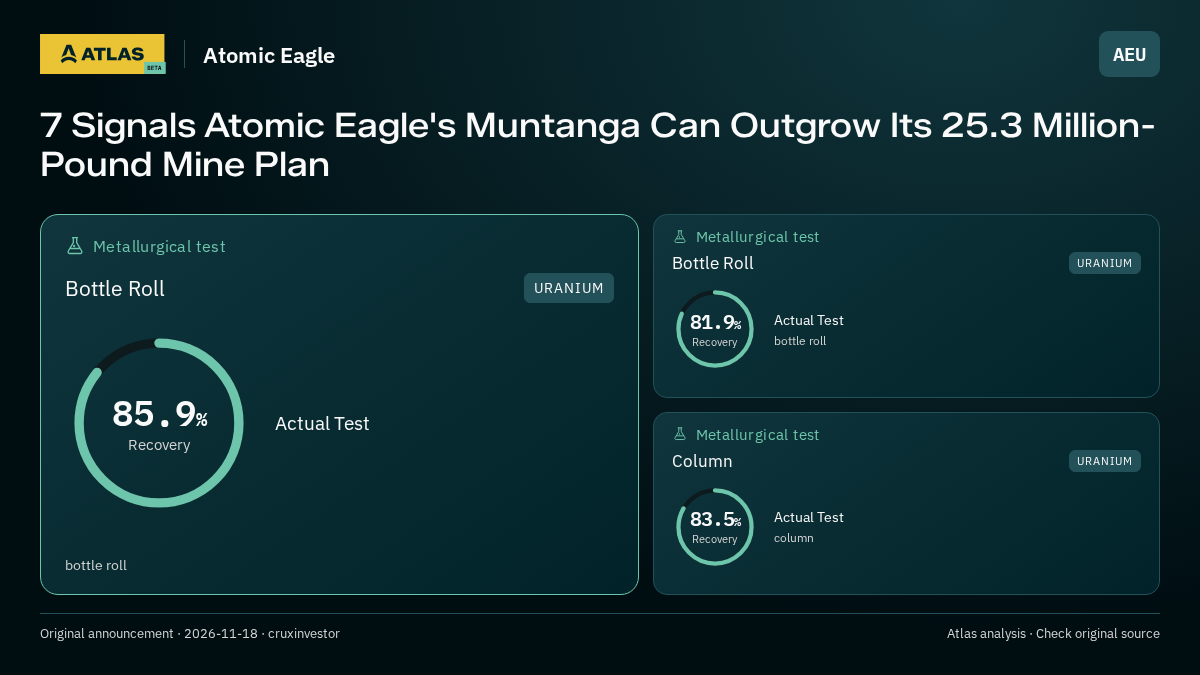
Atomic Eagle is positioning the Muntanga Uranium Project for expansion beyond its 2025 feasibility study baseline by targeting 44% of its JORC resource that was previously excluded. Recent metallurgical tests on the Muntanga East deposit show recoveries between 81% and 86% using low acid consumption, supporting the company's low-capital heap leach growth strategy.
Reasoning: The document details a significant resource expansion opportunity for the Muntanga project, highlighting substantial inferred resources excluded from previous studies and providing recent metallurgical validation for new ore domains.
Positive factors
- Significant resource upside (44% of JORC resource) not included in previous feasibility study
- Low-capital-intensity heap leach growth potential
- Muntanga East metallurgy shows acceptable recoveries (81-86%) on lower-grade material
- Project is fully permitted
Negative factors
- Muntanga East recoveries (81-86%) are lower than the 2025 FS baseline of >90%
- Expansion depends on successful conversion of inferred resources via infill drilling
Facts used in scoring: 4
Classification and evidence
Inferred Resourcenegative
Speculative category — limited drilling, geological continuity assumed but not confirmed. Cannot support economic studies alone.
Why it applies: The document notes that 44% of the resource is excluded from the FS and includes significant inferred components that need conversion.
Evidence · text
“Inferred resources carry the lowest geological confidence among the resource categories, so their conversion depends on infill drilling that raises that confidence.”
Heap Leach Routeneutral
Processing via heap leach — lower CAPEX and OPEX, lower recovery expected.
Why it applies: The project is explicitly described as a heap leach operation.
Evidence · text
“Atomic Eagle plans a larger Muntanga uranium mine on low-capital heap leach growth”
Single Domain Onlynegative
Testing limited to one composite or domain — representativeness not established.
Why it applies: only one composite was tested
Extracted facts
Stored fact records: 4. Some facts used in scoring do not have a stored record.
Resource Estimates (1)
inferredMuntanga Uranium Project · uraniumGrade: 309Grade Unit: ppmContained Metal: 58800000Contained Unit: lbView all detailsHide details
Identity
- Project
- Muntanga Uranium Project
- Commodity
- uranium
- Region
- zambia
- Reported Region
- Zambia
- Ticker
- AEU
Resource scope
- Estimate type
- resource
- Reporting standards
- jorc
- Resource group id
- resource:31bbb852e07127182057
- Deposit or zone
- Muntanga
- Mining method
- open_pit
- Ownership percent
- 100 %
- Resource basis
- gross
Resource Data
- Category
- inferred
- Grade
- 309
- Grade Unit
- ppm
- Contained Metal
- 58800000
- Contained Unit
- lb
Review
- Needs Review
- No
- Historical
- No
Dates
- Event date
- 2026-11-18T00:00:00.000Z
Reasoning: The total JORC resource is reported at 58.8 million pounds at 309 ppm.
Positive factors
- Large scale resource
Negative factors
- Inferred category implies lower geological confidence
Evidence · text
“owns 100% of the Muntanga Uranium Project in Zambia, with a JORC resource of 58.8 million pounds (lb) of uranium oxide at 309 parts per million.”
Tags used in scoring
Inferred Resourcenegative
Speculative category — limited drilling, geological continuity assumed but not confirmed. Cannot support economic studies alone.
Why it applies: category is "inferred"
Cut-off Undisclosednegative
High-grade interval reported without stating the cut-off grade used for compositing.
Why it applies: no cutoff_grade was stated
JORC Compliantpositive
Resource estimate prepared in compliance with JORC Code (Australia) — high reporting standard.
Why it applies: reporting_standards includes jorc
No QP/CP Disclosurenegative
No Qualified Person or Competent Person named — lower credibility for the estimate. A QP/CP should be a member of a recognized professional association with relevant experience.
Why it applies: no Qualified or Competent Person is named anywhere in the release
Resource Updateneutral
Revised estimate for an existing resource — compare to prior to assess progress.
Why it applies: the release compares against a previous estimate
DFS-Supportingneutral
Resource estimate prepared to support a Definitive Feasibility Study — requires high M&I confidence.
Why it applies: the release names the study this estimate supports
Metallurgical Results (3)
bottle rollMuntanga Uranium Project · uraniumRecovery: 85.9 %View all detailsHide details
Identity
- Project
- Muntanga Uranium Project
- Commodity
- uranium
- Region
- zambia
- Reported Region
- Zambia
- Ticker
- AEU
Test Work
- Program Status
- preliminary
- Test Type
- bottle roll
- Processing Route
- bottle roll
- Sample
- Muntanga East core, bottle roll tests
- Leach Time
- 600 hours
Recovery
- Recovery
- 85.9 %
- Recovery Basis
- actual_test
Reagents
- Acid
- 3 kg/t
Review
- Needs Review
- No
- Historical
- No
Dates
- Event date
- 2026-11-18T00:00:00.000Z
Reasoning: Bottle roll tests on Muntanga East core returned 85.9% recovery.
Positive factors
- Recovery is acceptable for lower-grade material
Negative factors
- Lower than project average recovery
Evidence · text
“Bottle roll tests, which leach a sample in a rotating bottle of acid solution, returned 85.9% and 81.9% after 25 days.”
bottle rollMuntanga Uranium Project · uraniumRecovery: 81.9 %View all detailsHide details
Identity
- Project
- Muntanga Uranium Project
- Commodity
- uranium
- Region
- zambia
- Reported Region
- Zambia
- Ticker
- AEU
Test Work
- Program Status
- preliminary
- Test Type
- bottle roll
- Processing Route
- bottle roll
- Sample
- Muntanga East core, bottle roll tests
- Leach Time
- 600 hours
Recovery
- Recovery
- 81.9 %
- Recovery Basis
- actual_test
Reagents
- Acid
- 3 kg/t
Review
- Needs Review
- No
- Historical
- No
Dates
- Event date
- 2026-11-18T00:00:00.000Z
Reasoning: Bottle roll tests on Muntanga East core returned 81.9% recovery.
Positive factors
- Recovery is acceptable for lower-grade material
Negative factors
- Lower than project average recovery
Evidence · text
“Bottle roll tests, which leach a sample in a rotating bottle of acid solution, returned 85.9% and 81.9% after 25 days.”
columnMuntanga Uranium Project · uraniumRecovery: 83.5 %View all detailsHide details
Identity
- Project
- Muntanga Uranium Project
- Commodity
- uranium
- Region
- zambia
- Reported Region
- Zambia
- Ticker
- AEU
Test Work
- Program Status
- preliminary
- Test Type
- column
- Processing Route
- column
- Sample
- Muntanga East core, column tests
- Leach Time
- 1488 hours
Recovery
- Recovery
- 83.5 %
- Recovery Basis
- actual_test
Reagents
- Acid
- 7.3 kg/t
Review
- Needs Review
- No
- Historical
- No
Dates
- Event date
- 2026-11-18T00:00:00.000Z
Reasoning: Column tests showed modest extra recovery but acid use rose to between 7.0 and 7.6 kg/t.
Positive factors
- Continued recovery observed
Negative factors
- Acid consumption rose significantly in column tests
Evidence · text
“Column tests, which trickle acid through a tall column of crushed ore to mimic a heap, continued for 62 days in total, with only modest extra recovery while acid use rose to between 7.0 and 7.6 kilograms per tonne.”
How Atlas produces this analysis
Minestarters Atlas uses automated extraction to summarize mining announcements, identify reported measurements, and classify supporting evidence. Sentiment reflects the extracted narrative and classification rules; it is an interpretation, not a reported measurement. Evidence quotes and context are provided where available. Missing data, low-confidence results, and review flags indicate limitations. Check the original publisher announcement before relying on an interpretation.